Gartner’s new Magic Quadrant names five CCaaS Leaders and adds Microsoft as a Visionary. The analysts warn that AI projects are stalling on data, vendor resources and ROI, while sovereignty gains weight in buying decisions.
By the end of 2026, cloud-based contact center platforms will account for more than half of all agent licenses worldwide, according to Gartner. In its new Magic Quadrant for Contact Center as a Service (CCaaS), published on 19 October 2026, the analysts describe a market that is moving into ever larger enterprises while generative and agentic AI puts vendors and buyers to the test.
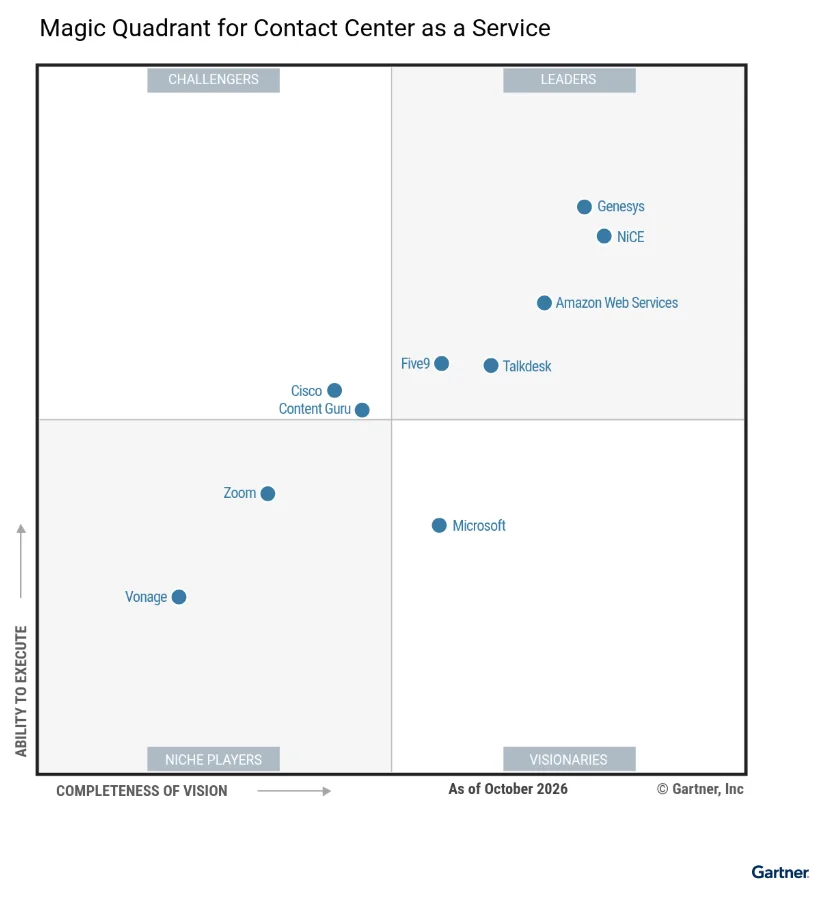
Five providers make it into the Leaders quadrant: Amazon Web Services with Amazon Connect, Five9, Genesys, NiCE and Talkdesk. Cisco and Content Guru are rated Challengers. Microsoft, newly added with Dynamics 365 Contact Center, appears as a Visionary, while Vonage and Zoom are Niche Players. No vendor was dropped. The assessment reflects execution through March 2026. Gartner names 8×8, Dialpad, Odigo, RingCentral, Salesforce and Sprinklr as honorable mentions that were not formally evaluated.
AI projects meet reality
The market overview is notably candid. According to Gartner, the surge in generative and agentic AI pilots and production deployments over the past year has exposed problems. Organizations report poor experiences with both agent-facing functions such as call summaries and customer-facing self-service. They also cite difficulties securing deployment resources from vendors and proving return on investment. Inconsistent customer data and a lack of AI-ready knowledge management slow projects further.
The vendor assessments reflect this. For Genesys, Gartner clients describe token-based AI pricing as a risk to predictable total cost of ownership, and AI deployments can take longer than expected. Some NiCE customers report similar delays. AWS earns praise for customizability and its AI portfolio, but consumption-based pricing makes budgeting difficult when volumes fluctuate. Gartner therefore advises buyers not to lose sight of foundational capabilities such as routing, reporting, workforce engagement management and integrations, and to plan for change management.
Different answers to the same question
The providers take distinct paths. NiCE uses Cognigy, acquired in 2025, as its conversational AI engine. Genesys works with Scaled Cognition on large action models intended to curb hallucinations. Cisco adds AI Defense guardrails against jailbreaks and prompt injection and supports the Agent2Agent and Model Context Protocol standards. Talkdesk connects natively to Databricks data lakes, and Zoom bundles core AI functions into its per-seat licenses. At the same time, traditional vendors face pressure from CRM customer engagement platforms, hyperscalers and specialized AI point solutions, which Gartner says can lengthen selection cycles.
Microsoft’s debut is the most notable change in the field. Gartner says Dynamics 365 Contact Center is mainly adopted by midsize contact centers and works best alongside Teams telephony and Microsoft’s own CRM. Advanced AI functions are harder to deploy with third-party CRMs, and routing and reporting are less mature than at other vendors. Vonage and Zoom, both Niche Players, address midmarket deployments. Zoom clients report high satisfaction with setup and administration, while Gartner describes Vonage as less mature in digital channels and native reporting.
Sovereignty becomes a selection criterion
Outside the United States, data and cloud sovereignty, tariff concerns and geopolitical complexity are creating friction, according to Gartner. Buyers are therefore adding AI roadmaps, sovereign cloud offerings and implementation and support capacity to their traditional criteria. For European organizations, several details stand out. Gartner notes that Cisco enables region- and country-specific sovereign cloud deployments, and Genesys lists an EU sovereign cloud on its roadmap. Content Guru, which Gartner describes as predominantly Europe-focused, is the only offering in the report with FedRAMP High accreditation. Odigo is singled out among the honorable mentions for EU data and application sovereignty.
Regional focus cuts both ways. Gartner notes that Five9 remains primarily North American and that Talkdesk concentrates on North America and the U.K. and Europe. Buyers elsewhere may need additional internal resources or certified partners. Support quality also appears in the cautions: remote technical support at Five9 and Talkdesk, and inconsistent service for midsize NiCE customers.
What it means for the channel
Most providers sell through partners, from Cisco’s indirect model to AWS with global system integrators and Salesforce. This puts resellers and integrators in a pivotal role, because Gartner stresses a vendor’s ability to support the deployment of AI-forward capabilities, including change management. Its advice is to inventory existing systems first and to verify a vendor’s track record in terms of scale, industry and geography. The report is a point-in-time view and should not be used in isolation, but alongside the Critical Capabilities research and the interactive versions of the documents, where criteria weightings can be adjusted to individual needs. For customers migrating from on-premises systems, the vendor’s ability to support that move is a further test.

Dr. Jakob Jung is Editor-in-Chief of Security Storage and Channel Germany. He has been working in IT journalism for more than 20 years. His career includes Computer Reseller News, Heise Resale, Informationweek, Techtarget (storage and data center) and ChannelBiz. He also freelances for numerous IT publications, including Computerwoche, Channelpartner, IT-Business, Storage-Insider and ZDnet. His main topics are channel, storage, security, data center, ERP and CRM.
Contact via Mail: jakob.jung@security-storage-und-channel-germany.de