At Red Hat Summit: Connect, Red Hat, SAP, Siemens and Debeka showed how AI, security and sovereignty collide. The recurring point: you can only patch fast if you know what you run, which is the premise of Project Lightwell.
German CIOs say they can get critical fixes into production within 24 hours, yet only 38 percent have a complete, current view of their open-source supply chain. That gap, taken from a Red Hat survey, ran through the keynotes, customer sessions and press roundtable at Red Hat Summit: Connect in Darmstadt on 18 November, and it frames Red Hat’s and IBM’s pitch for Project Lightwell.
A flagship event with a security undertone
Red Hat held its Summit: Connect at the Darmstadtium on 18 November 2026, with 28 sponsors and a programme of 69 sessions. Gregor von Jagow, Senior Director and Country Manager Germany, called it the company’s flagship event for Germany. His opening message was direct: organisations must know what their AI workloads run on, including indirect dependencies.
Von Jagow argued that AI is changing the threat landscape. New vulnerabilities quickly become targets, patches are not keeping pace, and a shortage of skilled staff makes matters worse. Open source remains the basis of modern IT, he said, but the foundation can slip if it is not understood. His advice to the audience: ask your teams how fast you can really react.
What the survey says
The figures come from the Red Hat EMEA AI & Security Survey 2026, run by Censuswide between 24 August and 1 September among 1,400 CIOs in 14 countries, with 100 respondents in Germany. According to Red Hat, 94 percent of German CIOs already have AI agents in use, and 77 percent say they bring critical fixes into production within 24 hours. Only 38 percent report a complete, continuously updated overview of their open-source supply chain, including origin, versions and indirect dependencies.
Von Jagow read the 94 percent as a good signal and said control over AI agents is stronger in Germany than elsewhere, though laggards remain. He sees a risk in what he called AI creep: AI functions arriving through the back door of existing products, with data flowing in the background. Every vendor wants to offer AI services, he said, and the security implications are underestimated. SAP’s Ricardo Silva shared the view that there is still a way to go. All numbers are self-reported and supplied by the vendor, but the contrast between 77 and 38 percent makes the point: fast patching presupposes knowing what runs and where it comes from.
Lightwell: remediation at machine speed
Red Hat positions Project Lightwell, announced with IBM on 28 May 2026, as the answer. According to the companies, they have committed 5 billion US dollars, and more than 20,000 engineers, supported by AI, are involved. Von Jagow described the aim as remediation at machine speed, SLA-based and meant for the entire open-source community. Deloitte joined as a collaboration partner on 26 June.
Lightwell has two parts. The Lightwell Network, generally available since 8 July, is a self-service offering through Red Hat repositories for Java and Python, built to SLSA Level 3. It has a Validated tier (vetted upstream code with signed provenance and SBOM), a Remediated tier (backported security fixes without a version upgrade) and a restricted Predisclosure tier with fixes before public disclosure for eligible members. The Lightwell Clearinghouse, which Red Hat lists as generally available since October, lets customers submit specific vulnerabilities for prioritised review, obtain backports for older versions still in use and handle disclosure under embargo. Fixes go back to the upstream community, no access to proprietary code or data is needed, and the packages plug into repository managers such as Artifactory or Nexus.
Red Hat says Lightwell started with more than 6,500 remediated, signed dependencies and that more than 400 previously unknown vulnerabilities in Java libraries were fixed by October. As context, its presentation cites Anthropic’s 7 April 2026 announcement of Claude Mythos Preview within Project Glasswing, which according to Anthropic has already found thousands of zero-day vulnerabilities in critical infrastructure, and Mandiant data showing the average time from disclosure to first exploitation falling from 63 days to 5. The bottleneck, the argument goes, is moving from finding flaws to fixing them and rolling fixes out.
The demo: from finding to proof
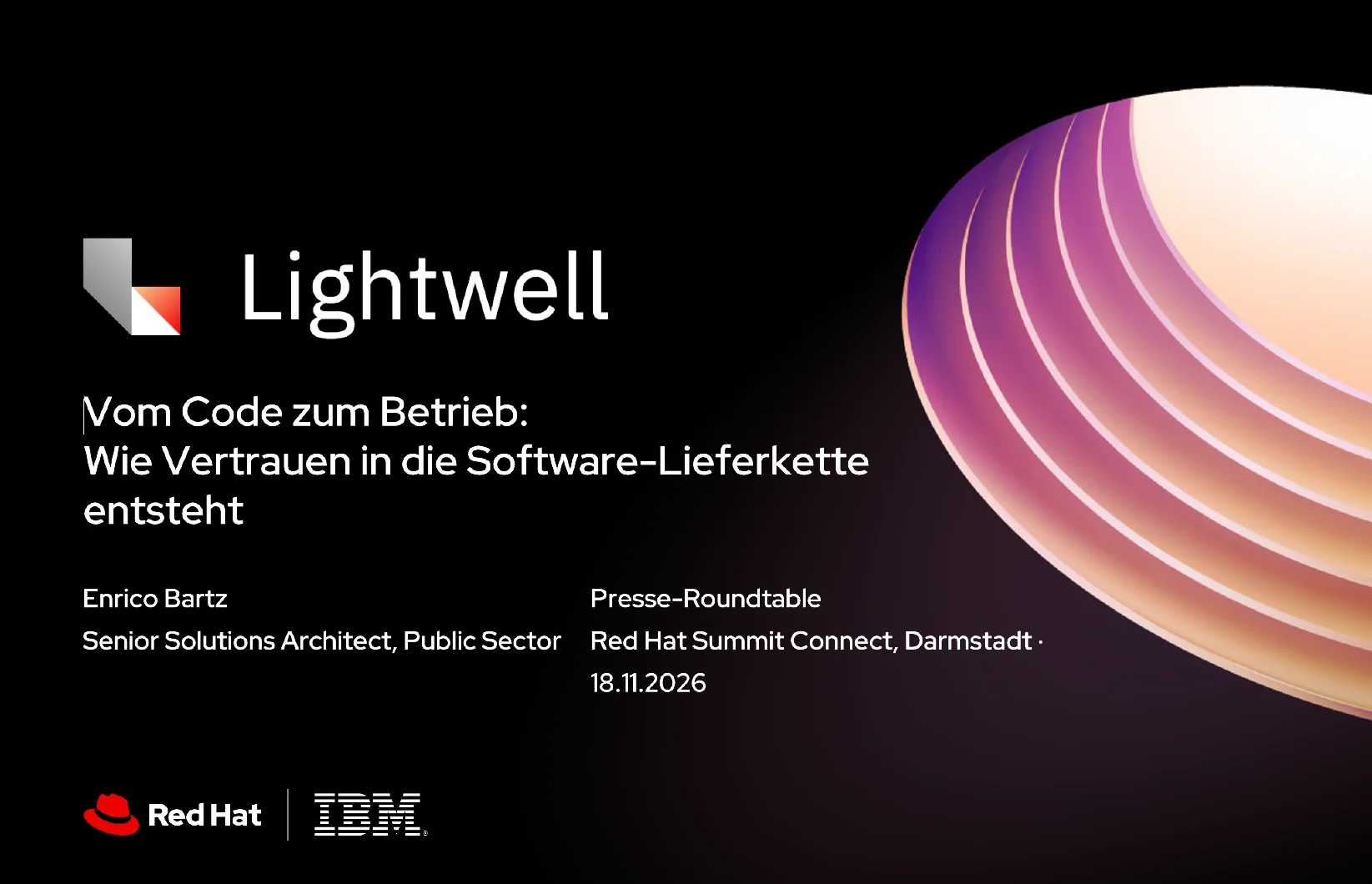
Enrico Bartz, Senior Solutions Architect for the Public Sector, showed Lightwell in a recorded demo. Where are the systems that need patching, he asked; thousands of dependencies, and what runs where? “Hope is not a strategy,” he said, adding that exploitation now takes only hours and the tools are available. Open source is in 97 percent of commercial codebases examined, according to the Black Duck OSSRA 2025 report that Red Hat cites.
In the demo, Red Hat Dependency Analytics in VS Code flagged slf4j-ext 1.7.25 (CVE-2018-8088). The quick fix proposed upstream version 1.7.26. The developer instead switched to the Lightwell-validated 2.0.9, the warning disappeared, and the build ran against a virtual Artifactory repository that consults Lightwell before Maven Central. No application code changed, only the repository configuration. The package carries a CycloneDX SBOM and a SLSA provenance file. Its checksum differs from the Maven Central artifact because Red Hat built it itself, from the original source on RHEL 9 with JDK 17.
Two caveats apply. Red Hat’s own slides note that the SBOM contains no vulnerability data, so a zero in the viewer does not mean “verified clean”, and that Lightwell is a building block, not a replacement for in-house processes: impact requires inventory, automated tests, fast rollout and planned recovery. Also, the demo used the Validated tier. The step from 1.7.25 to 2.0.9 is a version change, whereas backports without upgrades are the promise of the Remediated tier. Whether an application tolerates such a jump remains a matter for its own tests.
Operations at scale
Regulation adds pressure. Bartz’s slides list the NIS2 implementation law, in force in Germany since 6 December 2025, the Cyber Resilience Act, with reporting duties since 11 September 2026, full application from 11 December 2027 and an SBOM requirement for manufacturers, and DORA for the financial sector. The common denominator, according to the presentation: know what runs, where it comes from and how quickly it can be updated.
Customers showed what the preconditions look like. SAP’s Ricardo Silva said the company manages more than 400,000 hosts and 150,000 legacy tasks, and that proprietary patching no longer works. With Red Hat and Ansible Automation Platform, SAP is building an orchestration layer for security, patching and compliance, a basis for later AIOps. Project Cyclops, which includes AI-assisted coding of Ansible playbooks, is due to finish by the end of 2027. Siemens is moving 280 teams and 20,000 virtual machines to a new hypervisor platform on OpenShift. Debeka described its in-house cloud, built in project MANIAC over four years by 140 people from 14 service providers at a cost of 77 million euros, with the goal of sovereignty without hyperscaler lock-in.
Sovereignty, virtualisation and AI platforms
Red Hat’s CIO, Marco Bill-Peter, named tensions between AI, security, virtualisation, sovereignty and cost, and argued that the token economics of public cloud need to change and that companies should become token providers. Intel’s Andreas Timm said CPUs are regaining importance as orchestrators of AI workloads and pointed to hardware-enforced isolation with Intel TDX. He cited a Gartner estimate of 2 trillion US dollars in AI investment and, referring to the METR model, AI capability doubling roughly every four months.
At the roundtable, Matthias Kranz, Senior Director Enterprise Sales, said that full sovereignty is impossible and open source cannot be locked in; Red Hat provides support within the EU, and private-sector customers now ask for security seals too. On virtualisation, customers hesitated at first but now want at least a second option, he said, pointing to OpenShift 5 with in-place upgrades and a five-year lifecycle per major release. Customers, Kranz added, increasingly want their own platform for large language models across several clouds, with observability of token consumption, multi-tenancy and GPU billing. Demand for virtualisation, Lightwell and AI is rising together, he said: one customer runs roughly 3,000 applications, almost all virtualised, and smart agents could help map them. The open question is how long a patch rollout takes with machine-driven processes.
Bartz added that public-sector customers want air-gapped operation and that price is not the deciding factor. Red Hat supplies the technology, he said, while partners must bring the expertise to advise customers and help teams that now have to understand a new hypervisor technology.
Von Jagow said many German companies run numerous AI pilots but few reach production; ROI is underestimated, and a clean foundation, no silos and C-level backing matter. The Darmstadt message was consistent: the vendor can take over part of the burden, but knowing what runs, testing it and rolling out fixes stays with the operator.
Dr. Jakob Jung is Editor-in-Chief of Security Storage and Channel Germany. He has been working in IT journalism for more than 20 years. His career includes Computer Reseller News, Heise Resale, Informationweek, Techtarget (storage and data center) and ChannelBiz. He also freelances for numerous IT publications, including Computerwoche, Channelpartner, IT-Business, Storage-Insider and ZDnet. His main topics are channel, storage, security, data center, ERP and CRM.
Contact via Mail: jakob.jung@security-storage-und-channel-germany.de
Living near Berlin, our operational rhythm forces a more cautious approach to rapid updates. The sheer volume of legacy systems complicates swift application of new security fixes.