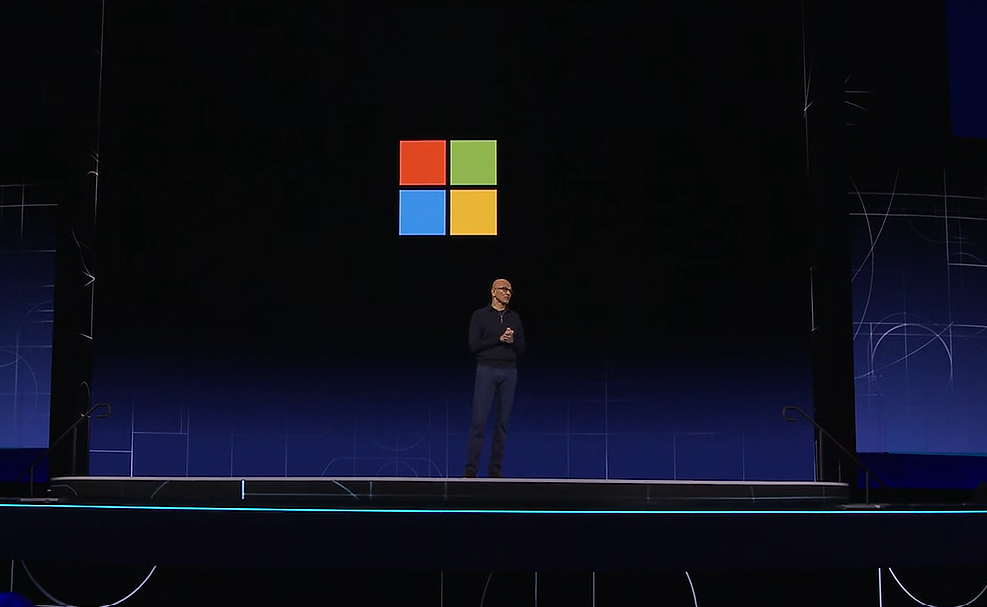
At Ignite 2026, Microsoft outlined an enterprise AI stack spanning Copilot, Microsoft IQ, new models, Agent 365 governance and the Perception security system.
At the opening keynote of Ignite 2026 in San Francisco on 17 November, Microsoft CEO Satya Nadella presented what the company calls a “Frontier ecosystem.” According to Microsoft, it rests on three principles: putting people’s goals at the center, letting organizations keep control over their own intelligence and learning, and building trust. The conference runs through 20 November in San Francisco and online, and Microsoft has published its announcements in a Book of News.
Copilot as the work interface
Microsoft describes Copilot as the new operating system for work, combining chat, Cowork, Code and Autopilot in one interface. Home, the starting point for Chat and Cowork, is rolling out worldwide, and Office in Copilot, which brings Word, Excel and PowerPoint into the app, is generally available. Autopilot, a long-running agent with its own identity, memory and tool access, is rolling out through the Frontier early-access program. Copilot Code, which lets users build dashboards and apps in natural language, belongs to the same program and is due to become generally available in December. Copilot Workspaces, a shared space for teams and their agents, is also offered through Frontier. Copilot Managed Runtime, which hosts applications built in these tools, is generally available.
For business applications, Microsoft released Dynamics 365 Sales and ERP plugins for Copilot. A Salesforce integration with prebuilt sales skills is in preview, and a data federation between Salesforce Data 360 and Microsoft Fabric is generally available.
Microsoft IQ and continuous improvement
Microsoft IQ is now generally available. It combines Work IQ, Fabric IQ, Foundry IQ and Web IQ as sources of context for agents, together with reusable plugins, skills and tools. According to Microsoft, it requires no new SKU or subscription. Business plugins, which add scenario-specific guidance with governance controls, are available in the Frontier program. In Microsoft Foundry, the agent optimizer is generally available, while Managed Training and Programmed Training for adapting models with organizational data are in preview.
New models
Microsoft-Decision-1.1, a model for structured decisions such as routing and classification, is generally available. It is built on Gemma 4 26B A4B and adds image input. Microsoft cites a score of 68 on the Artificial Analysis Decision Index v2.1, six points above its predecessor. The coding models MAI-Code-2 and MAI-Code-2-Flash are generally available in GitHub; according to the Book of News, Code-2-Flash is in private preview in Foundry. MAI-Cyber-2-Flash is in preview and limited to Codename MDASH. Nadella also announced MAI Licensed Weights, which will give selected customers access to Microsoft AI model weights. Foundry lists more than 11,000 models according to the Book of News; in the keynote, Nadella said GPT 6.2 is now available there and that current Meta models will follow.
Governance and cost control
Nadella said more than 50 million agents are registered in Agent 365, the control plane for governing agents. New FinOps functions are meant to link AI spending to outcomes. Agent 365 Business Analytics is available in the Frontier program, and Cost Management is in preview. Microsoft notes that insights on Microsoft services require at least one Microsoft 365 Copilot license in the tenant, while insights on non-Microsoft services require an Agent 365 license.
Security
Microsoft Perception, a system of red, blue and green team agents, is generally available. Red agents simulate attacks, blue agents detect and investigate them, and green agents prioritize and help fix weaknesses. Microsoft says the triage agent now covers about 80 percent of alerts in a typical Defender queue. Codename MDASH, an agentic code security system with more than 100 AI agents, is in preview for eligible organizations. Microsoft Defender now offers runtime protection for local AI agents on Windows, including Claude Code, GitHub Copilot CLI and Claude Desktop. Microsoft also announced an AI Transparency Initiative that expands its work with NIST’s Agent Standards Initiative. According to Microsoft, 40 organizations are already helping to define standards for independently verifiable AI systems.
Infrastructure
Azure Cobalt 200 virtual machines, based on Microsoft’s own Arm processor, are generally available. Microsoft cites up to 50 percent higher CPU performance than Cobalt 100 and plans deployment in 24 Azure regions by year-end. Two new VM types target large in-memory databases and storage-heavy workloads. Nadella said the Maia 300 chip delivers 40 percent more tokens per watt than leading GPU-based systems; the figure comes from Microsoft and has not been independently verified. Windows Server 2028 is in preview, with post-quantum cryptography and support for local AI inference.
Dr. Jakob Jung is Editor-in-Chief of Security Storage and Channel Germany. He has been working in IT journalism for more than 20 years. His career includes Computer Reseller News, Heise Resale, Informationweek, Techtarget (storage and data center) and ChannelBiz. He also freelances for numerous IT publications, including Computerwoche, Channelpartner, IT-Business, Storage-Insider and ZDnet. His main topics are channel, storage, security, data center, ERP and CRM.
Contact via Mail: jakob.jung@security-storage-und-channel-germany.de