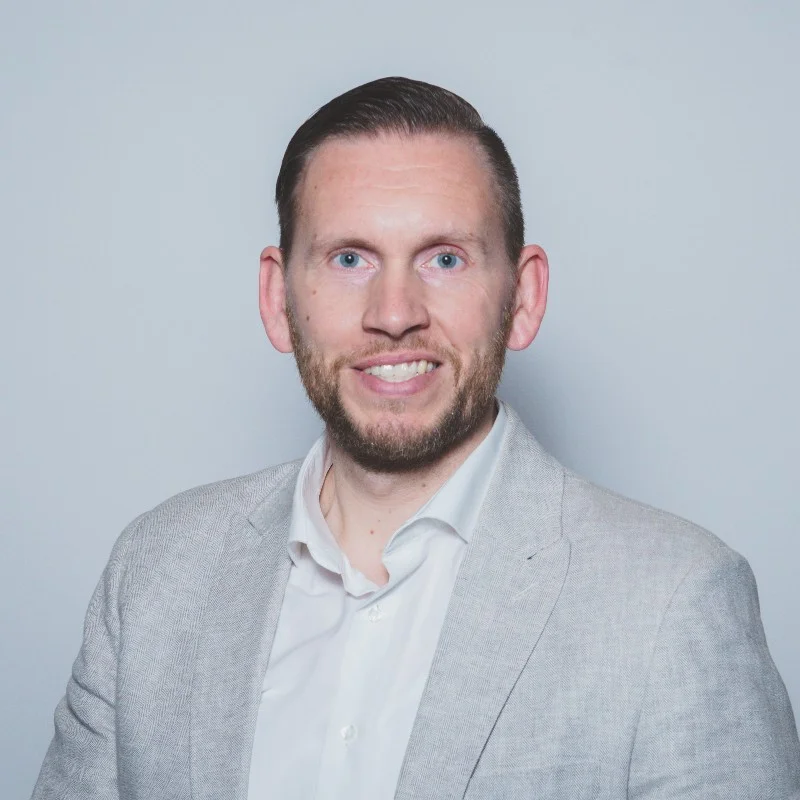
Daniel Karadza, the new head of partners and alliances for Central Europe and Benelux, plans fewer but more specialised partners. He is focusing on transformation consultancies, the public sector and AI expertise, with the European Sovereign Cloud as a key argument.
Genesys wants to generate 80 percent of its business through partners again. In Germany, the actual ratio has recently been closer to 50:50. Daniel Karadza, who recently took over as Senior Director for Partners and Alliances for Central Europe and Benelux, explains how he intends to close that gap: with a rebuilt, more focused and more specialised partner landscape.
From 50:50 back to 80:20
Globally, Genesys follows an 80:20 rule in its go-to-market, according to Karadza. Four-fifths of revenue is meant to come from partners handling resale and implementation, and the company’s team structure reflects that. In Germany, however, the split has settled at roughly half and half in recent years, because many customers explicitly asked for direct contracts. “My task is to bring this back into balance,” Karadza says. That requires restructuring and expanding the partner organisation and adding new partners.
He describes his remit as three pillars. The first consists of value-added resellers handling resale and implementation. The second comprises large consultancies such as Accenture, Capgemini and Deloitte, which use the Genesys platform to develop transformation concepts with their clients, for example the move from on-premises systems to the cloud. The third is made up of strategic technology partnerships. Genesys Cloud is built natively on Amazon Web Services and runs exclusively there, which is why Karadza describes AWS as a very close partner in technology, sales and strategy. Salesforce is the partner for linking contact center as a service with CRM, while ServiceNow covers integration with IT service management and help desks.
Fewer partners, more focus
Karadza says there are no numerical targets for new partners: the market sets the target. Genesys is currently evaluating its partner landscape, with the stated ambition of working with fewer partners in future and doing more business with each of them. Given the complexity of the offering, he argues, partners need a clear core competence and a dedicated CX practice.
He sees three fields of action. The first is transformation consultancies that develop a target picture, derive migration phases from it and let customers take technology decisions against that picture. Otherwise, Karadza warns, situational decisions tend to end in silos. The second is partners with experience in the public sector, including public tenders and procurement procedures. The third is AI-proven partners who can build end-to-end AI strategies beyond a website chatbot or a voicebot. In parallel, Genesys wants to align its partners more strongly with industries. According to Karadza, this already works in banking and insurance, where partners have taken on the regulatory requirements. Automotive is being developed, and the European Sovereign Cloud is meant to open up public authorities and health insurers.
A further lever lies in the partner base itself. When he started, Karadza found that many partners saw resellers and transformation consultancies as competitors. The first joint projects suggest the opposite, he says: resellers work on the IT and operational side, consultancies at business and management level, where they develop target pictures that the resellers then implement. The result, in his words, is a win-win: customers receive end-to-end solutions from one joint approach rather than from isolated offers, and the two partner types complement each other instead of competing.
Sovereignty as a prerequisite for the public sector
For many customers in Germany, Genesys Cloud runs in the AWS region Frankfurt, which Karadza describes as BSI C5-compliant. According to him, the same software version runs in all 22 AWS data centers used worldwide. BMW, which Genesys has rolled out in 90 countries, has grouped its workloads into five AWS hubs for reasons of latency and availability, among other things, and to separate its regulated financial services and leasing business from the rest. For banks and insurers, which classify such services as material outsourcing, Genesys has developed a financial services addendum covering, among other things, audit rights, in line with BaFin requirements.
For authorities and health insurers, the European Sovereign Cloud comes into play. According to Karadza, AWS built a fully self-sufficient infrastructure in Brandenburg for it. Genesys is relying on European contracts, European support and operations without access from outside Europe, and oversight mechanisms intended to decouple the service from its US parent companies. All data is encrypted with customer-owned keys, which in his view makes access by third parties practically meaningless. Karadza acknowledges that both Genesys and AWS have US parent companies and that the debate is emotionally charged. Ultimately, he says, every customer has to carry out its own risk assessment.
As references, Karadza names Deutsche Rentenversicherung, which is due to present its path into the cloud at a customer event, and Barmer, which he describes as the first health insurer currently migrating to the Sovereign Cloud. “This is no longer a matter for the future,” he says.

Carolina Heyder is a business analyst and moderator with extensive experience in the German and international IT market. She has worked for many years at renowned European trade publishers such as WEKA Fachmedien, Vogel IT Medien, Springer, and Aspencore. She creates content for both web and print media and is an expert in front of the microphone and camera. Thanks to her fluency in German, English, and Spanish, as well as her Chilean roots, she brings a global and intercultural perspective to topics such as cybersecurity, artificial intelligence, digital transformation, sustainability, and other key areas of the IT sector.