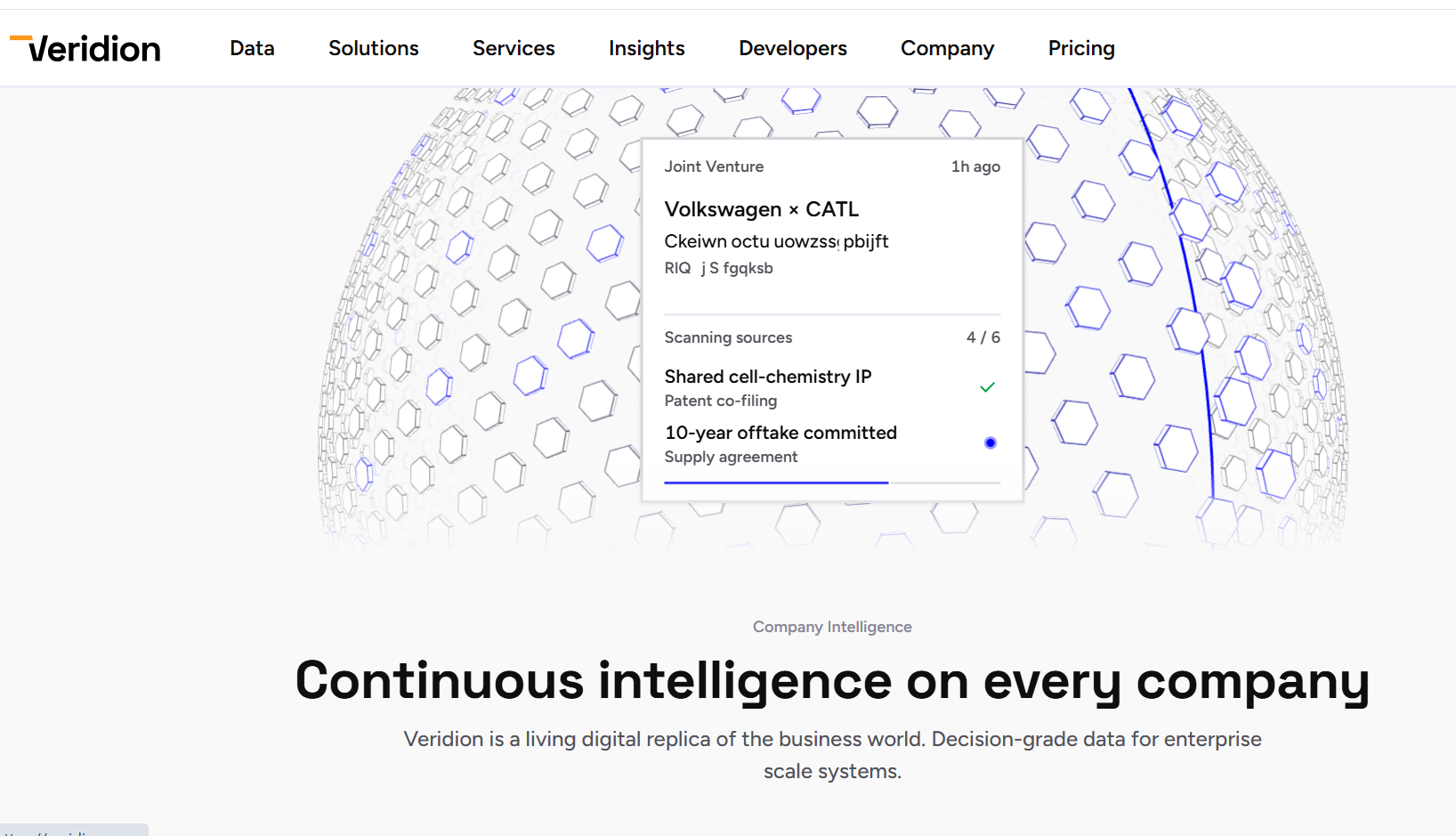
At the 69th IT Press Tour in Ljubljana, Romanian data intelligence firm Veridion presented its approach to replacing outdated company registries with a continuously refreshed, multi-source database covering hundreds of millions of businesses worldwide.
It is surprisingly difficult to reliably verify, on a large scale, who a company actually is, what it does, and whether it is even still in business. During a presentation at the Eurostar Hotel in Ljubljana on September 2, 2026, as part of the 69th IT Press Tour, speakers Alexandra Tofan, head of growth and product, and her husband, Alexandru Tofan, introduced Veridion, a company based in Bucharest. Their argument was that the infrastructure behind most corporate data today no longer keeps pace with the reality of economic activity.
Founded in 2017 under the name Soleadify and rebranded as Veridion in 2023, the company says it maintains records on 693 million companies across more than 250 countries, of which roughly 180 million are classified as currently operational, with more than 400 data attributes tracked per entity. The company, led by CEO Florin Tugan and backed by roughly seven and a half million euros in seed funding, employs about 60 people across Romania, the United Kingdom and the United States, with most staff based in Bucharest.
According to the company, the core problem it addresses is structural rather than technical: most corporate information available today still traces back to government registries, a model of record-keeping the company’s presenters compared conceptually to practices dating back to Dun & Bradstreet’s founding in New York in 1841. Registries, they argued, remain the backbone of company data in 2026 but are frequently incomplete, updated irregularly and dependent on manual filings prone to error. The company noted that only around 5,000 companies worldwide are public and therefore subject to regulatory disclosure requirements, leaving the far larger population of private companies largely undocumented by comparable standards — a gap Veridion frames as the central pain point in private markets, including insurance underwriting, credit assessment and private equity due diligence.
Veridion cited Gartner research estimating that around 27 percent of company data in use by organizations is inaccurate, with poor data quality costing businesses an average of 15 million dollars annually. The company uses these figures to frame the market opportunity for its knowledge-graph approach, while stressing that it does not operate as a credit rating agency.
Veridion’s data pipeline follows what it describes internally as an “acquire, extract, resolve, refresh” process. The company says it draws on more than 50 external sources and over 400 registries, ingesting between one and two billion records daily. Extracted data points are run through an entity-resolution system intended to link related pieces of information into a single company profile, with confidence scores attached and source trails retained; the company said all data is legally obtained. Veridion also said it tracks around 119 million websites, out of an estimated 800 million active sites globally, and does not collect personal data in the process.
A newer offering, launched roughly two weeks before the Ljubljana presentation, compares website snapshots over time to detect changes at company sites — an early-stage “microproduct” that, according to the company, has already surfaced instances of compromised websites during its alpha phase. The presenters cited this as evidence that industries tend to change incrementally rather than in sudden shifts.
On infrastructure, Veridion said it relies mainly on open-source tooling, including an Apache Cassandra database described as running at roughly 252 terabytes, with web-crawling infrastructure based in France and a data center in Germany. The company also distributes data through Snowflake, Databricks, AWS Data Exchange and Nomad Data, and said its largest clients maintain their own data warehouses. Internally, Veridion described its core “Orion” data pipeline as intentionally simple, while custom workflows built for individual clients can be substantially more complex.
Use cases the company presented include supply-chain mapping — citing a Toyota factory in Kolín, Czech Republic, as an example — mergers-and-acquisitions research, datacenter and hyperscaler footprint tracking, fraud-pattern detection, and resilience analysis such as assessing airline exposure to fuel-price disruption. Veridion positioned its offering against both established players such as Dun & Bradstreet and newer, regionally focused competitors based in London, arguing that its coverage is intended to be global rather than limited to specific markets.
Commercially, Veridion sells API access priced according to call volume and the breadth of data requested rather than per-seat licensing, offered across three packages. The company said resellers make up a significant share of its customer base and reported zero customer churn to date among roughly 50 clients, with new implementations typically taking about three months from initial scoping to production. Basic registry data, the company said, is offered free of charge.

Dr. Jakob Jung is Editor-in-Chief of Security Storage and Channel Germany. He has been working in IT journalism for more than 20 years. His career includes Computer Reseller News, Heise Resale, Informationweek, Techtarget (storage and data center) and ChannelBiz. He also freelances for numerous IT publications, including Computerwoche, Channelpartner, IT-Business, Storage-Insider and ZDnet. His main topics are channel, storage, security, data center, ERP and CRM.
Contact via Mail: jakob.jung@security-storage-und-channel-germany.de
The data volume presents a challenge for many legacy systems. My specific instance showed that source integrity varies greatly across different regions.