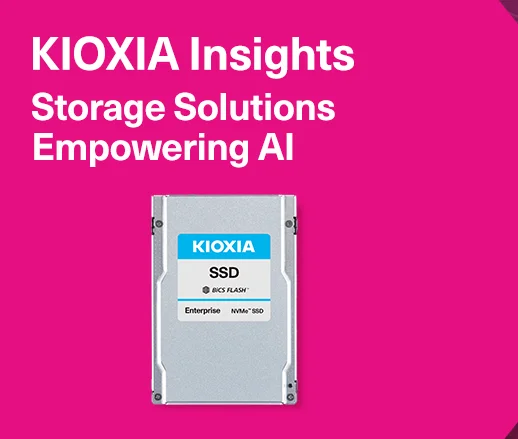
KIOXIA Europe has announced new E3.S models in its CM9 enterprise SSD line that support direct liquid cooling. The PCIe 5.0 drives target AI and HPC servers with cold-plate cooling, but according to the manufacturer they also run in air-cooled environments.
KIOXIA Europe GmbH has expanded its CM9 enterprise SSD line with E3.S models that support direct liquid cooling (DLC). They are intended mainly for server designs with cold-plate cooling, in which a coolant flows through plates mounted directly on the heat-generating components. According to the company, the drives are also suitable for conventional air-cooled environments.
Cooling moves into focus
The background is the rising power demand of AI and high-performance computing (HPC) systems. As compute performance grows, so does the waste heat, which air can remove only to a limited extent in densely populated racks. According to KIOXIA, DLC infrastructure enables considerable energy savings compared with conventional air cooling and allows more servers to be cooled per rack. The company does not give concrete figures for savings or density in its announcement. The fact that SSDs are now being offered for these cooling concepts shows that storage media in dense AI servers are being included in thermal planning.
Key technical data
The CM9 series SSDs comply with the PCIe 5.0, NVMe 2.0 and NVMe-MI 1.2c specifications and support the Open Compute Project (OCP) Datacenter NVMe SSD Specification version 2.5. In the E3.S form factor, they offer dual-port support. Two endurance classes are available: for read-intensive workloads at 1 DWPD (drive writes per day), capacity reaches up to 30.72 TB; for mixed workloads at 3 DWPD, up to 25.6 TB. One DWPD means the drive can be fully written once per day over its stated lifetime.
For sequential access (128 KiB, QD32), KIOXIA quotes up to 14.8 GB/s read and 11 GB/s write. For random access (4 KiB), the figures are up to 3,400 KIOPS at QD512 and 800 KIOPS at QD32. The announcement does not explicitly assign these two values to read or write operations. Performance may vary depending on the device, software and access conditions.
Context caching as a use case
KIOXIA highlights SSD context caching as an application, which, according to the company, benefits from the two endurance options. Context data from AI applications is stored on fast flash instead of being held in scarce GPU memory. Paul Rowan, Vice President & Chief Marketing Officer at KIOXIA Europe, says that scaling AI infrastructure means more than adding compute. It is also about meeting growing storage demand more efficiently and managing the heat generated by denser systems. He says the CM9 drives provide flash storage for context caching that can relieve the limited HBM capacity of GPUs, while also supporting the transition to DLC in next-generation data centers.
Availability
The drives are currently being provided to select customers as samples. According to KIOXIA, these are intended solely for functional testing, and specifications of production models may differ. The company gives no information on pricing or a date for volume production. KIOXIA plans to present the new drives at the OCP Global Summit 2026, taking place October 12–15 in San José, California.

Dr. Jakob Jung is Editor-in-Chief of Security Storage and Channel Germany. He has been working in IT journalism for more than 20 years. His career includes Computer Reseller News, Heise Resale, Informationweek, Techtarget (storage and data center) and ChannelBiz. He also freelances for numerous IT publications, including Computerwoche, Channelpartner, IT-Business, Storage-Insider and ZDnet. His main topics are channel, storage, security, data center, ERP and CRM.
Contact via Mail: jakob.jung@security-storage-und-channel-germany.de