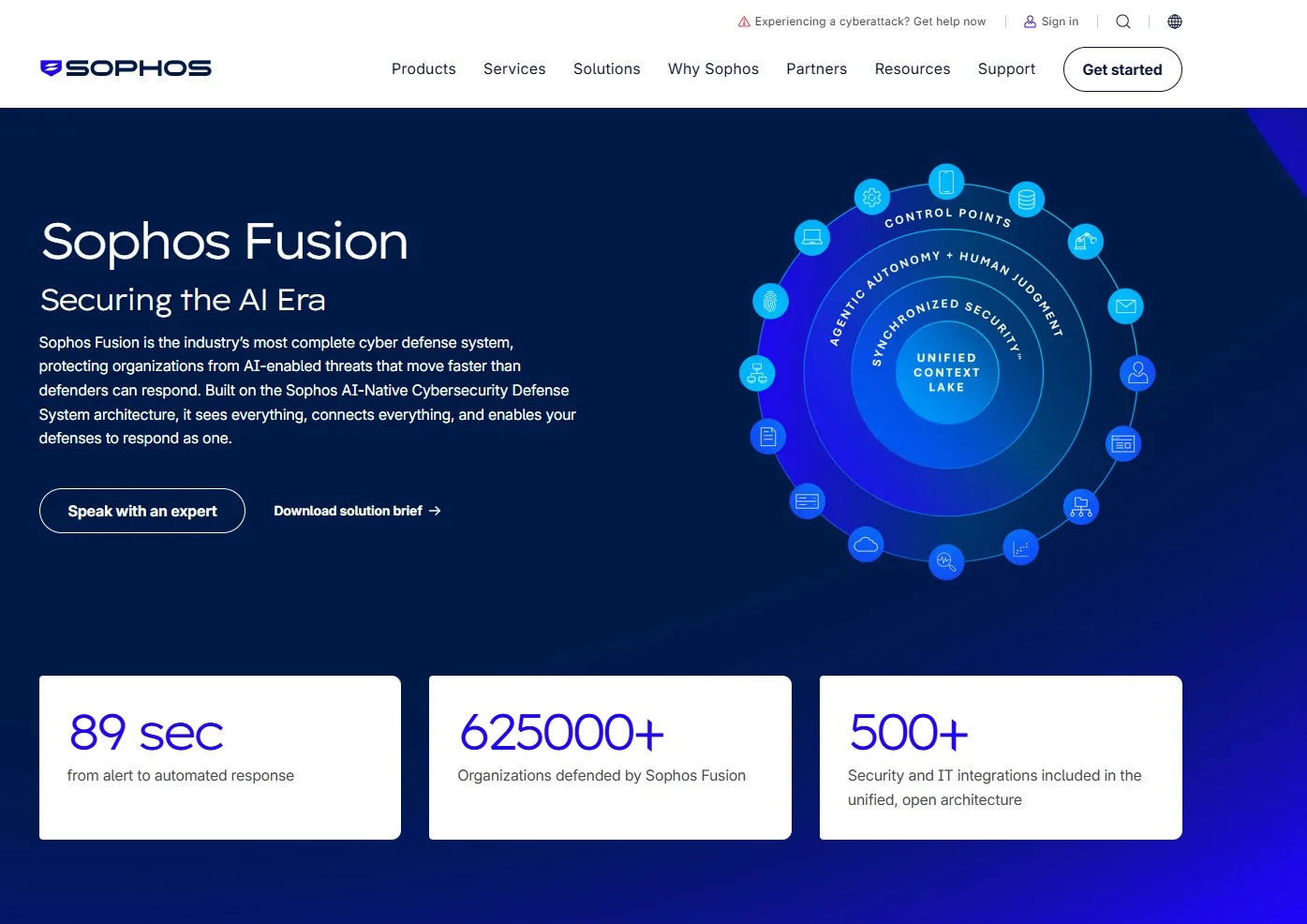
At it-sa 2026, Sophos unveiled Fusion, an AI-native cyber defense system set to replace Sophos Central. Sven Jansen, Vice President Central Sales, explains how Context Lake, agentic AI and human judgment work together, and what AI Defense, NextGen SIEM and CISO Advantage offer midsize firms.
At it-sa 2026 in Nuremberg, Sophos presented Fusion, an AI-native cyber defense system that is set to replace Sophos Central. In conversation, Sven Jansen, Vice President Central Sales, explained how a shared Context Lake, agentic AI and human judgment are meant to bring enterprise-grade protection to the Mittelstand without the cost and complexity that usually come with it.
From management console to defense system
Automated and increasingly complex attacks are putting conventional safeguards to the test. With Fusion, Sophos is moving from a classic cloud management console to a broader, AI-based defense system, with a focus on linking security components and detecting threats faster. Customers are to gain more transparency across their security infrastructure, covering not only Sophos products but also third-party solutions. “With Fusion, we are delivering a completely new approach with an AI-based cyber defense system,” says Jansen.
At its core is the Context Lake, which replaces the earlier pure data lake. Data is no longer merely collected but put into relation, so that firewall, endpoint and third-party systems can communicate. More than 500 integrations are meant to let customers adopt Fusion without replacing their entire portfolio at once.
What AI-native means in practice
According to Jansen, AI-native means that precise correlations are drawn across the Context Lake, allowing AI to resolve most attacks within 89 seconds on average. What sets Sophos apart from many vendors, he says, is that agentic AI is consistently paired with human expertise. “Even if the AI has already responded on its own, an additional layer of control is added by experienced threat analysts making the final decision,” Jansen explains.
The AI handles first analysis and response. In severe or complex incidents, analysts decide whether customers or partners must be informed and whether incident response teams should be activated. Sophos calls this human judgment. According to the company’s website, it protects more than 30,000 organizations with its MDR services.
Secureworks technology for the midmarket
Fusion draws heavily on the Secureworks acquisition and its Taegis platform. Sophos has merged its own MDR service with Taegis’s enterprise analytics, resulting in two packages, Standard and Plus, available to SMB, midmarket and enterprise customers alike. The aim, Jansen says, is to make enterprise-ready technology available to everyone, with fitting pricing. By his account, revenue splits into 40 percent SMB, 40 percent midmarket and 20 to 25 percent enterprise. Secureworks added large customers, but the core remains the Mittelstand.
Data location and shadow AI
Many midsize firms worry about where their data ends up and about uncontrolled AI use, Jansen observes. With Sophos Central and its successor Fusion, customers can choose the hosting location, for example a data center in Frankfurt.
For the growing shadow IT around generative AI, Sophos launched AI Defense a few weeks ago. The module works on an identity basis and shows which users use which tools. A company that has approved only Copilot can enforce that rule rather than rely on firewalls and traffic blocking, which many organizations find reach their administrative limits. AI Defense can also define which data may be sent to which systems, covering risks from shadow AI to unintended data leakage to large language models. “Customers can first analyze application use by identity and user, then establish binding policies,” Jansen explains.
Compliance and the CISO gap
NIS 2 and the Cyber Resilience Act raise requirements for log retention and audit-ready reporting, while classic SIEM products are often too costly for midsize firms. Sophos positions its new NextGen SIEM as a low-cost alternative with unlimited data retention, licensed per user instead of by data volume.
CISO Advantage, which stems from the Argo Cyber acquisition, begins with a basic assessment of the security posture, adds reporting for management and auditors and ends with concrete recommendations. For companies without a CISO it acts as a virtual replacement, says Jansen, and managed service providers can offer it as a service. The need is documented: the 2026 CISO Report by Cybersecurity Ventures and Sophos estimates 35,000 CISOs for 359 million companies, while Sophos’s 2026 MSP Perspectives Report finds that 46 percent of clients on average already expect their MSP to act as CISO. Although the offering had been on the market for only about three weeks, Jansen called it one of the most requested topics at the booth. He cites an MSP that already sells a virtual data protection officer and sees a virtual CISO as the logical next service for closing roles its clients cannot fill themselves.
Conclusion
Sophos is betting that Fusion, AI Defense, NextGen SIEM and CISO Advantage can carry enterprise capabilities into the Mittelstand. The combination of agentic AI, Context Lake and deliberately involved human judgment is meant to shorten response times while increasing control over data and AI use.

Dr. Dietmar Müller is an experienced IT journalist and editor-in-chief of Beyond Buzzwords. He has decades of expertise in the German and international IT markets, as well as extensive editorial experience at renowned publishing and media companies such as Springer, IDG, and CBS Interactive. Whether writing cross-media technical articles, conducting in-depth analyses, or conducting insightful interviews—whether at his desk or in direct dialogue with industry leaders—Dr. Dietmar Müller is right at home in the world of enterprise IT. His key areas of focus include enterprise IT and OT architectures, the cloud, ERP, MES, data centers, cybersecurity and compliance, industrial automation, and AI governance, among others.