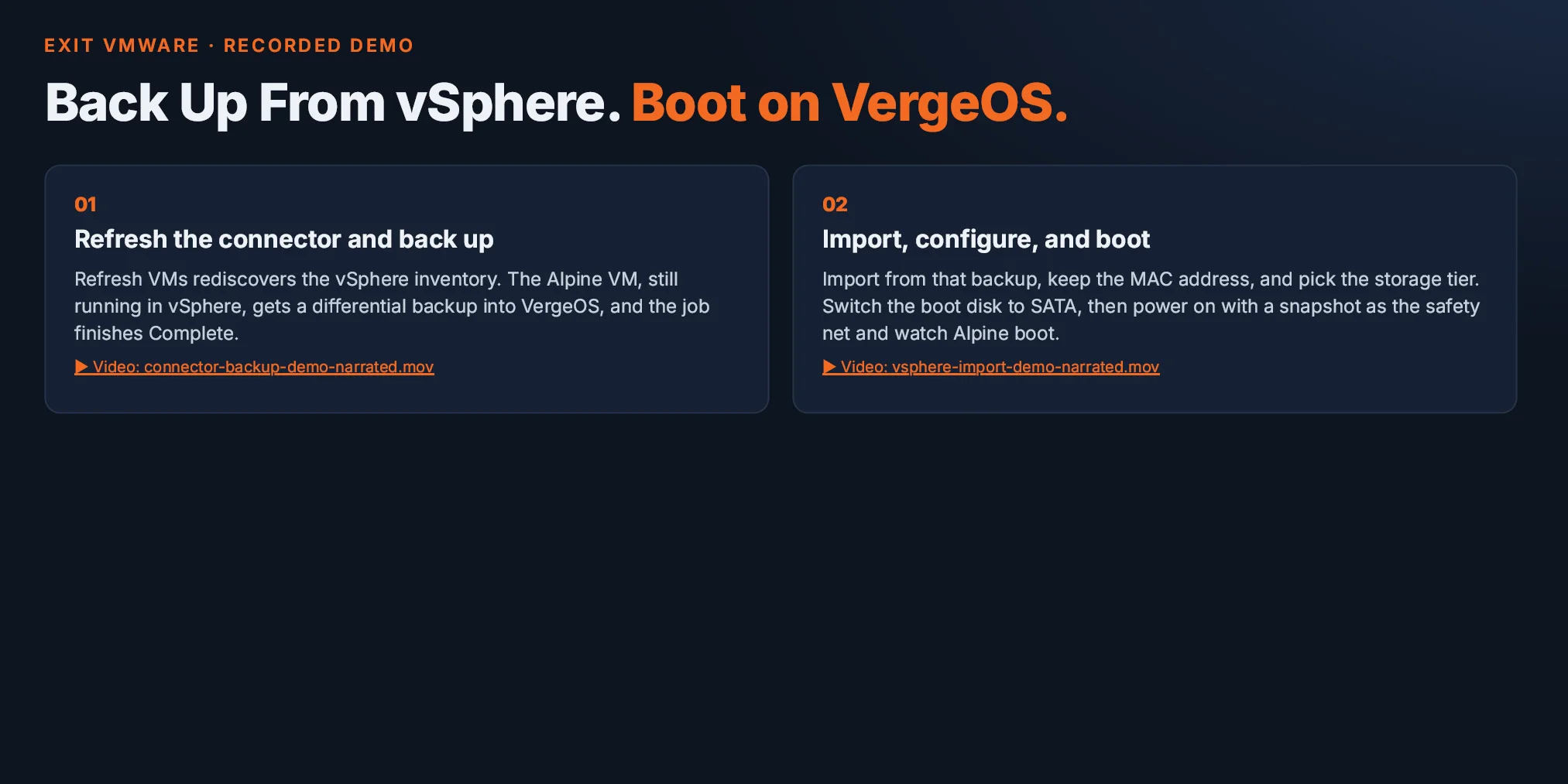
At the IT Press Tour in Palo Alto, VergeIO presented its infrastructure operating system under new CEO Parag Patel, focusing on VMware migration, ageing servers and local AI.
VergeIO wants to win customers who are reconsidering VMware under Broadcom licensing: one infrastructure operating system that turns servers they already own into a complete platform. At the IT Press Tour #70 in Palo Alto on 7 October 2026, the vendor outlined its course under new CEO Parag Patel. He took over about a month ago. He spent roughly half his career at VMware, where he built the partner ecosystem and later ran worldwide sales for vSAN. In his view, the market has reopened: around 300,000 customers worldwide are looking to leave an incumbent, while Broadcom and Nutanix fight over the top 10,000 enterprise accounts.
VergeIO is targeting the mid-market first, including the German Mittelstand. According to Patel, the board expects revenue to grow from eight to nine and ten digits, and fresh capital is available. The company has added board members, among them former VMware CTO Kit Colbert, and is building an EMEA sales team under Rémi Bargoing. Patel announced a channel-heavy approach with local staff and support.
Technically, VergeOS combines hypervisor, storage, networking, backup and disaster recovery in a single code base of fewer than 400,000 lines, according to the company. CMO George Crump cited 25 to 30 percent higher VM density per physical server. Licensing is per physical server, regardless of sockets, cores or capacity; VergeIO puts the savings versus VMware at 45 percent. As a reference, Crump named Topgolf, which reportedly cut its infrastructure from six VxRail servers to three standard Dell servers at each of its 110 venues.
For migration, VergeIO promotes a server-by-server approach without a big bang: VMs are moved off one host, the host is reimaged with VergeOS, and the process repeats. According to Crump, roughly half of customers manage without buying additional hardware. In a demo, a VM was backed up from vSphere through a connector, imported and booted after a single controller change. Asked about Broadcom’s changes to the VDDK interface, Patel said VergeIO is unaffected so far and has workarounds ready, including third-party tools.
With memory and flash prices rising, hardware reuse is the second pillar. VergeOS mixes vendors and server generations in one cluster; Patel pointed to VxRail users who could wipe their systems, install VergeOS and extend maintenance through third parties. UK manufacturer Formica reportedly re-amortised its servers to 2034. A demo showed the cost lever: at September 2026 street prices ($706 per TB for NVMe, $56 per TB for hard drives), moving a live SQL Server data disk to the HDD tier cut the VM’s storage media cost from $263 to $133, or 49 percent. The switch took about a second, while data moved in the background and the load of roughly 80,000 rows per second continued. Crump conceded that hard drives cannot match flash and that RAM cache cushions part of the effect. He favours administrators controlling tiers manually over automatic tiering.
Beyond migration, VergeIO sells multi-tenancy: virtual data centers give departments or customers isolated compute, storage, network and protection. Crump argued that this limits the spread of ransomware and simplifies disaster recovery, because replicating a virtual data center carries network and storage settings along. Distributed sites are a core use case; according to the vendor, every location runs the same version and is automated with Terraform, Ansible and Packer.
The third theme is AI sovereignty. Models run on GPUs inside a customer’s own tenant, and GPU resources can be allocated per virtual data center via NVIDIA MIG. In one demo, an agent framework with a local model built 20 Ubuntu VMs in around six minutes via the VergeOS command line and then deleted them. In another, a local model analysed anonymised webinar data on two consumer GPUs costing about $600 each, at roughly 110 tokens per second. Dave Vincent called it a technology demo. In Europe, Crump said, sovereignty is the trigger; in the US, it is token costs. Patel argued that running AI on-premises can eliminate per-token fees, a claim that depends on workload and hardware.
On ransomware, the company points to IO Fortify, which monitors growth of net-new data, and to independent snapshots. A rise of only a few percent, Crump said, should already trigger an alert, after which a snapshot can be restored. Veeam is supported, yet Crump called a separate backup copy best practice.
The biggest obstacle, Crump said, is not price or features but getting into the evaluation at all. Details of the roadmap for the next twelve months were not disclosed.
For DACH storage resellers, the planned EMEA channel build-out will be the next thing to watch as an interesting technology with a low presence in DACH so far.
Dr. Jakob Jung is Editor-in-Chief of Security Storage and Channel Germany. He has been working in IT journalism for more than 20 years. His career includes Computer Reseller News, Heise Resale, Informationweek, Techtarget (storage and data center) and ChannelBiz. He also freelances for numerous IT publications, including Computerwoche, Channelpartner, IT-Business, Storage-Insider and ZDnet. His main topics are channel, storage, security, data center, ERP and CRM.
Contact via Mail: jakob.jung@security-storage-und-channel-germany.de