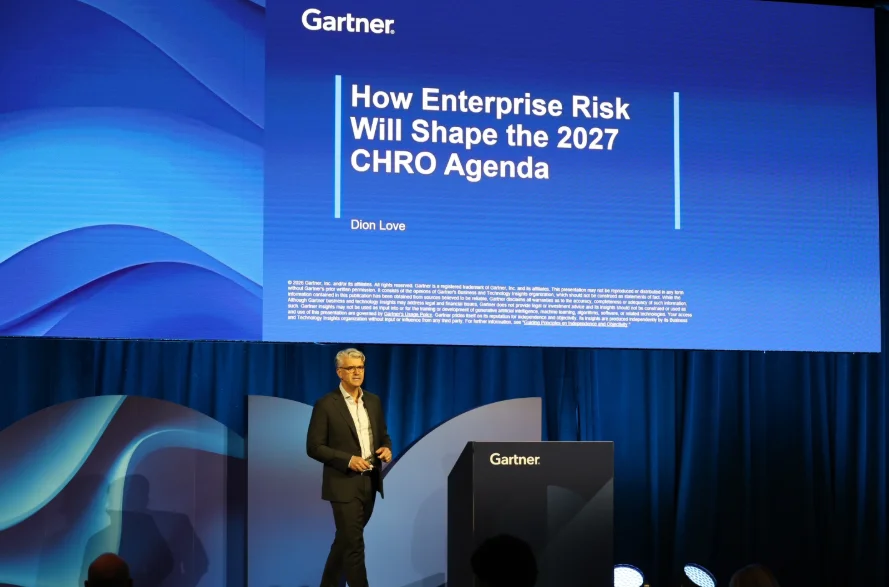
Gartner names four emerging enterprise risks for 2027: overstretched executive teams, costly workforce reductions, declining engagement and an employer promise that no longer matches what employees expect.
At the HR Symposium/Xpo in Sydney, Gartner presented four emerging enterprise risks that, in the analyst firm’s assessment, will redefine workforces in 2027. Dion Love, VP Analyst in the Gartner HR practice, said, according to the company, that chief human resources officers (CHROs) increasingly contend with risks originating well beyond traditional HR domains but affecting the work needed to execute strategy. This raises the stakes for leadership capability, workforce readiness and organizational effectiveness.
Concurrent Disruptions Strain Executive Teams
The first risk concerns the top of the organization. According to Gartner, overlapping economic, technological, geopolitical and workforce disruptions are making it hard for executive teams to align priorities. Gartner research identifies hidden misalignment on enterprise priorities as the most frequently cited barrier. In a July 2026 Gartner survey of 287 CHROs, 68 percent reported that more than 10 percent of their organization’s leaders are misaligned on the current business strategy or transformation efforts. According to Love, as complexity grows, execution depends less on individual executives and more on their ability to combine their strengths into greater collective capability.
Workforce Reductions Create Hidden Costs
The second risk arises when companies cut staff before they understand which capabilities they will need in the future. According to Gartner, capabilities and institutional knowledge are then lost; hidden productivity losses, operational disruption and rehiring costs follow. Gartner predicts that by 2029, around 30 percent of employees who were terminated and replaced by AI will be rehired, often at a higher cost because of ineffective workforce planning. For an organization with 60,000 employees, Gartner estimates that reducing the workforce by 2 percent and then rehiring 30 percent of those affected could cost nearly $100 million. Love said financial benefits appear immediately, while capability gaps emerge only gradually, for example through slower execution, reduced flexibility and lost knowledge.
Continuous Transformation Erodes Engagement
As its third risk, Gartner cites the possibility that continuous change reduces engagement, discretionary effort and innovation, because employees find it harder to see how their work contributes to organizational success. Gartner names a lack of alignment between day-to-day work and organizational purpose, along with the perception that engagement is solely HR’s responsibility, as the most common barriers. In an organization of 10,000 employees, Gartner estimates that every 1 percent drop in engagement can add approximately $272,590 in annual turnover costs. Organizations typically manage change as a series of initiatives, Love said. Employees, by contrast, experience the cumulative effect of shifting priorities, new technologies and ongoing uncertainty.
Shifting Preferences Weaken the Employer Promise
The fourth risk concerns attractiveness as an employer. When employee expectations evolve rapidly, it becomes harder to maintain a compelling employee value proposition (EVP), and investments in the workforce may miss employees’ needs. A May 2026 Gartner survey of 10,055 employees found that both the intent to stay in a role and performance increase by 17 percent when employees perceive total rewards offerings as relevant to their needs. Love said CHROs must proactively engage leaders in reconnecting employees’ work to organizational purpose. Responsibility for employee commitment, he added, should be shared across the leadership team, not just HR.

Dr. Jakob Jung is Editor-in-Chief of Security Storage and Channel Germany. He has been working in IT journalism for more than 20 years. His career includes Computer Reseller News, Heise Resale, Informationweek, Techtarget (storage and data center) and ChannelBiz. He also freelances for numerous IT publications, including Computerwoche, Channelpartner, IT-Business, Storage-Insider and ZDnet. His main topics are channel, storage, security, data center, ERP and CRM.
Contact via Mail: jakob.jung@security-storage-und-channel-germany.de