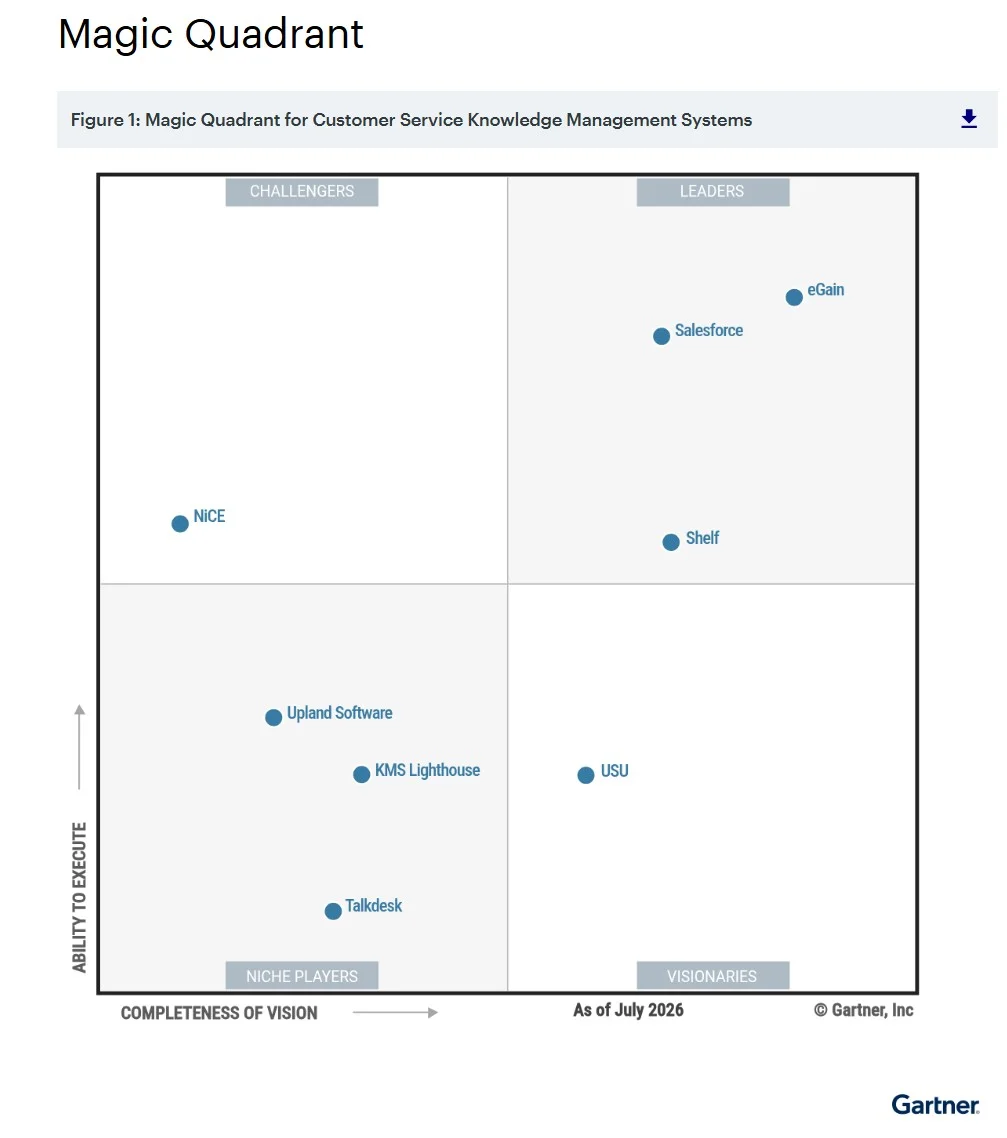
Traditional, passive knowledge bases are giving way to dynamic, AI-driven knowledge engines. The Gartner Magic Quadrant for Customer Service Knowledge Management Systems reveals a market undergoing a fundamental transformation toward trusted, real-time enterprise AI.
The customer service technology landscape is undergoing a structural transformation. Passive content repositories and static knowledge bases—once the standard for support teams—are rapidly becoming obsolete. Driven by advancements in artificial intelligence, customer service knowledge management systems (CS-KMS) are evolving into active, machine-readable reasoning layers that supply contextually relevant answers directly into frontline workflows. The Gartner Magic Quadrant for Customer Service Knowledge Management Systems highlights this shift, showing how automated taxonomy, real-time curation, and generative architectures are redefining customer experience (CX) and operational efficiency.
The primary mandate of a modern CS-KMS is to serve as a single, trustworthy source of truth for both human agents and automated systems. Historically, organizations struggled with disjointed information across service channels, high agent onboarding times, and the heavy manual burden required to keep documentation up to date. Today, AI-powered features such as Retrieval-Augmented Generation (RAG), vector embeddings, and automated knowledge capture from call interactions are turning knowledge management into a fluid, highly responsive enterprise asset.
According to market research, mandatory platform capabilities now extend far beyond basic search functionality. Systems must deliver sophisticated end-user engagement through intelligent search, guided assistance, and conversational interfaces. On the back end, robust curation demands classification, taxonomy management, and insight engines, while lifecycle management requires automated content discovery, dynamic editing, and strict data governance. Optional innovations—such as knowledge graphs, atomized authoring, and AI-driven data quality diagnostics—are quickly differentiating top-tier providers from basic content stores.
The competitive landscape illustrates a clear divide between established platform Leaders, agile Visionaries, Challengers, and specialized Niche Players. Market Leaders such as eGain, Salesforce, and Shelf demonstrate strong execution in embedding AI deeply into knowledge workflows. eGain emphasizes an “AI KnowledgeOps” methodology alongside developer tools for agentic flows, though prospective clients must navigate trade-offs between precision and recall search capabilities. Salesforce leverages its Agentforce ecosystem to ground customer interactions in governed knowledge, though its broad release cycles and complex credit-based pricing present key considerations for buyers. Meanwhile, Shelf stands out through ontology-driven engineering and deep automated quality diagnostics, even as its cloud deployment options remain concentrated.
Other key players bring distinct strengths to specific operational environments. NiCE operates as a Challenger with deep integration into its CXone CCaaS environment, offering strong auditability for compliance-focused sectors. In the Niche quadrant, vendors like Upland Software excel in large enterprise settings using Knowledge-Centered Service (KCS) practices, while KMS Lighthouse focuses on answer-centric, modular content and agentic authoring. Talkdesk embeds governed knowledge into its broader agentic architecture, offering sector-specific models tailored to regulated verticals.
A notable highlight in the analysis is USU, positioning itself as a Visionary through a “complexity-to-simplicity” design philosophy. By translating intricate corporate data into intuitive frontline experiences, USU enables organizations to build reliable AI infrastructure. Following its acquisition of Mayday, USU released its AI Agent Factory to launch task-specific agents directly from curated content bases. Commenting on the shift, Dr. Benjamin Strehl, CEO of USU, noted that the recognition reinforces their strategy of helping organizations build AI-powered customer service on a foundation of trusted knowledge. Johannes Biesing, Vice President of Product Management at USU, reinforced this, emphasizing that there is no trustworthy AI without robust knowledge management.
Ultimately, the market trajectory is clear: knowledge management is no longer merely an administrative support tool, but the essential intelligence foundation for all enterprise AI deployments. Organizations seeking to automate customer interactions must prioritize data hygiene, structural governance, and seamless workflow integration to realize the full promise of agentic AI.

Dr. Jakob Jung is Editor-in-Chief of Security Storage and Channel Germany. He has been working in IT journalism for more than 20 years. His career includes Computer Reseller News, Heise Resale, Informationweek, Techtarget (storage and data center) and ChannelBiz. He also freelances for numerous IT publications, including Computerwoche, Channelpartner, IT-Business, Storage-Insider and ZDnet. His main topics are channel, storage, security, data center, ERP and CRM.
Contact via Mail: jakob.jung@security-storage-und-channel-germany.de