Forensic measurements and a validated Monte Carlo model show that the 1945 B8 pile needed roughly twice the uranium and heavy water Germany had. Neither a heavy-water nor a graphite reactor was within reach.
For eight decades, Werner Heisenberg’s own account has shaped how the world sees Nazi Germany’s last reactor experiment: a near miss, lacking only a little more uranium. A new study in PNAS Nexus tests that story against forensic evidence and modern simulation, and finds that it does not hold up.
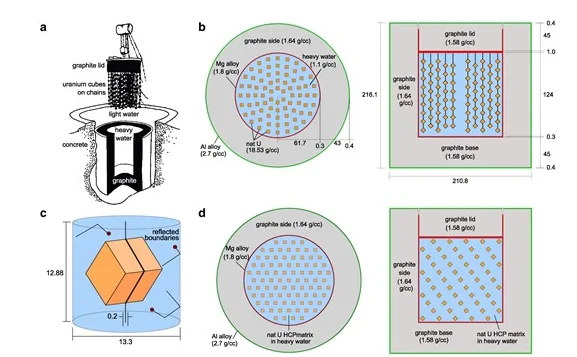
The B8 pile was assembled in April 1945 in a cellar at Haigerloch. Its core held 664 cubes of natural uranium metal, hung in chains inside roughly 1,400 litres of heavy water and surrounded by graphite and light water. It never sustained a chain reaction. In a 1947 Nature article, Heisenberg wrote that the available material was “just insufficient,” and a year later he suggested that enlarging the core volume by not quite half would have done the job.
Because Allied intelligence kept much of the German data classified for decades and the nuclear materiel was scattered after the war, the claim was hard to check. Historians have drawn opposite conclusions from it. Some accept that heavy water would have worked with slightly more material; others, including author Richard Rhodes, argue that Germany should have chosen graphite, as the Americans did.
Forensics meet simulation
The open-access paper, published on 29 September 2026 by Patrick Park, Brittany Robertson, Miriam Hiebert, Jason Zhao, Ciara Sivels and Timothy Koeth, combines archival research with laboratory work, an approach known as document-based nuclear archaeology. A helium pycnometer measurement of a surviving uranium cube gave a density of 18.53 g/cm³, below the nominal 19.01 g/cm³ because of internal porosity; gamma spectroscopy of a second cube confirmed natural enrichment. For the heavy water, the only surviving purity measurement, taken by a US chemist in 1947, indicates 96.8 mol%. Production records from the Norsk Hydro plant in Vemork capped the heavy water that could have been available in Germany by 1945 at about 1,836 kilograms. The graphite, reused from the earlier B7 experiment, was estimated at 3.4 parts per million boron-equivalent impurity.
These inputs fed a Monte Carlo neutronics model. As a test, the team reproduced Heisenberg’s own measured multiplication factor within the counting uncertainty of his raw data, without tuning free parameters. That validation sets the work apart from earlier calculations, which had to assume key material properties. The model puts the effective multiplication factor of the B8 as built at 0.9425, short of the critical value of 1.0, with about 16 percent of neutrons escaping the core. An infinite lattice of the same materials would reach 1.1271 at best, so criticality was possible in principle, but only at a size Germany could not supply.
Twice the material, more than Germany had
At the optimal moderator-to-fuel ratio, the B8 would have needed about 1,343 cubes and 3,100 litres of heavy water. That is about twice the uranium and about 2.2 times the heavy water actually used. The leanest alternatives still demand 1,292 cubes with 3,411 litres, or 1,775 cubes with 2,966 litres. Even pooling every cube and every drop of heavy water the German pile groups held, 1,110 cubes and about 1,700 litres, would have left the pile subcritical at 0.959. The required inventories were roughly 1.2 times Germany’s estimated available uranium and 1.8 times its available heavy water. As a plausibility check, the authors cite Chicago Pile 3, an American heavy-water reactor of 1944, which needed 2.5 tonnes of uranium and 3.8 tonnes of heavy water.
No shortcut through graphite
The study also tests the counterfactual favoured by many historians. Using archival impurity data, the team modelled lattices of natural uranium in German graphite and found that no realistic arrangement reaches criticality with the Siemens graphite and Degussa uranium available at the time. The cause lies upstream. American graphite was made from low-boron petroleum coke, and an especially pure Pennsylvania coke made Chicago Pile 1 possible. German producers, cut off from US petroleum coke by the 1940 blockade, relied on metallurgical coke from the Ruhr with up to twice the impurities. Industrial capacity points the same way: Siemens’ graphitisation capacity of 15,000 tonnes a year was already committed to steelmaking, against the roughly 5,000 tonnes a Hanford-scale plutonium reactor would have required.
Limits and outlook
The authors flag remaining uncertainties. The 96.8 percent purity is a conservative assumption, but even pure heavy water would raise the multiplication factor by only about 1.3 percent, and the uranium density changes it by just 0.04 percent. Ashing graphite to measure impurities can release boron, so the 3.4 ppm estimate may, if anything, understate the problem. Details of Heisenberg’s detector positions are incompletely documented. What he described as a small shortfall was, by this calculation, a doubling of the material. The authors have published their code and data on GitHub and suggest that the method could serve as a template for reassessing other early reactor programs.

Dr. Jakob Jung is Editor-in-Chief of Security Storage and Channel Germany. He has been working in IT journalism for more than 20 years. His career includes Computer Reseller News, Heise Resale, Informationweek, Techtarget (storage and data center) and ChannelBiz. He also freelances for numerous IT publications, including Computerwoche, Channelpartner, IT-Business, Storage-Insider and ZDnet. His main topics are channel, storage, security, data center, ERP and CRM.
Contact via Mail: jakob.jung@security-storage-und-channel-germany.de