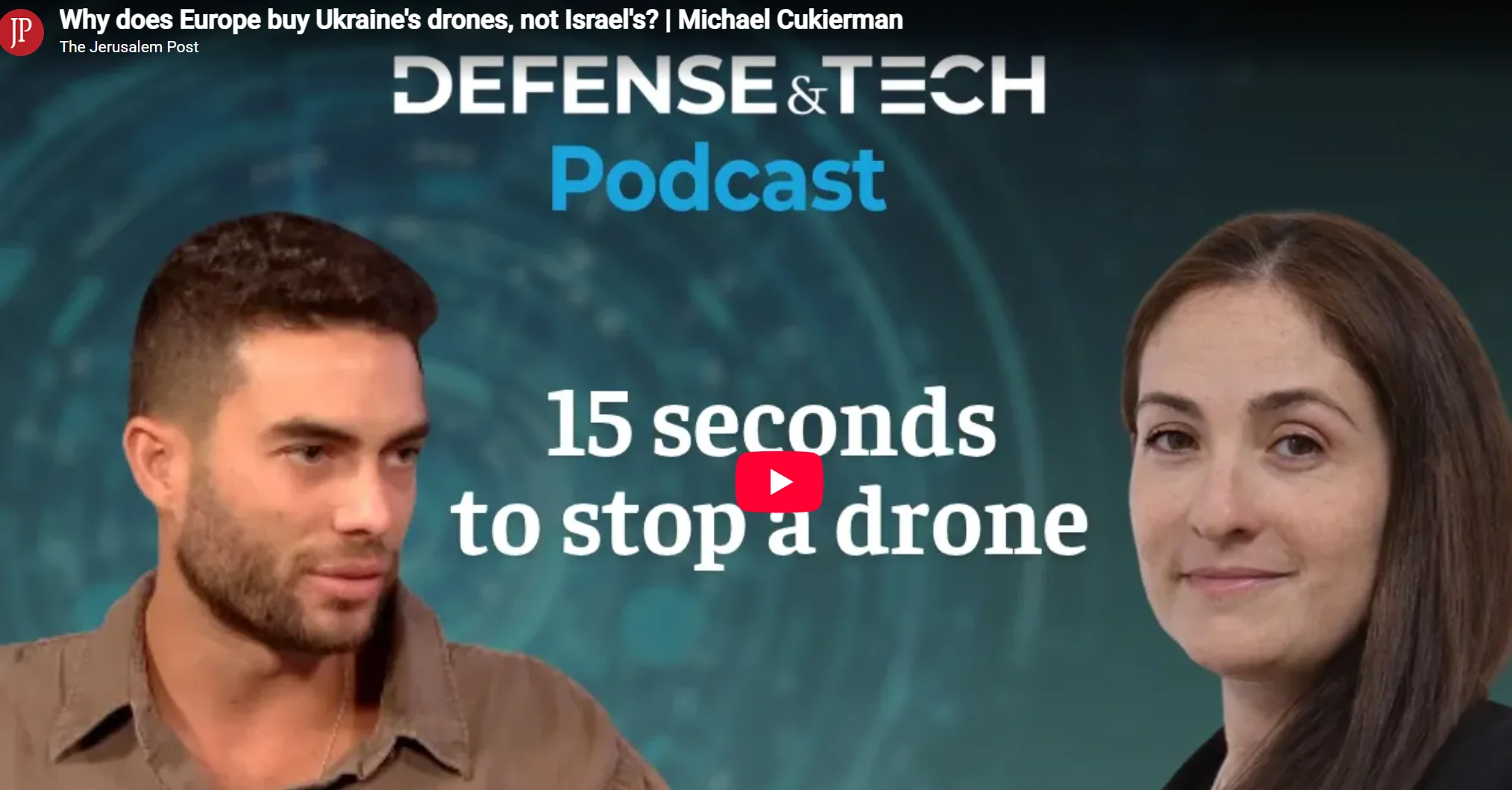
When German defense giant Rheinmetall weighed Israeli innovation against Ukrainian battlefield experience for a critical counter-drone contract, market valuation and manufacturing capabilities tipped the scale.
In modern warfare, drone threats evolve on a monthly basis—moving rapidly from off-the-shelf commercial quadcopters to do-it-yourself 3D-printed UAVs and fiber-optic-guided kinetic threats. As European defense procurement accelerates, defense primes like Germany’s Rheinmetall face a critical strategic choice: invest in Israel’s high-valuation, battle-tested innovations or turn toward Ukraine’s rapid-adaptation manufacturing power.
The Evolving Sky: From Amazon Drones to Kinetic Intercepts
The proliferation of unmanned aerial systems (UAVs) has fundamental impacts on force protection. Early conflict phases saw basic commercial quadcopters modified with improvised explosives. Today, combat units operate under 24/7 aerial surveillance and strike risks.
Michael Cukierman, Head of the Defense Division at Cukierman & Co. and former IDF drone-interception commander, said in a podcast by Jerusalem Post that modern defense depends on a multi-layered counter-UAS framework. While electronic warfare, cyber RF hacking, and GPS spoofing effectively counter long-range threats, emerging fiber-optic drones omit radio-frequency signatures entirely. This triggers a multi-million-dollar industry race for line-of-sight kinetic and laser interception systems capable of neutralizing fast-moving aerial targets within tight 15-second response windows.
Command & Control: The Underestimated Force Multiplier
Despite advancements in laser beam destruction and localized jammers, defense companies often operate in isolated technological silos. Individual vendors frequently develop full-stack solutions ranging from radar and LIDAR sensors to interception mechanisms.
However, Cukierman emphasizes that the most critical underappreciated layer remains command and control (C2) software. By integrating disparate sensor inputs with artificial intelligence, modern C2 systems rapidly evaluate battlefield data to determine optimal intercept methods—whether cyber, radio jammer, or kinetic strikes—before passing final engagement decisions to human operators.
+———————————————————————————+
| LAYERED COUNTER-UAS C2 ARCHITECTURE |
+———————————————————————————+
| 1. AERIAL DETECTION : Radar / LIDAR / Optical / Acoustic Sensors |
| 2. IDENTIFICATION : Protocol Analysis / Target vs. Friendly Clearance |
| 3. AI DECISION MATRIX : Evaluation of Threat Profile & Optimal Layer Choice |
| 4. INTERCEPTION LAYER : EW & Cyber RF (Long Range) / Kinetic & Laser (Short) |
+———————————————————————————+
The Rheinmetall Tender: Valuation and Scalability
The operational gap between laboratory settings and true battlefield environments presents severe commercialization challenges. Environmental factors such as fog, humidity, and nearby heavy artillery interference routinely degrade sensor efficiency in combat environments.
This distinction became paramount during an eight-month competitive procurement tender held by German defense contractor Rheinmetall. Seeking to expand its international counter-drone footprint, Rheinmetall evaluated ten global defense technologies. The selection process culminated in a head-to-head comparison between a top-tier Israeli defense firm represented by Cukierman & Co. and an Ukrainian manufacturer.
Ultimately, Rheinmetall awarded the contract to the Ukrainian enterprise. While the Israeli solution demonstrated superior technology and battle-proven reliability, high Israeli market valuation multipliers and scale limitations influenced the decision. While military customers in Israel often order small initial operational batches of 10 to 20 units, European primes require rapid industrial scalability capable of mass-producing hundreds of systems.
To overcome regulatory barriers and scaling costs, international defense partnerships increasingly rely on local joint ventures and on-the-ground manufacturing footprints across Europe.
Dr. Jakob Jung is Editor-in-Chief of Security Storage and Channel Germany. He has been working in IT journalism for more than 20 years. His career includes Computer Reseller News, Heise Resale, Informationweek, Techtarget (storage and data center) and ChannelBiz. He also freelances for numerous IT publications, including Computerwoche, Channelpartner, IT-Business, Storage-Insider and ZDnet. His main topics are channel, storage, security, data center, ERP and CRM.
Contact via Mail: jakob.jung@security-storage-und-channel-germany.de