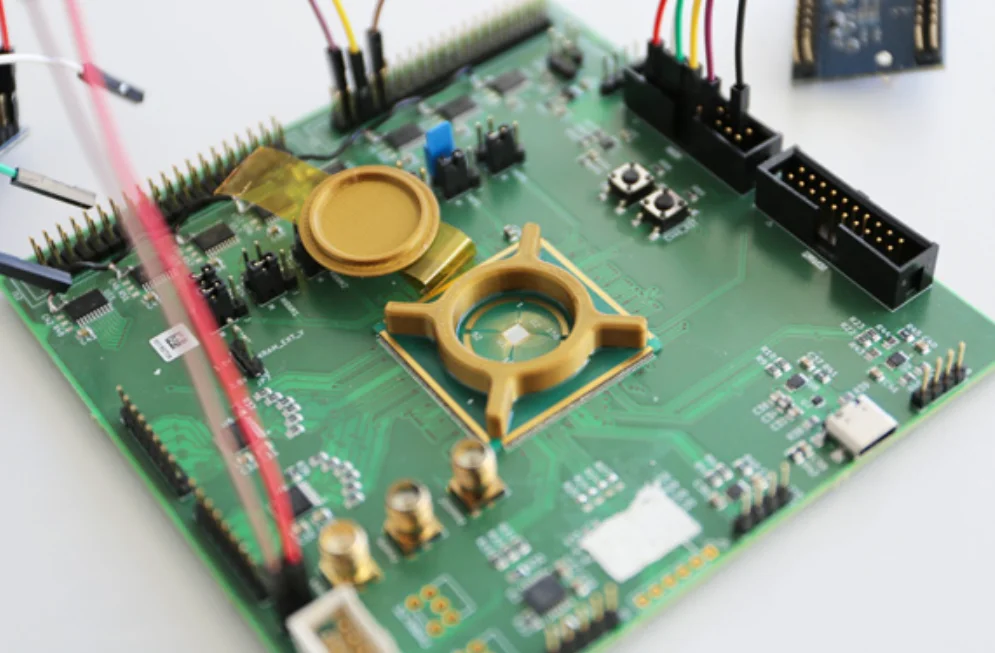
Fraunhofer is offering its OpenTitan-based RISC-V Secure Element as a licensable security platform for custom SoCs, ASICs and chiplets. Fraunhofer is also launching a “Linux for Quantum Computers” initiative.
Following the successful functional evaluation of its silicon prototype, the Fraunhofer-Gesellschaft is moving the RISC-V Secure Element into technology transfer. The OpenTitan-based implementation is available to companies as licensable intellectual property (IP). Fraunhofer also offers integration support and joint development projects.
Companies can use the Secure Element as a complete solution or through individual IP blocks and incorporate it into their own designs for systems-on-chip (SoCs), application-specific integrated circuits (ASICs) or chiplets. According to Fraunhofer, the verified hardware foundation is intended to shorten development times and reduce technical risk. It should also make it easier to apply the security-by-design principle at the semiconductor level. The offer is therefore aimed at companies that want to integrate security functions into their own chip rather than add them externally.
Security functions built directly into the chip
The platform anchors core security functions directly in the chip. These include a hardware root of trust, secure boot, secure key storage, device identities, authentication and protected firmware updates. It is also meant to help companies take regulatory requirements such as those of the Cyber Resilience Act into account early in the hardware architecture. The EU regulation sets cybersecurity requirements for products with digital elements. Fraunhofer names the integration of additional sensor functions as the next development step.
According to Fraunhofer, integrating the functions directly into custom SoCs, ASICs or chiplets reduces external attack surfaces. It also cuts circuit board area and component count, and allows the security functions to be tuned for performance, area and power consumption. Fraunhofer lists security-critical applications in industrial automation, medical technology, communications and energy supply, as well as the Internet of Things (IoT) and edge computing, as fields of use.
Platform and security chip
Like the previously developed security chip, the newly available platform is based on OpenTitan and a RISC-V architecture. OpenTitan is an open-source project for hardware root of trust; RISC-V is an open instruction set architecture. The difference from the security chip: the chip is the physical hardware component, while the platform comprises the complete implementation, including firmware integration blocks.
The platform supports classical encryption as well as post-quantum cryptography. It was manufactured using GlobalFoundries’ 22-nanometer FDSOI technology in Dresden. The European development and manufacturing chain provides transparency and strengthens trust in the underlying hardware, Fraunhofer says. The offering thus differs from a finished component: what is licensed is the implementation, not a physical chip.
Developed at the Trusted Electronic Bayern Center
The platform was developed at the Trusted Electronic Bayern (TrEB) Center. The Fraunhofer Institutes for Applied and Integrated Security AISEC, for Electronic Microsystems and Solid State Technologies EMFT, and for Integrated Circuits IIS took part. The TrEB Center was funded by the Bavarian State Ministry of Economic Affairs, Regional Development and Energy and by the European Union from European Regional Development Fund (ERDF) resources.
Linux for Quantum Computers
In September, the European “Q-VERSE” project was also launched with the goal of developing a European quantum software stack. The project focuses on components and tools for scalable, technologically sovereign, and reliable software solutions designed to harness the computing power of quantum computers—a kind of “Linux for quantum computers.” The project is based on “Eclipse Qrisp,” an open-source framework for quantum programming initiated by Fraunhofer FOKUS.
The tools developed based on “Eclipse Qrisp” can be used across platforms—that is, they are not tailored to a specific hardware architecture. In this way, the goal is to develop a technologically sovereign and interoperable European quantum software stack. “With Q-VERSE, developers will be able to write quantum applications independently of hardware in the future—a kind of Linux for quantum computers,” says Prof. Dr. Nikolay Tcholtchev, group leader of Quality Engineering for Urban ICT and Quantum Computing at Fraunhofer FOKUS.
Standard for Programming Quantum Computers
To achieve this goal, scientists at Fraunhofer FOKUS, together with their project partners, aim to establish “Eclipse Qrisp” as a standard for programming quantum computers. This would promote the interoperability and accessibility of various quantum technologies, thereby enabling scalability in the implementation of various use cases, such as in the fields of IT security, telecommunications, rail transportation, and portfolio optimization in finance.
The project “Quantum Virtual Ecosystem for a Unified Runtime-Agnostic Software Engineering” (Q-VERSE) is funded as a HORIZON Europe project with 4.9 million euros from the European Union over three years. In addition to Fraunhofer FOKUS as the project coordinator, 12 other partners are involved in the project, including DB Systel GmbH, the Eclipse Foundation, Multiverse, Simula Research Laboratory, and RheinMain University of Applied Sciences.
Dr. Jakob Jung is Editor-in-Chief of Security Storage and Channel Germany. He has been working in IT journalism for more than 20 years. His career includes Computer Reseller News, Heise Resale, Informationweek, Techtarget (storage and data center) and ChannelBiz. He also freelances for numerous IT publications, including Computerwoche, Channelpartner, IT-Business, Storage-Insider and ZDnet. His main topics are channel, storage, security, data center, ERP and CRM.
Contact via Mail: jakob.jung@security-storage-und-channel-germany.de