Cyber resilience and generative AI are reshaping enterprise backup strategy. Gartner’s latest Magic Quadrant evaluates twelve vendors as ransomware recovery, identity protection and sovereign data requirements move to the top of the agenda.
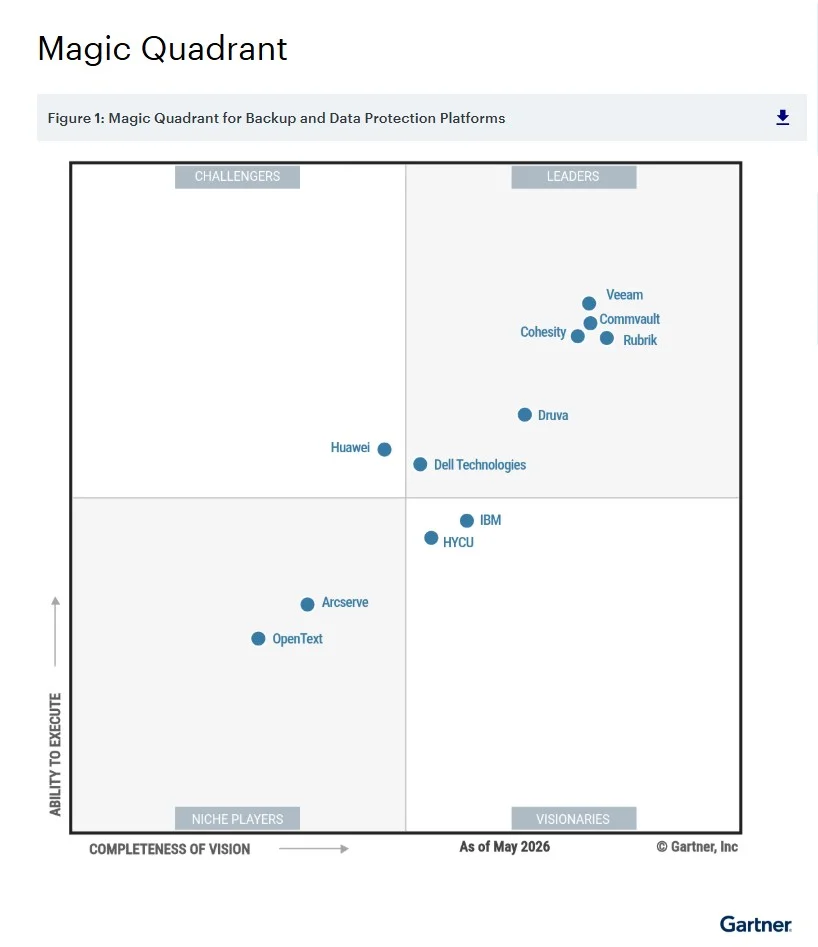
Gartner has published its 2026 Magic Quadrant for Backup and Data Protection Platforms, placing Cohesity, Commvault, Dell Technologies, Druva, Rubrik and Veeam in the Leaders quadrant. The report, authored by analysts Michael Hoeck, Jason Donham and colleagues and released on 29 June 2026, evaluates twelve vendors against criteria spanning hybrid, multicloud and SaaS data protection.
According to Gartner, backup and data protection platforms (BDPP) capture point-in-time copies of enterprise data for recovery, cyberreadiness and, increasingly, broader business use cases such as data discovery and analytics. The research firm defines the category as covering software-only products, integrated appliances and vendor-hosted backup as a service (BaaS), all required to protect data across on-premises infrastructure, public cloud IaaS and major SaaS applications such as Microsoft 365, Salesforce and Google Workspace.
Alongside Cohesity, Commvault, Dell Technologies, Druva, Rubrik and Veeam in the Leaders quadrant, Gartner places Huawei as the sole Challenger. HYCU and IBM appear as Visionaries, while Arcserve and OpenText are categorized as Niche Players. No vendors were newly added to this year’s evaluation; Kaseya’s Unitrends offering was dropped from the formal analysis, though Kaseya itself remains listed among four Honorable Mentions alongside Acronis, Bacula Systems and Synology.
Gartner’s assessment highlights a market increasingly defined by cyber recovery capabilities rather than backup performance alone. Leaders such as Rubrik and Commvault have introduced tools to govern and roll back actions taken by AI agents, reflecting a broader shift toward protecting non-traditional data types including AI models, vector databases and large language model infrastructure. Veeam’s acquisition of Securiti AI and Cohesity’s Cyera-powered data security posture management point to a convergence between backup platforms and data security tooling.
Identity resilience emerges as a recurring theme across vendor evaluations. Gartner notes that most vendors have added backup and recovery capabilities for identity systems such as Microsoft Active Directory, Microsoft Entra ID and Okta, though coverage varies significantly. Rubrik and HYCU are cited for relatively broad identity protection scope, while Dell Technologies, Huawei and Veeam are flagged as lagging in orchestrated Active Directory Forest Recovery.
The report’s strategic planning assumptions underscore how quickly these priorities are expected to shift. Gartner forecasts that by 2030, 70% of organizations will prioritize identity system recoverability alongside preventive access controls, up from under 15% in 2026. The firm also projects that 90% of backup and data protection products will integrate generative AI by 2029, compared with fewer than a quarter in 2025, and that responsibility for cloud backup will shift from cloud operations teams to IT operations teams at 70% of enterprises by 2029.
Generative and agentic AI feature prominently across the vendor profiles. Arcserve, Commvault, Dell Technologies, Druva, IBM, OpenText, Rubrik and Veeam have each introduced AI-based assistants or automation features over the past twelve months, ranging from natural-language troubleshooting to autonomous recovery workflows. HYCU is noted as an exception, with Gartner citing its lack of generative and agentic AI capabilities as a caution.
Sovereign data requirements and geographic diversification also factor into the evaluation. Gartner’s inclusion criteria require vendors to generate at least a quarter of annual recurring revenue outside their largest geography and to actively support customers across at least three of four major regions. The report anticipates that by 2030, 40% of regulated organizations in jurisdictions with active data sovereignty mandates will deploy jurisdiction-specific backup architectures, up from under 10% today.
For heads of infrastructure and operations, Gartner recommends prioritizing platforms offering centralized management across hybrid, multicloud and SaaS environments, built-in cyberattack detection, and support for cloud application infrastructure recovery services. The firm also advises evaluating vendors on their ability to protect AI-specific datasets and to support isolated recovery environments and clean rooms as part of a broader cyber recovery strategy.
Vendor-hosted BaaS offerings continue to gain traction as an alternative to customer-managed deployments, according to Gartner, with providers expanding coverage to include on-premises, IaaS, PaaS and SaaS workloads under a single subscription model. The analysts also point to growing interest in cloud application infrastructure recovery services (CAIRS), which extend backup beyond individual workloads to discover and recover entire application stacks, including infrastructure-as-code components, following a disruption.
The full report, including detailed vendor strengths, cautions and evaluation criteria, is available through Gartner’s research portal.

Dr. Jakob Jung is Editor-in-Chief of Security Storage and Channel Germany. He has been working in IT journalism for more than 20 years. His career includes Computer Reseller News, Heise Resale, Informationweek, Techtarget (storage and data center) and ChannelBiz. He also freelances for numerous IT publications, including Computerwoche, Channelpartner, IT-Business, Storage-Insider and ZDnet. His main topics are channel, storage, security, data center, ERP and CRM.
Contact via Mail: jakob.jung@security-storage-und-channel-germany.de