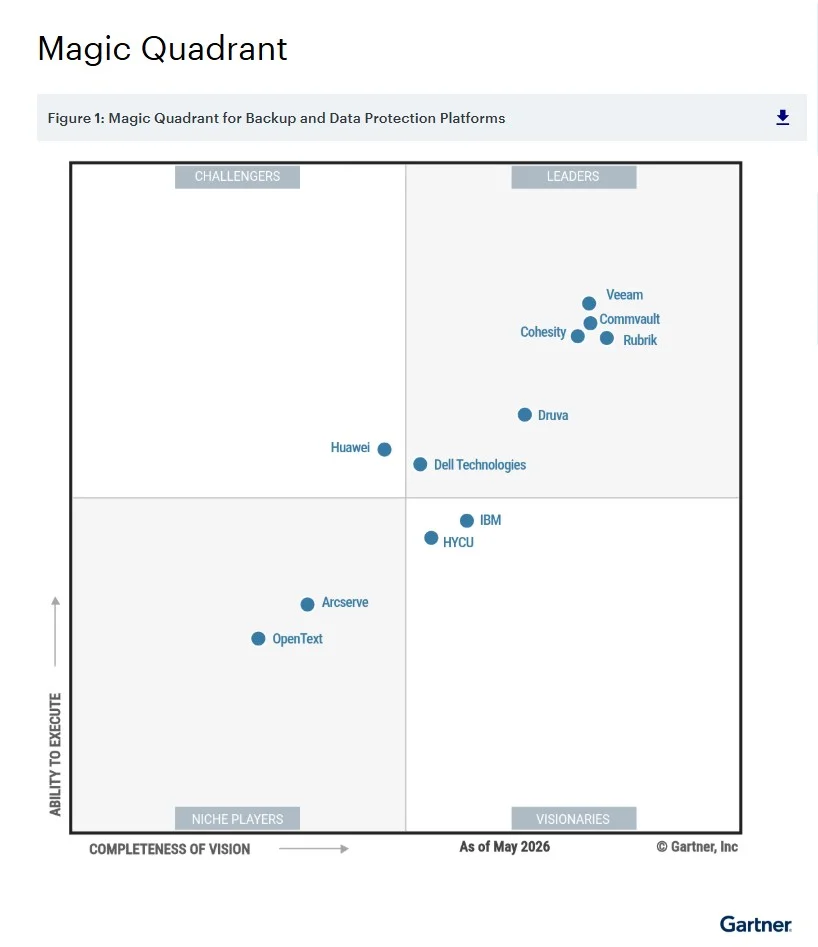
Gartner’s latest Critical Capabilities research compares eleven backup and data protection vendors across hybrid, multicloud, SaaS and ransomware recovery scenarios, offering enterprise IT leaders a fresh reference point as data protection strategies converge with broader cyber resilience planning.
Gartner has released an updated edition of its Critical Capabilities for Backup and Data Protection Platforms report, evaluating eleven vendor products against a defined set of technical and operational criteria spanning hybrid infrastructure, multicloud environments, SaaS workloads, disaster recovery and ransomware protection.
Published in late June 2026, the report forms part of Gartner’s Critical Capabilities series, which is typically issued alongside the analyst firm’s Magic Quadrant research to provide a more granular, use-case-based comparison of vendor offerings. Where Magic Quadrant reports plot vendors along axes of vision and execution, Critical Capabilities research breaks products down by specific technical attributes and rates how well each addresses defined enterprise scenarios.
For this report, Gartner assessed vendor products across criteria including data center integration, support for major public cloud platforms, SaaS application coverage, recovery and orchestration capabilities, and ransomware detection features. The evaluation also incorporates newer categories addressing platform management, platform security and platform architecture, reflecting how backup tooling has expanded beyond simple data copying into broader resilience and governance functions.
Backup and data protection has become a more prominent line item in enterprise IT budgets in recent years, driven largely by the dual pressures of increasingly complex hybrid and multicloud environments and the persistent threat of ransomware. Organizations running workloads across on-premises data centers, multiple public cloud providers and a growing number of SaaS applications face a correspondingly complex set of requirements for ensuring that data can be recovered quickly and reliably in the event of an outage, error or attack.
Analysts covering the space have noted a broader shift in how backup platforms are positioned. Rather than being treated purely as a recovery mechanism triggered after an incident, backup infrastructure is increasingly expected to play an active role in an organization’s overall security posture — supporting faster detection of anomalies, validating the integrity of data before it is restored and integrating with the wider set of tools that security and operations teams rely on day to day.
The inclusion criteria for vendors in this year’s report required qualifying products to support infrastructure-as-a-service protection across at least two major public cloud platforms and to protect data across at least two significant SaaS applications, among other technical and commercial thresholds. Gartner also applied revenue and customer-base minimums intended to ensure the vendors assessed serve a meaningful base of enterprise customers.
As in previous years, the report evaluates a single product per vendor, even where a company offers multiple backup or recovery solutions. Gartner noted that no new vendors were added to this year’s edition, while one vendor was dropped from the research.
The growing weight given to SaaS protection in this year’s report reflects a wider industry trend: organizations have moved significant portions of their operations into cloud-based collaboration and business applications, yet backup coverage for those platforms has historically lagged behind protection for on-premises systems. Vendors serving the enterprise market have responded over the past several years by extending native backup support beyond core productivity suites into a wider range of business-critical SaaS applications, though the depth and consistency of that coverage still varies considerably across providers.
Ransomware resilience remains another consistent theme across the backup and recovery market. As attackers have increasingly targeted backup repositories themselves in an effort to prevent recovery, vendors have invested in immutable storage, anomaly detection and isolated recovery environments designed to let organizations restore data with confidence that it has not been compromised. Gartner’s evaluation criteria for this report reflect that shift, incorporating ransomware detection and recovery as a distinct use case rather than treating it as a subset of general disaster recovery.
For enterprise IT leaders, Critical Capabilities reports are generally used as one input among several when evaluating or renewing backup and data protection tooling, alongside factors such as existing infrastructure investments, in-house expertise, and specific regulatory or industry requirements that may not be fully captured in a generalized vendor comparison. Procurement teams typically pair this kind of research with proof-of-concept testing and reference checks before making platform decisions of this scale.
The full report, including detailed vendor assessments, use-case scoring and methodology, is available to Gartner clients through the company’s research portal.

Dr. Jakob Jung is Editor-in-Chief of Security Storage and Channel Germany. He has been working in IT journalism for more than 20 years. His career includes Computer Reseller News, Heise Resale, Informationweek, Techtarget (storage and data center) and ChannelBiz. He also freelances for numerous IT publications, including Computerwoche, Channelpartner, IT-Business, Storage-Insider and ZDnet. His main topics are channel, storage, security, data center, ERP and CRM.
Contact via Mail: jakob.jung@security-storage-und-channel-germany.de