Managed Service Providers frequently face increasing costs per terabyte as data volumes and client bases grow. Hamburg-based software developer NovaStor is researching a SaaS backup architecture designed to reverse this cost curve. The project has received official recognition as a Research & Development initiative from the Certification Authority for Research Allowance (BSFZ).
In Backup-as-a-Service (BaaS) operations, Managed Service Providers (MSPs) and system integrators routinely face structural economic challenges. As service providers onboard more tenants and handle larger volumes of data, costs per unit generally increase. This phenomenon is driven by expanding metadata catalogs, transaction fees for object storage access, and the necessity to maintain excess capacity to handle workload spikes. For smaller clients, these factors often make individual service delivery unprofitable, leading to cross-subsidization or refusal of service.
To address this cost structure, NovaStor GmbH is developing a degressively scaling SaaS backup architecture. The initiative aims to progressively lower the resource requirement and operational costs per terabyte as total data volume expands.
The German Certification Authority for Research Allowance (BSFZ) has formally recognized the initiative as research and development under the German Research Allowance Act. Operating on behalf of the Federal Ministry for Research, Technology and Space, the BSFZ evaluates whether corporate projects meet statutory criteria for tax-based research incentives. Consequently, NovaStor has been awarded the official BSFZ seal. A previous project by the company, focused on securing large-scale data volumes on tape infrastructure, also received approval.
The current research focuses on three primary technical components:
- Dynamic S3 Storage Containerization: Rather than using fixed storage structures, storage containers are created dynamically at runtime based on data profiles, change rates, and recovery requirements. This approach aims to minimize object access transactions and reduce associated cloud costs while maintaining fine-grained recovery capabilities.
- Hybrid Metadata Splitting: Managing billions of files often creates bottlenecks in metadata catalogs rather than in core storage. NovaStor is investigating a split model where latency-sensitive metadata remains near the source, while global metadata is managed centrally. This structure is intended to maintain fast search, browsing, and restore speeds across expanding environments.
- Decentralized Job Splitting: To manage workload spikes—such as end-of-month processing or mass restores following security incidents—backup and recovery jobs are automatically divided at runtime and distributed across available resources, bypassing central control bottlenecks.
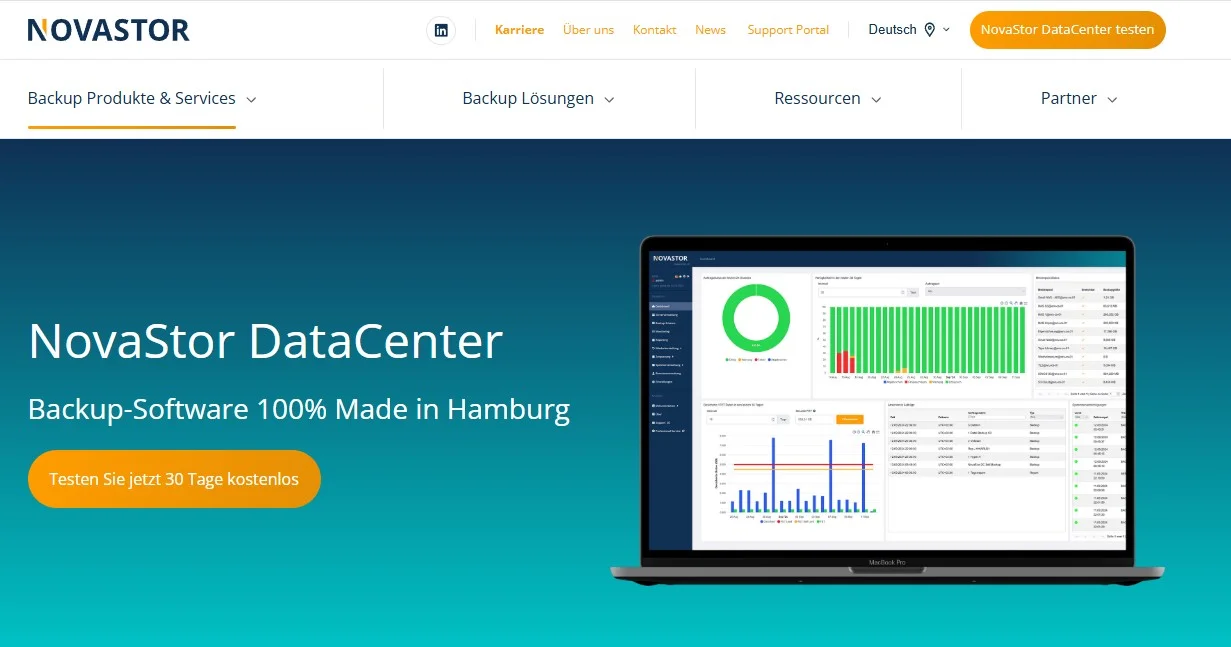
The results of this research will be integrated into the NovaStor DataCenter Evolve SaaS platform, which is hosted in German data centers and tailored for MSPs and system integrators. Primary target environments include providers with numerous small clients, organizations with large file volumes, and operations subject to fluctuating workload peaks.

Dr. Jakob Jung is Editor-in-Chief of Security Storage and Channel Germany. He has been working in IT journalism for more than 20 years. His career includes Computer Reseller News, Heise Resale, Informationweek, Techtarget (storage and data center) and ChannelBiz. He also freelances for numerous IT publications, including Computerwoche, Channelpartner, IT-Business, Storage-Insider and ZDnet. His main topics are channel, storage, security, data center, ERP and CRM.
Contact via Mail: jakob.jung@security-storage-und-channel-germany.de