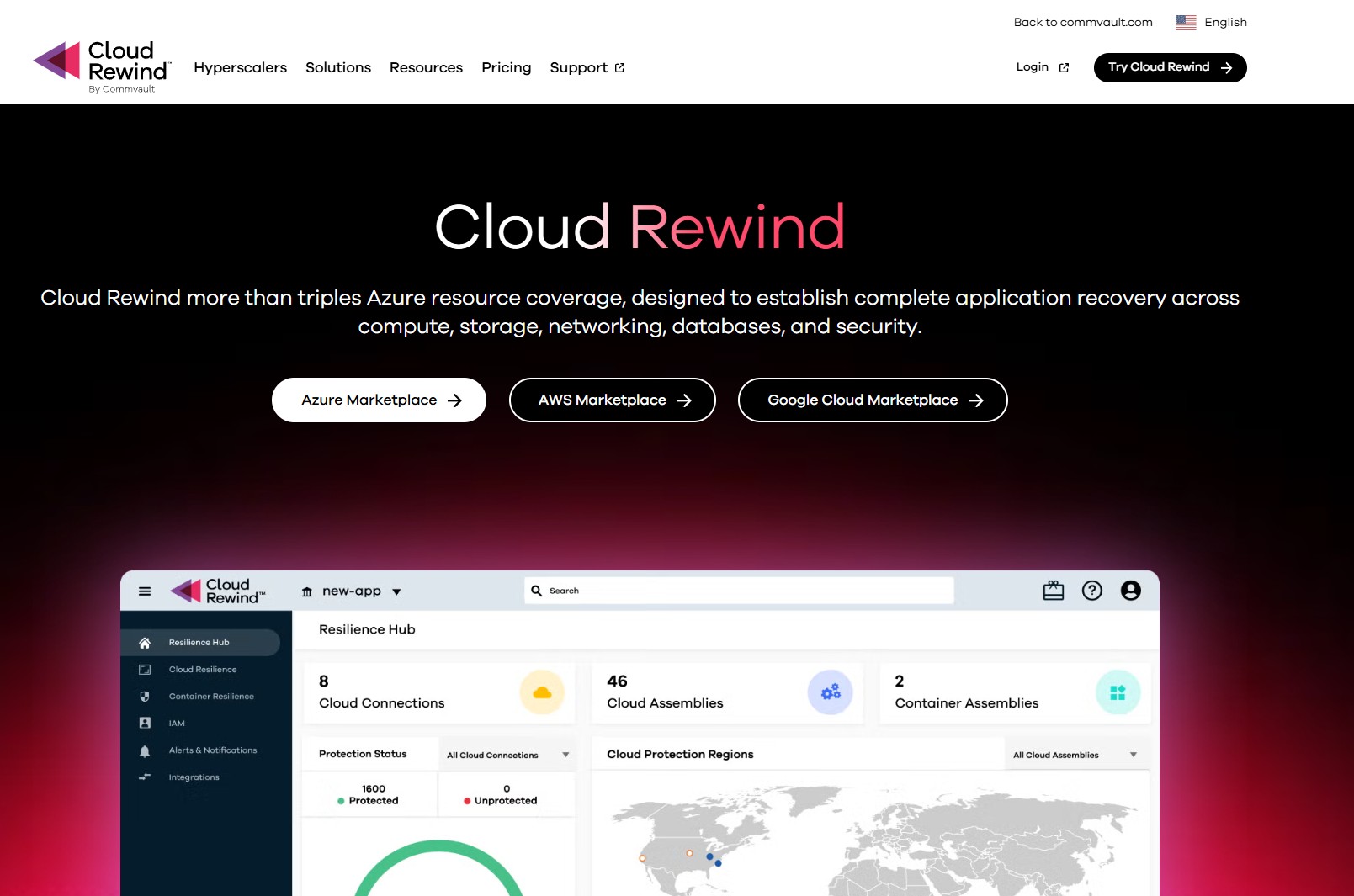
New enhancements to Commvault’s Cloud Rewind extend protection to a much broader set of Azure resources, aiming to cut enterprise cloud recovery times after cyberattacks and outages from days to hours.
Commvault has extended Cloud Rewind, its cloud application recovery offering, to cover a substantially broader set of Microsoft Azure resources. The expansion is designed to help enterprises protect configurations, cloud applications and their associated resources, and recover them faster after an incident.
Manual environment recovery remains one of the most persistent weak points in enterprise IT. According to the 2026 State of Enterprise Cyber Resilience report from Absolute Security, 57 percent of organizations said recovery from a cyberattack took more than 4.5 days on average. For businesses running critical workloads in the cloud, that gap between an incident and a working environment can translate directly into lost revenue and eroded customer trust.
Cloud Rewind addresses that gap by continuously discovering cloud resources, mapping application dependencies, and orchestrating the recovery and rebuilding of cloud applications — including the underlying infrastructure, configurations and dependencies — through a single, centralized platform. With this update, Commvault says it has tripled Azure protection scope, now covering 62 percent of the enterprise-relevant Azure resource types available on the market. Organizations can also validate their recovery readiness through application recovery simulations, including in isolated, air-gapped environments, before an incident occurs.
The Azure expansion is part of a broader multi-cloud push. Cloud Rewind is also available through the AWS and Google Cloud marketplaces, and Commvault positions the platform as covering application recovery across compute, storage, networking, databases and security — not just the data layer that traditional backup tools focus on. As enterprises push more AI-powered workloads into the cloud, the number and complexity of resources tied to a single application has grown accordingly, making manual, resource-by-resource recovery increasingly impractical at scale.
Two additional capabilities round out the release. Deeper integration with Commvault Backup and Recovery introduces Protection Groups that unify application data and cloud configuration into a single, air-gapped recovery workflow, letting teams plan and execute recovery centrally instead of coordinating separate tools. Scalable policies for dynamic protection automatically discover new resources within a single workflow, apply appropriate protection policies, and tag them by region, type and multi-cloud environment — allowing teams to protect resources at cloud scale rather than capturing them one by one.
“Modern applications depend on interconnected cloud services, infrastructure and configurations that must be recovered together,” said Pranay Ahlawat, Chief Technology and AI Officer at Commvault. “Cloud Rewind helps organizations restore cloud applications through a unified console in Commvault Cloud, strengthening customer confidence in their ability to recover from a cyberattack or outage.”
The urgency of that promise is not abstract for some early customers. “In global logistics, every minute of downtime can disrupt supply chains and undermine customer trust. Data is critical, but it needs the right cloud infrastructure to keep working,” said Venkata Sudhakar Nagandla, SVP & Global Head of IT Infrastructure & Cloud at Allcargo Group Companies. “With Cloud Rewind, we don’t just restore files — we restore our entire operating environment within hours, so our customers experience continuity without compromise.”
The expanded coverage arrives as more enterprises pair infrastructure-as-code tools such as Terraform with dedicated recovery platforms, rather than treating IaC state as a substitute for one. Commvault has positioned Cloud Rewind as a complement rather than a replacement: where Terraform manages desired configuration going forward, Cloud Rewind is built to restore the actual environment that was running at a specific point in time, regardless of whether the change that caused an incident came through code, the console, or manual intervention.
Cloud Rewind is available now as an add-on workload within Commvault Cloud for cloud application protection and application-centric recovery. The expanded Azure coverage is expected to roll out over the coming months. Pricing is consumption-based, calculated according to the volume of protected cloud resources.
For IT and security leaders evaluating cloud resilience investments, the Azure expansion signals where Commvault sees the next phase of the recovery market heading: away from siloed, resource-specific backup tools and toward a single platform that can reconstruct an entire application environment — infrastructure, configuration and data together — on demand.

Dr. Jakob Jung is Editor-in-Chief of Security Storage and Channel Germany. He has been working in IT journalism for more than 20 years. His career includes Computer Reseller News, Heise Resale, Informationweek, Techtarget (storage and data center) and ChannelBiz. He also freelances for numerous IT publications, including Computerwoche, Channelpartner, IT-Business, Storage-Insider and ZDnet. His main topics are channel, storage, security, data center, ERP and CRM.
Contact via Mail: jakob.jung@security-storage-und-channel-germany.de