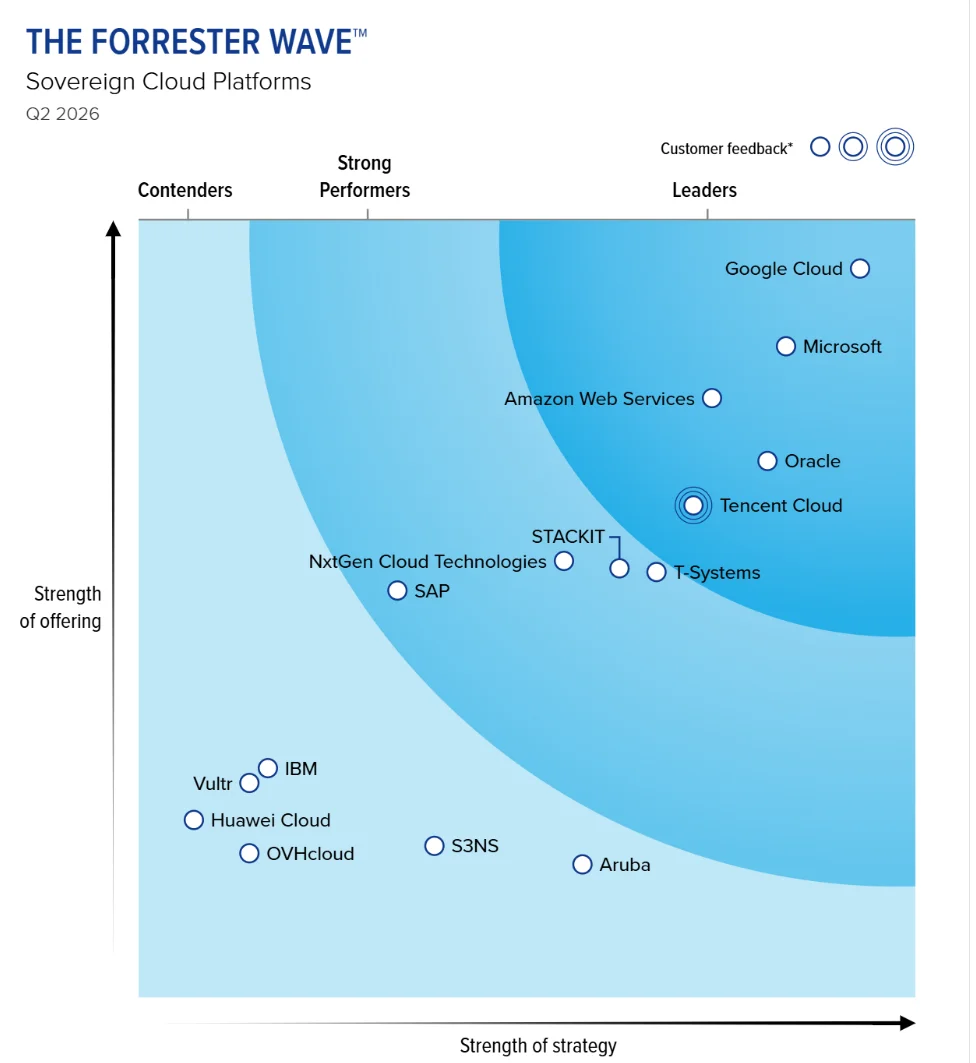
Forrester’s new evaluation of 15 sovereign cloud providers warns that technical data controls alone don’t make a platform sovereign — and singles out a legal dispute over OVHcloud’s Canadian unit as a cautionary tale.
Sovereign cloud has graduated from a niche compliance checkbox to a full-blown vendor battleground. In The Forrester Wave™: Sovereign Cloud Platforms, Q2 2026, authored by analyst Dario Maisto and three contributors, Forrester evaluated 15 providers and concluded that no single vendor or deployment model can satisfy every organization’s sovereignty needs — and that some offerings on the market amount to little more than “sovereignty-washing.”
According to the report, sovereign cloud platforms are not off-the-shelf products. Global hyperscalers instead offer a menu of deployment models — public cloud with data boundaries, private cloud, and fully air-gapped environments — while regional providers tend to be sovereign by design but lack the breadth of services their global rivals offer. Forrester’s central warning to buyers: technical data isolation is not enough on its own. True sovereignty, the report argues, requires that self-contained services be paired with physical, logical, and legal independence, or organizations risk falling for sovereignty claims that don’t hold up under scrutiny.
Google Cloud, Microsoft, Amazon Web Services, Oracle, and Tencent Cloud were named Leaders. Google Cloud’s strategy rests on three platforms — a public-cloud data boundary, a dedicated private cloud, and an air-gapped offering that uniquely carries Gemini and Vertex AI — with Forrester crediting the company for making core services consistently available across all three, even though customers pay a premium for specific sovereign controls. Microsoft was recognized for sovereignty spanning cloud, AI, and productivity tools, including new national partner-cloud tie-ups with Bleu and Delos Cloud that run Microsoft 365 and Azure on independently operated infrastructure; Forrester noted customer unease, however, about potential back-door access tied to Microsoft’s Key Vault.
AWS earned praise for its “Control Without Compromise” positioning and strong CI/CD and DevOps tooling, but Forrester flagged that its sovereignty approach — spread across GovCloud, Top Secret, China, its European Sovereign Cloud, Dedicated Local Zones, and AI Factories — remains fragmented rather than unified, and its European Sovereign Cloud is still new enough that only one AWS reference customer responded to Forrester’s outreach. Oracle stood out for pricing sovereign and nonsovereign services identically and for a broad database and AI portfolio, though its roadmap develops market-by-market rather than as one coherent global strategy. Tencent Cloud, the sole Chinese hyperscaler with a deliberate sovereignty strategy, was named a Customer Favorite for its data-governance and operations tooling via Tencent Cloud Enterprise, but its focus on governments and regulated industries leaves it with a gap in public-cloud sovereignty.
Four vendors landed in the Strong Performers tier — a group with particular relevance for DACH buyers. T-Systems, bundled with Deutsche Telekom’s T Cloud, is developing a VMware alternative called Future Cloud Infrastructure for 2026 and was flagged by Forrester as a strong fit for organizations with core operations in Germany, Austria, and Switzerland, despite customer complaints about pricing complexity. STACKIT, led since November 2024 by former Google Germany chief Bernd Wagner, builds its pitch on three pillars: data held exclusively in Germany and Austria, private-company ownership as protection from stock-market volatility, and open-source-based technical autonomy — though Forrester notes its product catalog still trails larger rivals and customers have flagged unannounced GPU maintenance downtime. SAP’s sovereign cloud, extended through its Delos Cloud subsidiary and AI partnerships with OpenAI, Mistral, and Cohere, was rated solid on serverless and integration but lacking a clear forward-looking sovereignty vision. India’s NxtGen Cloud Technologies rounded out the tier with a government- and finance-focused sovereign AI stack that Forrester said does not yet scale outside India.
Among the six Contenders, OVHcloud drew the report’s sharpest warning: Canadian authorities reportedly ordered OVHcloud’s Canadian entity to hand over data physically stored in France, leaving the company caught between violating French law or facing contempt charges in Canada — a scenario Forrester frames as exposing the practical limits of sovereignty claims once cross-border legal jurisdiction gets tested. Huawei Cloud, despite exceeding $55 billion in public-cloud revenue in 2024, was held back by US chip bans and the EU’s phase-out of its network equipment. S3NS, the Thales–Google Cloud joint venture that earned France’s SecNum Cloud certification in December 2025, and IBM, now pivoting toward an OpenShift-based “Sovereign Core,” both scored below the Leaders on current capability but were seen as having credible longer-term potential. Vultr rounded out the group on the strength of affordable, isolated regional infrastructure.
Forrester based its scoring on vendor questionnaires, product demonstrations, briefings, and customer reference interviews submitted by January 27, 2026; Huawei Cloud, IBM, OVHcloud, and Vultr did not participate fully, so their positions rely more heavily on public information and independent sourcing. For DACH enterprises weighing GDPR, sector-specific compliance, and geopolitical risk, the report’s throughline is clear: evaluate the legal and operational insulation behind a sovereignty claim, not just where the servers happen to sit.

Dr. Jakob Jung is Editor-in-Chief of Security Storage and Channel Germany. He has been working in IT journalism for more than 20 years. His career includes Computer Reseller News, Heise Resale, Informationweek, Techtarget (storage and data center) and ChannelBiz. He also freelances for numerous IT publications, including Computerwoche, Channelpartner, IT-Business, Storage-Insider and ZDnet. His main topics are channel, storage, security, data center, ERP and CRM.
Contact via Mail: jakob.jung@security-storage-und-channel-germany.de