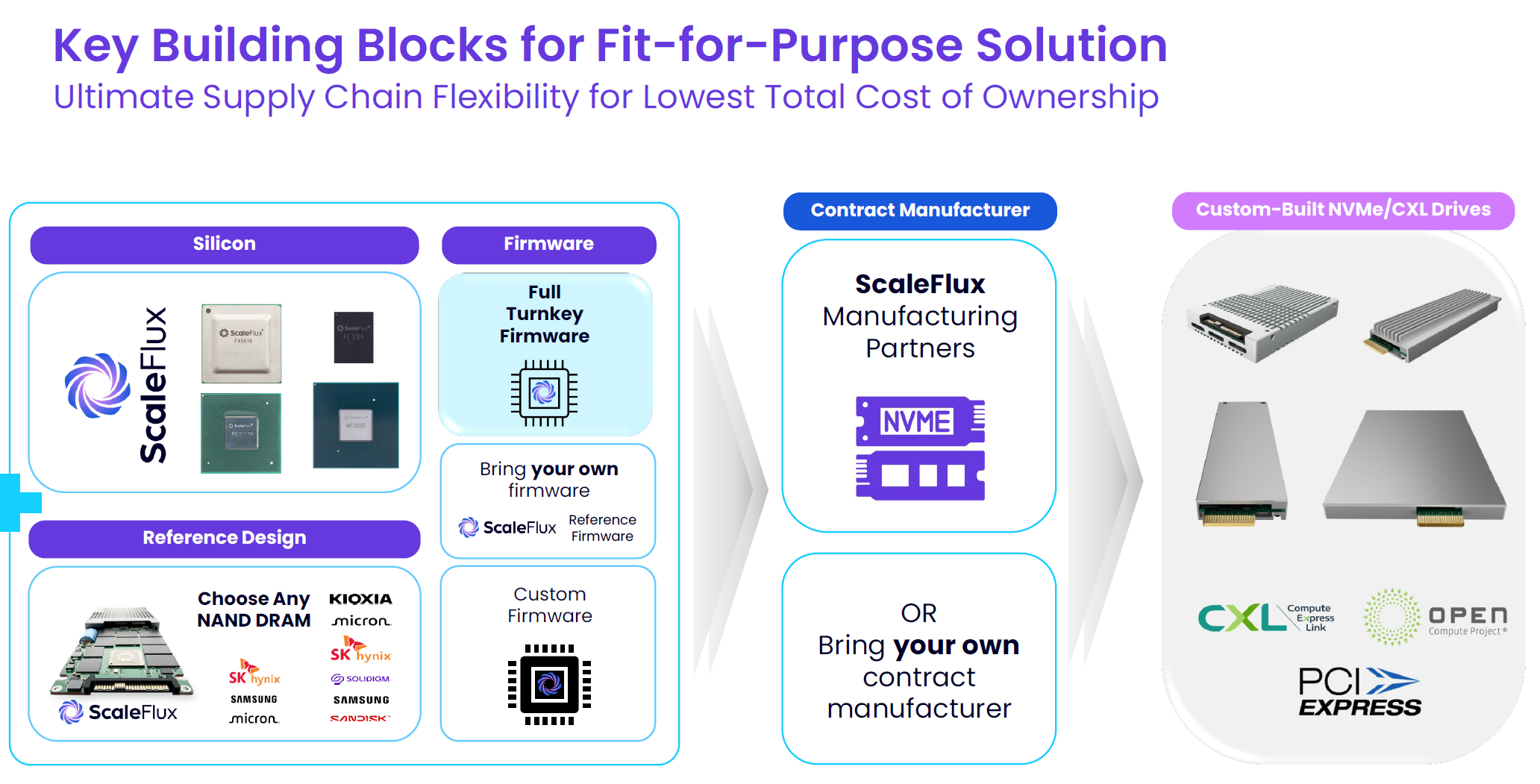
At the IT Press Tour, ScaleFlux presented its PCIe 6.0 SSD controller FC6116 and CXL controller MC600, and explained why it now sells silicon, firmware and reference designs instead of drives.
Computational storage was ScaleFlux’s founding idea. Today the company describes itself as a silicon platform provider for the AI data pipeline. At the IT Press Tour #70 at its Milpitas headquarters on 7 October 2026, executives explained how a PCIe 6.0 SSD controller and a CXL memory controller are meant to ease data-movement bottlenecks between GPU, memory and storage.
A bottleneck described in numbers
ScaleFlux frames the problem around the GPU, the most expensive component in an AI cluster. According to the company, a GPU handles roughly 20 to 22 TB/s and expects responses in about two milliseconds. DDR5 is 37 to 40 times slower, a PCIe 6.0 SSD 750 to 800 times. “Storage is becoming important again,” said CEO Hao Zhong, recalling that acceleration first reached GPUs and then network processors.
The second challenge is supply. For 2027, ScaleFlux cites nine to ten million GPUs with about 3 EB of HBM, 20 to 30 EB of DRAM for 20 to 25 million enterprise servers, and 500 to 600 EB of enterprise NAND for 55 to 60 million SSDs. In the company’s illustrative estimate, roughly 94 percent of memory demand falls on AI data centres and enterprise SSDs. Third, training, inference caches, hyperscale compute, neoclouds and boot drives each need different capacities, cooling and latency profiles. Management argued that enterprise boot drives, for instance, cannot be derived from client designs because of security and latency requirements.
Computational storage, which ScaleFlux pioneered after its founding in 2014, has widened accordingly. Zhong said the early use cases of filtering, search, compression and encryption now extend to vector computing and data preparation for AI. Data should move only when necessary, he argued, so acceleration has to happen at several stages of the pipeline rather than in the processor alone. Transparent compression on SSDs, the company’s signature feature, found limited uptake at first; ScaleFlux says hyperscalers have only recently learned to exploit it at stack level.
Two controllers, sampling since FMS 2026
The company’s answers are two chips announced at FMS 2026. The FC6116 is a 16-channel NVMe SSD controller for PCIe 6.0 with up to 28 GB/s and, depending on the NAND, up to 7 million IOPS. It supports TLC and QLC NAND, capacities from 512 GB to 256 TB and E1.S, E3.S and U.2/U.3 form factors, at about 9 W typical active power. ScaleFlux also cites more than 200 Flexible Data Placement streams per SSD for KV-cache workloads and endurance of up to 10 drive writes per day on standard TLC NAND, achieved through the controller alone. The PCIe 5.0 predecessor FC5116 is in production. General availability of the FC6116 is targeted for mid-2027, depending on customer qualification.
The MC600 is a CXL 3.2 controller with PCIe 6.0 for DDR4 and DDR5 with up to 2 TB capacity. ScaleFlux specifies about 60 nanoseconds round-trip latency at queue depth 1 at controller level, without DRAM, and under 9 W typical. Security features include PCIe IDE and OCP Caliptra 2.0. The company positions CXL as a “G2.5” tier between HBM/DRAM and SSD, within a model that also lists local SSDs (G3), context storage for KV caches (G3.5) and network storage (G4). Compression for DRAM remains unannounced: Zhong called it too early and promised details next year. CXL attached to NAND is, by his account, still at an early pilot stage.
From drive vendor to ecosystem enabler
The more notable shift is commercial. ScaleFlux offers four engagement models: custom SoCs for customers’ own logos, merchant controllers with turnkey firmware, reference-design solutions built by contract manufacturers, and ScaleFlux-branded modules. Partners in the “ScaleFlux Driven” programme include Avant, Memblaze, TWSC, Unigen, VAST and Hosinglobal. Zhong compared the approach with processor vendors that leave server assembly to others and called the company a “chip plus solution” provider. It works with all major NAND and DRAM suppliers, among them Kioxia, Micron, SK hynix, Samsung, Solidigm and Sandisk according to its slides, which it presents as an answer to allocation shortages. Customers are hyperscalers, memory makers and contract manufacturers supplying neocloud and server OEMs.
Entry thresholds are high. ScaleFlux expects volumes of hundreds of thousands of units for custom firmware and commitments above 10 million US dollars for a custom ASIC; smaller orders go to module partners. The company, with more than 300 employees, said it has raised over 700 million US dollars to date. Customer names remain confidential because of non-disclosure agreements. Zhong added that the company has been quiet in recent years while investing heavily in the new products.
Dr. Jakob Jung is Editor-in-Chief of Security Storage and Channel Germany. He has been working in IT journalism for more than 20 years. His career includes Computer Reseller News, Heise Resale, Informationweek, Techtarget (storage and data center) and ChannelBiz. He also freelances for numerous IT publications, including Computerwoche, Channelpartner, IT-Business, Storage-Insider and ZDnet. His main topics are channel, storage, security, data center, ERP and CRM.
Contact via Mail: jakob.jung@security-storage-und-channel-germany.de