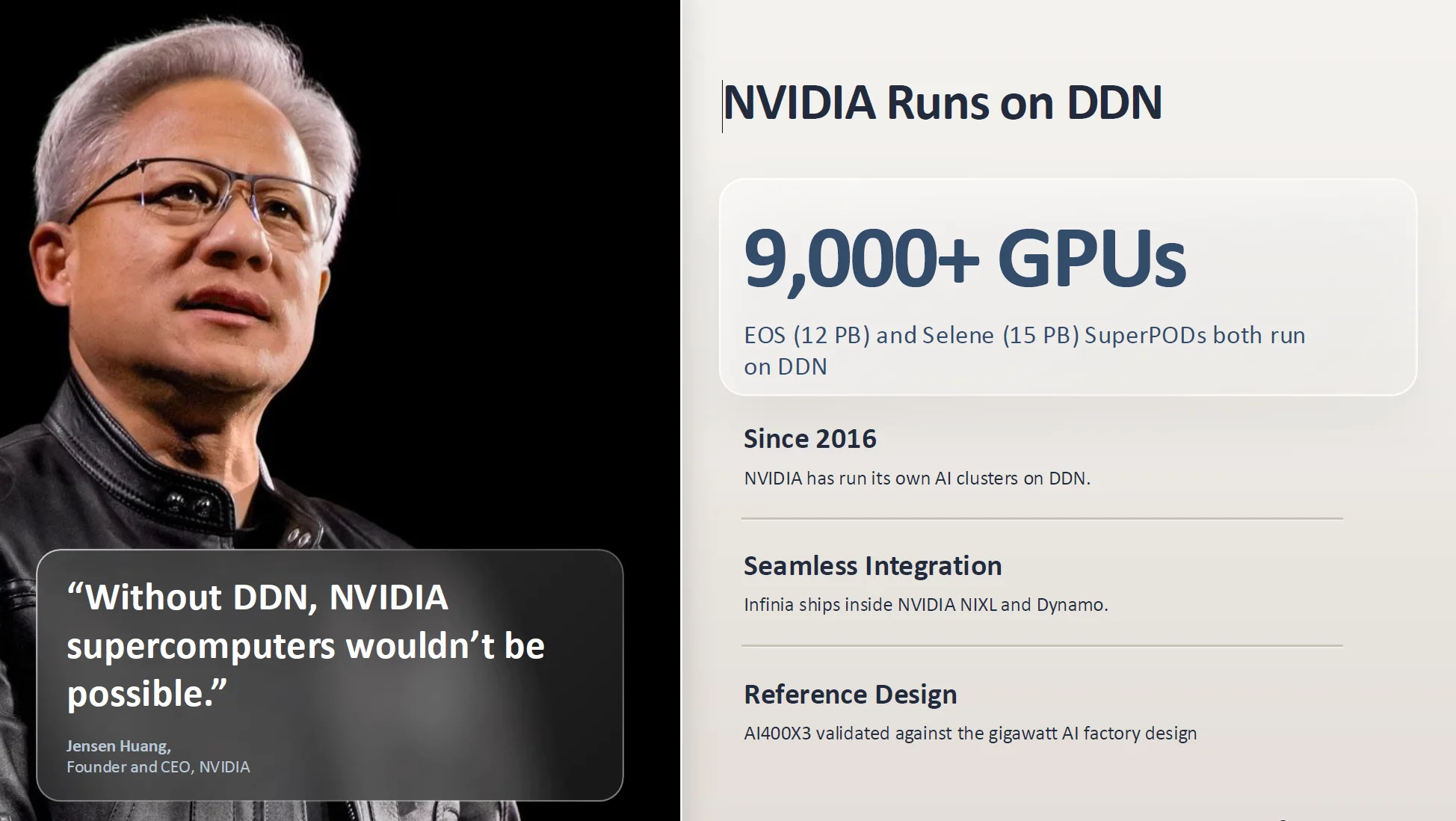
At the 70th IT Press Tour, DDN presented two data engines for AI training and inference. According to the company, they are meant to lift GPU utilization at a time when power and capacity are scarce.
DDN is positioning its data platform as a lever for AI profitability: the more of each GPU’s time goes into productive work instead of waiting for data, the better the economics for cloud providers and enterprises. At the 70th IT Press Tour, the vendor said its bookings are growing threefold year over year.
Demand for compute is outrunning supply, said Kevin Delane, DDN’s president and chief revenue officer. The company’s goal is to push GPU utilization toward 99 to 100 percent, so that existing hardware earns more while supply chains catch up. Delane cited Gartner figures from August 2026: spending on AI-optimized infrastructure as a service is expected to reach 42 billion US dollars this year, nearly double 2025. Inference accounts for 23.3 billion dollars, or 55 percent, and leads training for the first time.
According to DDN, bookings are growing threefold year over year. Delane said the company had already doubled this year and expected to exceed threefold growth by year-end. DDN counts more than 5,000 customers and over one million GPUs served, spread across neoclouds, sovereign AI providers, government, healthcare, finance and enterprises. The leadership team has been rebuilt in recent months, including a chief marketing officer who joined only weeks ago. Chief Product Officer Omer Asad noted that many users of Google’s training service do not know DDN runs underneath; more customer logos and brand work are to follow.
The Google and Nvidia relationships carry much of that story. Asad described Google’s Managed Lustre as a first-party service built on DDN’s EXAScaler, not a marketplace listing: Google bills customers and pays DDN in the background. Nvidia, DDN’s most important partner, runs more than 9,000 GPUs on DDN storage, according to Delane, including the Eos and Selene SuperPODs. Asad added that models such as Mistral and Nvidia’s Nemotron were trained on DDN systems.
Asad argued that the data layer becomes a bottleneck before a data center reaches its power limit. Each stage of the AI pipeline puts conflicting demands on storage: training needs massively parallel reads, checkpoints suddenly produce bursty writes while thousands of GPUs wait, and inference brings random reads. Cloud providers must also keep tenants apart. DDN’s answer is two engines under one management layer. EXAScaler, a Lustre-based parallel file system developed further since DDN acquired Whamcloud, targets training. Asad said there are no plans to replace it with Infinia.
For EXAScaler, DDN reports 190 GB/s from a two-rack-unit appliance and 96 percent network utilization in Nvidia’s DGX SuperPOD reference design. The company cites up to 15 times faster checkpointing and, for Salesforce on Google Managed Lustre, 1.5 times faster training at 42 percent lower cost. Yotta’s Shakti Cloud in India reports 99 percent GPU utilization across tenants on 8,000 Nvidia B200 GPUs.
Infinia, built over about four years, is the newer engine. It is a distributed key-value store that exposes S3, POSIX and a native KV cache interface, and it runs as software on qualified hardware from partners such as Supermicro, Dell and Lenovo. Its plugin ships inside Nvidia’s Dynamo and NIXL, so a model’s KV cache is loaded over RDMA directly into GPU memory instead of being recomputed. DDN states a 4.2 times faster time to first token at 100,000 tokens of context. In an audited object storage test on Oracle Cloud Infrastructure, Infinia reached 225,000 GET and 194,000 LIST requests per second.
The largest deployment serves a frontier AI lab with 700 petabytes across four data halls and peaks at 6.4 terabytes per second of GET throughput, according to DDN. Clusters of more than 300 nodes run in a single namespace. Around 15 Infinia installations are in production, ranging from seven to over 300 nodes.
Journalists pressed on how the engines relate. Asad said they exchange data and that the use case decides: Infinia leads where object access dominates, EXAScaler where training at 100,000 GPUs or more is required. Asked about funding plans and valuation, Delane gave no details and pointed to the company’s growth. Asad said native Kafka and vector database interfaces are planned for next year, and that DDN also works with AMD and Google’s TPUs, while Delane called Nvidia the fastest path to growth.
The discussion also turned to infrastructure limits. Delane noted that data centers are easier to build outside the US, which is why Asia-Pacific is currently growing faster for DDN than North America and Europe. Asad said DDN uses AI tools internally for code review and test generation as well as for analyzing customer telemetry, and has moved to release cycles of under three months. A colleague added that raising utilization of GPUs already deployed matters because power, permits and community resistance are slowing new capacity.

Dr. Jakob Jung is Editor-in-Chief of Security Storage and Channel Germany. He has been working in IT journalism for more than 20 years. His career includes Computer Reseller News, Heise Resale, Informationweek, Techtarget (storage and data center) and ChannelBiz. He also freelances for numerous IT publications, including Computerwoche, Channelpartner, IT-Business, Storage-Insider and ZDnet. His main topics are channel, storage, security, data center, ERP and CRM.
Contact via Mail: jakob.jung@security-storage-und-channel-germany.de