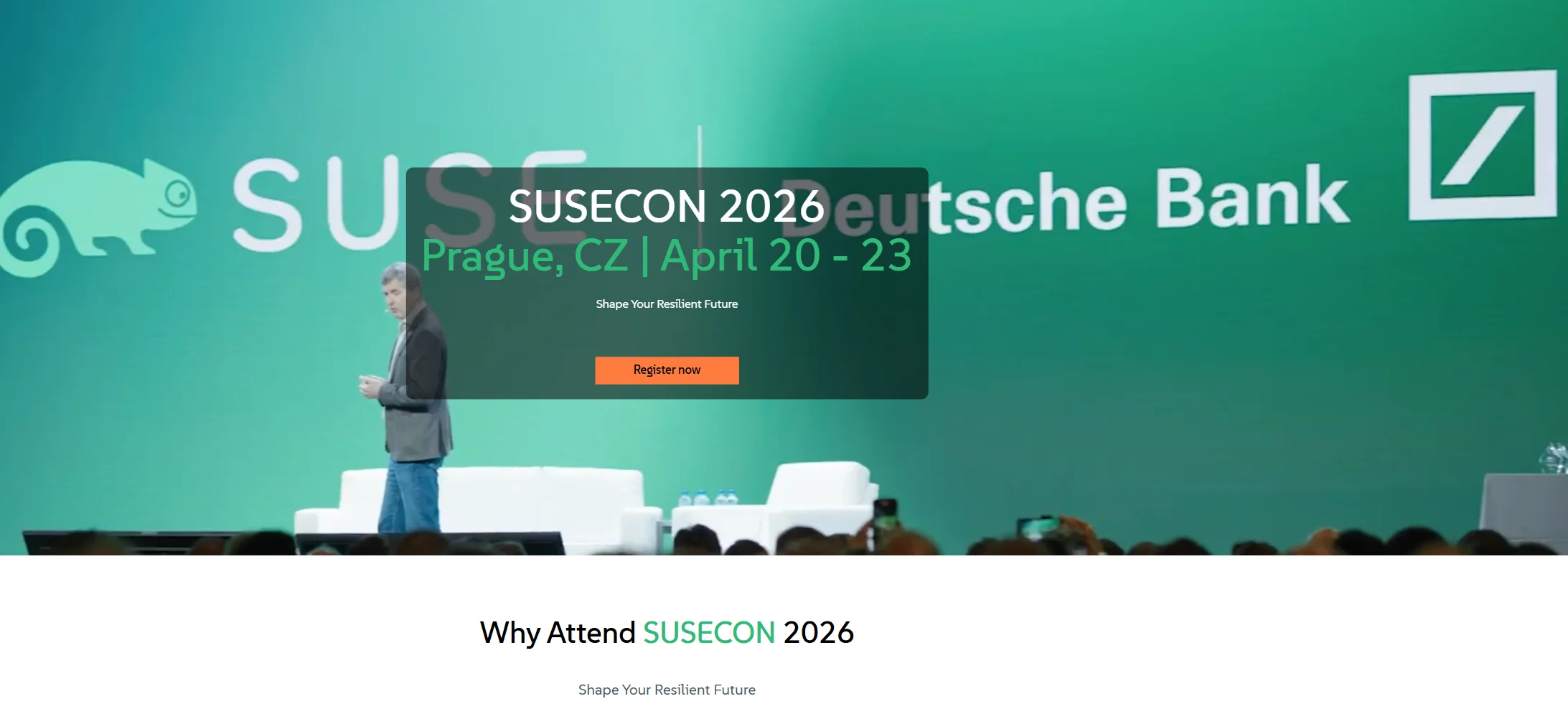
At SUSECON Prague, SUSE launched a new AI platform with NVIDIA, released research revealing a critical gap in digital sovereignty execution, and honored a dozen global customers for technological innovation.
At its annual SUSECON conference held in Prague, enterprise open source solutions provider SUSE unveiled a series of strategic announcements. The event, which took place on April 20-21, 2026, served as a platform for the company to launch a major artificial intelligence product, present new research on the state of digital sovereignty, and recognize a dozen customers for their technological achievements.
Bridging the AI Prototype-to-Production Gap
The central product announcement at the conference was the SUSE AI Factory with NVIDIA, an integrated platform designed to streamline the deployment of AI workloads from development to production. The solution addresses a common industry challenge: the “hidden technical debt” of AI, which includes managing GPU drivers, securing model supply chains, and ensuring consistency across different environments.
The SUSE AI Factory is architected as a unified stack, combining the SUSE AI stack with NVIDIA AI Enterprise software. Its core components include SUSE Linux Enterprise Server (SLES) and SUSE Rancher Prime for orchestration, alongside NVIDIA NIM microservices and NeMo framework for model customization. The platform aims to simplify AI operations through “blueprint-driven deployment,” offering pre-validated templates for use cases like Retrieval-Augmented Generation (RAG).
A key feature of the platform is its support for both ClickOps (UI-driven) and GitOps (code-driven) management styles, facilitated by Rancher’s Fleet for continuous delivery. The solution is designed with a focus on data sovereignty, allowing organizations to maintain control over their data, models, and intellectual property within their own infrastructure. SUSE will provide a single point of support for the entire stack, including L1 and L2 support for NVIDIA components.
The Digital Sovereignty Paradox
Concurrently with the conference, SUSE released its Navigating Digital Resilience report, based on a survey of 309 IT leaders across France, Germany, India, Japan, and the United States. The research highlights a significant gap between ambition and execution regarding digital sovereignty.
According to the findings, 98% of enterprises prioritize digital sovereignty, yet only 52% report actively taking steps to achieve it. This gap, termed a “sovereignty paradox,” appears to be driven by the urgency to adopt AI. The research indicates that even with a hypothetical 20% budget increase, organizations overwhelmingly prioritize AI initiatives over sovereignty efforts, suggesting a tension between innovation speed and foundational control.
External pressure remains the primary catalyst for action, with 41% of respondents stating they only act on sovereignty when required by customers or regulations. AI transparency—control over model training and data provenance—was identified by 64% of IT leaders as the top driver of digital resilience in the next five years. Regionally, India showed the highest level of active investment (62%), while France reported the lowest (39%). The study also found that 65% of enterprises still rely on hyperscalers for sovereign workloads, highlighting a complex balancing act between scale and jurisdictional control.
Recognizing Global Innovation
SUSE also announced the winners of its 2026 Customer Awards, honoring 12 organizations across four continents. The awards recognized achievements in several categories, including AI acceleration, edge innovation, and digital sovereignty.
Airbus Defense & Space and Dienst ICT (DICTU) were jointly honored as Digital Sovereignty Pioneers. Airbus was recognized for co-engineering a Kubernetes security framework with SUSE to meet stringent national cybersecurity requirements. DICTU, a Dutch public sector IT provider, was cited for rapidly deploying a secure healthcare gateway using SUSE Rancher Prime during the pandemic.
FETC (Far Eastern Electronic Toll Collection) won the AI Accelerator award for using SUSE Edge to reduce smart parking site deployment times from one hour to ten minutes. Nexi Group, a European digital payments leader, was named Cloud Native Champion for increasing operational efficiency by 80% while maintaining 99.99% service continuity. In the Edge Innovator category, CVS Health and Carnival Corporation were recognized for large-scale deployments across pharmacy locations and a fleet of over 90 ships, respectively.
Other winners included Grupo Elektra (Geeko Innovation Award), Omnicell (Innovation for Good), and the Swiss National Supercomputing Center (CSCS) (Virtualization Visionary). The awards underscored the diverse ways enterprises are applying open source solutions to mission-critical challenges.
Expanded Ecosystem and Migration Support
Beyond the mainstage announcements, SUSE disclosed two additional partnerships. The company’s portfolio is now available on the Oracle Marketplace, allowing customers to deploy SUSE Linux and Rancher solutions within Oracle Cloud Infrastructure. Furthermore, SUSE announced a partnership with Cloudbase Solutions to automate the migration of virtualized workloads to hybrid cloud environments, addressing a key challenge for organizations modernizing their infrastructure.
Taken together, the announcements from SUSECON Prague 2026 portray an enterprise software landscape where managing complexity, ensuring data control, and bridging the gap between development and operations are the central challenges for IT leaders.

Carolina Heyder is a business analyst and moderator with extensive experience in the German and international IT market. She has worked for many years at renowned European trade publishers such as WEKA Fachmedien, Vogel IT Medien, Springer, and Aspencore. She creates content for both web and print media and is an expert in front of the microphone and camera. Thanks to her fluency in German, English, and Spanish, as well as her Chilean roots, she brings a global and intercultural perspective to topics such as cybersecurity, artificial intelligence, digital transformation, sustainability, and other key areas of the IT sector.