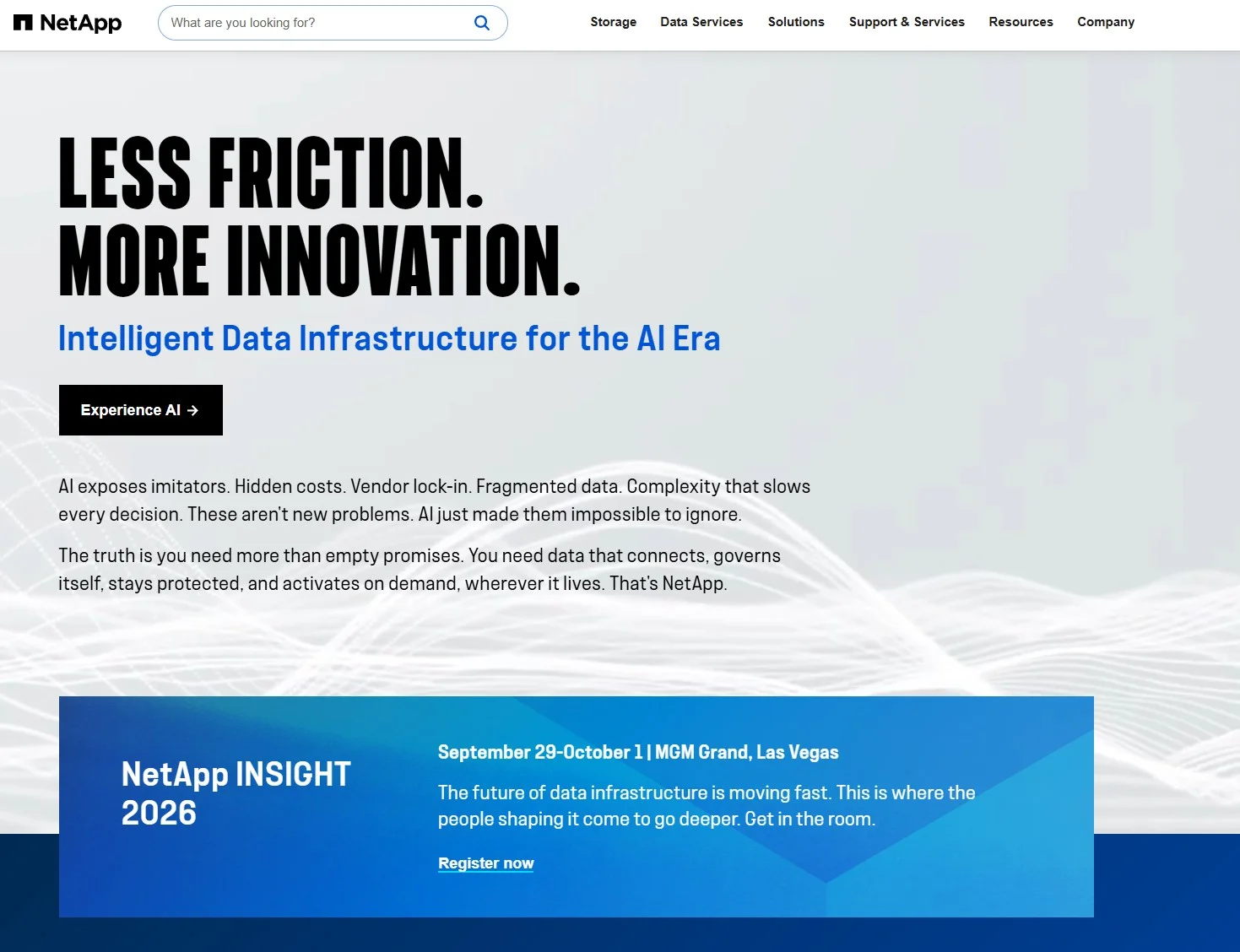
NetApp plans to acquire PEAK and combine its metadata and parallel file system technology with ONTAP. The goal is a storage architecture designed for large AI environments and growing GPU clusters.
NetApp plans to acquire UK-based software company PEAK as part of an effort to expand its architecture for AI infrastructure. The storage vendor intends to address the requirements of large-scale file environments and highly parallel workloads by combining PEAK technology with its ONTAP data management software.
PEAK develops technology for metadata management, global namespaces and parallel NFS access. NetApp says these capabilities could complement ONTAP as AI infrastructures grow in scale and GPU clusters require access to increasingly large and complex datasets.
According to NetApp, traditional storage architectures were not designed for the scale, concurrency and performance requirements associated with AI factories, AI clouds and other data-intensive applications. As GPU clusters expand, storage systems have to serve a growing number of parallel operations without becoming a bottleneck for available compute resources.
NetApp is therefore working on an architecture that separates metadata services from data services and allows metadata to scale independently. The company says the planned architecture is intended to support environments containing trillions of files and data volumes measured in multiple exabytes.
Metadata as a key component
PEAK develops software-defined storage for AI and data-intensive workloads. According to NetApp, its technology originated in collaborations with research institutions including Los Alamos National Laboratory and Carnegie Mellon University. The company says its platform is already deployed at several research and other organizations.
The planned integration centers on combining PEAK’s metadata architecture with NetApp ONTAP. PEAK would contribute metadata scalability, a global namespace and parallel NFS-based access. ONTAP would provide the underlying data architecture and existing data-management capabilities.
The separation of metadata and data processing is particularly relevant for AI environments because training and analytics workloads can involve very large numbers of files and concurrent operations. A storage system has to coordinate these requests without limiting the utilization of GPU resources.
NetApp says the planned architecture could help reduce data-related GPU stalls and improve infrastructure efficiency. The company also expects it to simplify the deployment and operation of shared storage in larger AI environments. These statements describe the intended architecture and remain subject to future product development.
Planned integration with ONTAP
NetApp describes an evolution path for existing ONTAP customers. The PEAK technology is expected to add specialized metadata services and parallel namespace capabilities while retaining the resilience, security and operational characteristics associated with ONTAP.
PEAK is based in Manchester, UK, and develops software-defined storage for AI workloads. According to the company, its platform can scale from individual server configurations to exabyte-scale environments and run on industry-standard hardware. NetApp lists deployments at organizations including Los Alamos National Laboratory, Carnegie Mellon University and the Oxford Robotics Institute.
The proposed transaction is part of NetApp’s broader expansion in AI infrastructure. The company has also expanded its portfolio through acquisitions including DataPelago and JetStream Software. PEAK would add another technology component focused specifically on storage architecture for highly parallel AI workloads.
NetApp did not disclose financial terms for the planned transaction. Closing remains subject to customary conditions and regulatory approvals. The company also states that descriptions of future integration and potential product capabilities are forward-looking statements. The actual development, release and timing of those capabilities remain subject to change.

Dr. Jakob Jung is Editor-in-Chief of Security Storage and Channel Germany. He has been working in IT journalism for more than 20 years. His career includes Computer Reseller News, Heise Resale, Informationweek, Techtarget (storage and data center) and ChannelBiz. He also freelances for numerous IT publications, including Computerwoche, Channelpartner, IT-Business, Storage-Insider and ZDnet. His main topics are channel, storage, security, data center, ERP and CRM.
Contact via Mail: jakob.jung@security-storage-und-channel-germany.de