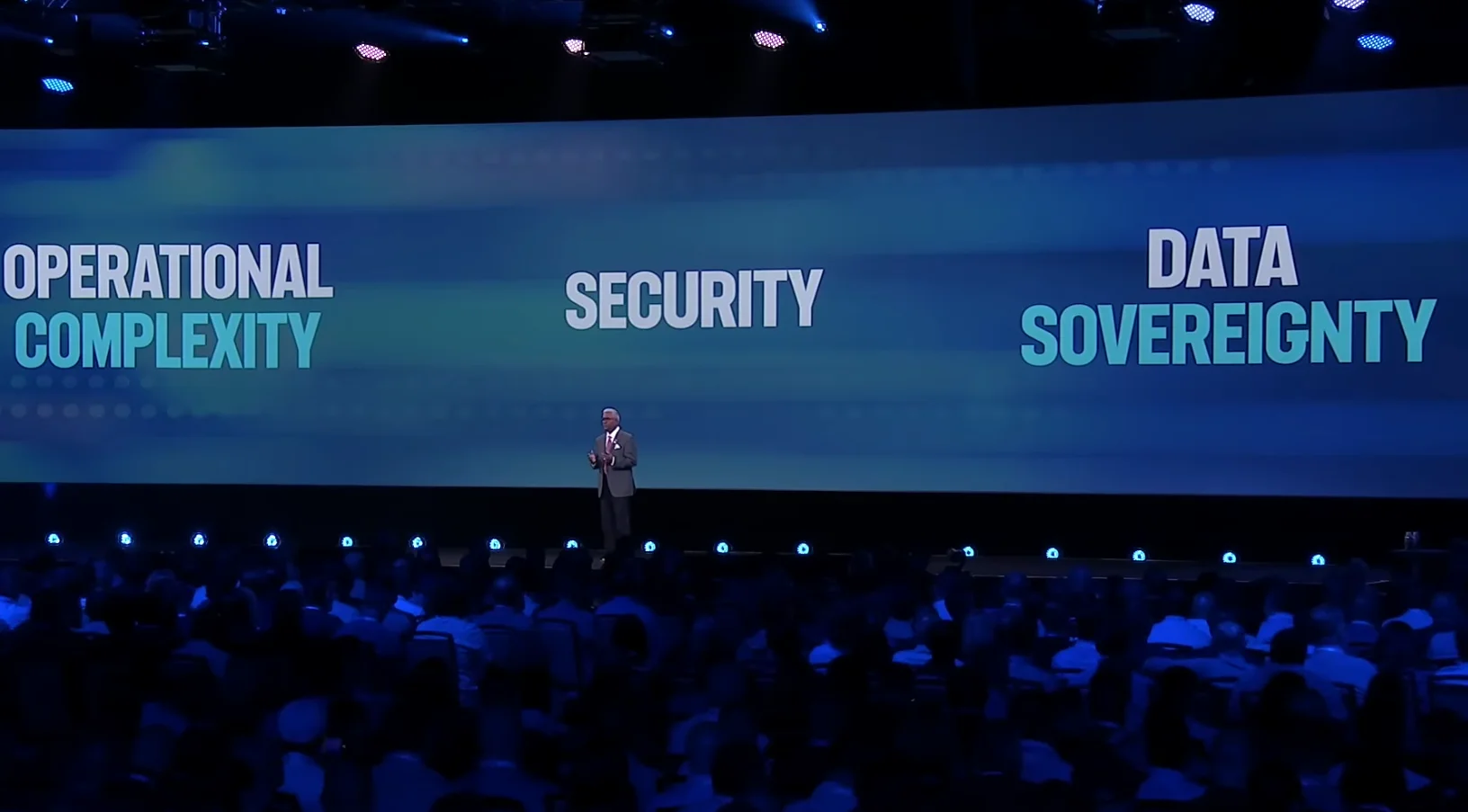
At its INSIGHT 2026 conference, NetApp announced three key data management initiatives. Featuring the new Novus storage architecture, updates to the AI Data Engine, and new sovereign storage capabilities, the developments address enterprise data bottlenecks in AI environments.
The rapid adoption of artificial intelligence presents significant infrastructure challenges for enterprise IT organizations. According to research cited by NetApp, 93 percent of enterprises report data-related obstacles that hinder their AI projects. A primary factor is data fragmentation, with an estimated 85 percent of enterprise data residing in unstructured formats across disparate storage arrays, edge locations, and public clouds.
To resolve throughput bottlenecks in high-density computing facilities, NetApp introduced NetApp Novus, a dedicated storage architecture designed for AI factories. Novus decouples metadata processing from data storage, allowing both components to scale independently. According to technical specifications, the architecture achieves throughput levels of up to 100 terabytes per second, aimed at maintaining high GPU utilization rates. The underlying architecture is engineered to support zettabyte-scale file systems while utilizing a distributed key-value store to flatten directory hierarchies for low-latency lookups.
In addition to infrastructure throughput, autonomous AI agents require direct access to distributed enterprise data. Historically, providing data access involved constructing complex data pipelines and generating duplicate data copies. Through updates to its AI Data Engine, NetApp introduced zero-copy data activation. The system indexes and classifies unstructured data directly at its original location across NetApp ONTAP, StorageGRID, and third-party storage systems while preserving established access control lists (ACLs). NetApp is offering a six-month trial period for organizations to map their data environments without initiating data transfers.
The final component addresses regulatory compliance and operational resilience. NetApp launched Keystone Sovereign, an extension to its Storage-as-a-Service model that provides dedicated sovereign storage configurations. Initial deployment begins in France and Germany to meet regional data protection requirements. Furthermore, NetApp deepened its cybersecurity integrations with Commvault, enabling automated recovery workflows using immutable data snapshots following ransomware incidents.
SAP Cooperation
“SAP Cloud Infrastructure is the foundation for secure, resilient and sovereign digital transformation,” said Jonathan Bletscher, SVP, Head of Infrastructure Platform Engineering & Delivery, SAP SE. “Together with NetApp, we are exploring ways to strengthen the infrastructure and data layer that enables SAP applications, SAP Business AI Platform and customer workloads to run with the performance, availability and security our customers expect.”
In addition, NetApp plans to explore joint go-to-market initiatives with SAP to help customers accelerate their cloud transformation journeys. These initiatives will focus on enabling customers to migrate, modernize and operate SAP and non-SAP workloads on SAP Cloud Infrastructure with enterprise-grade performance, resilience, security and operational consistency.

Dr. Jakob Jung is Editor-in-Chief of Security Storage and Channel Germany. He has been working in IT journalism for more than 20 years. His career includes Computer Reseller News, Heise Resale, Informationweek, Techtarget (storage and data center) and ChannelBiz. He also freelances for numerous IT publications, including Computerwoche, Channelpartner, IT-Business, Storage-Insider and ZDnet. His main topics are channel, storage, security, data center, ERP and CRM.
Contact via Mail: jakob.jung@security-storage-und-channel-germany.de
My firm struggled with the Novus storage requirements during the initial pilot phase.