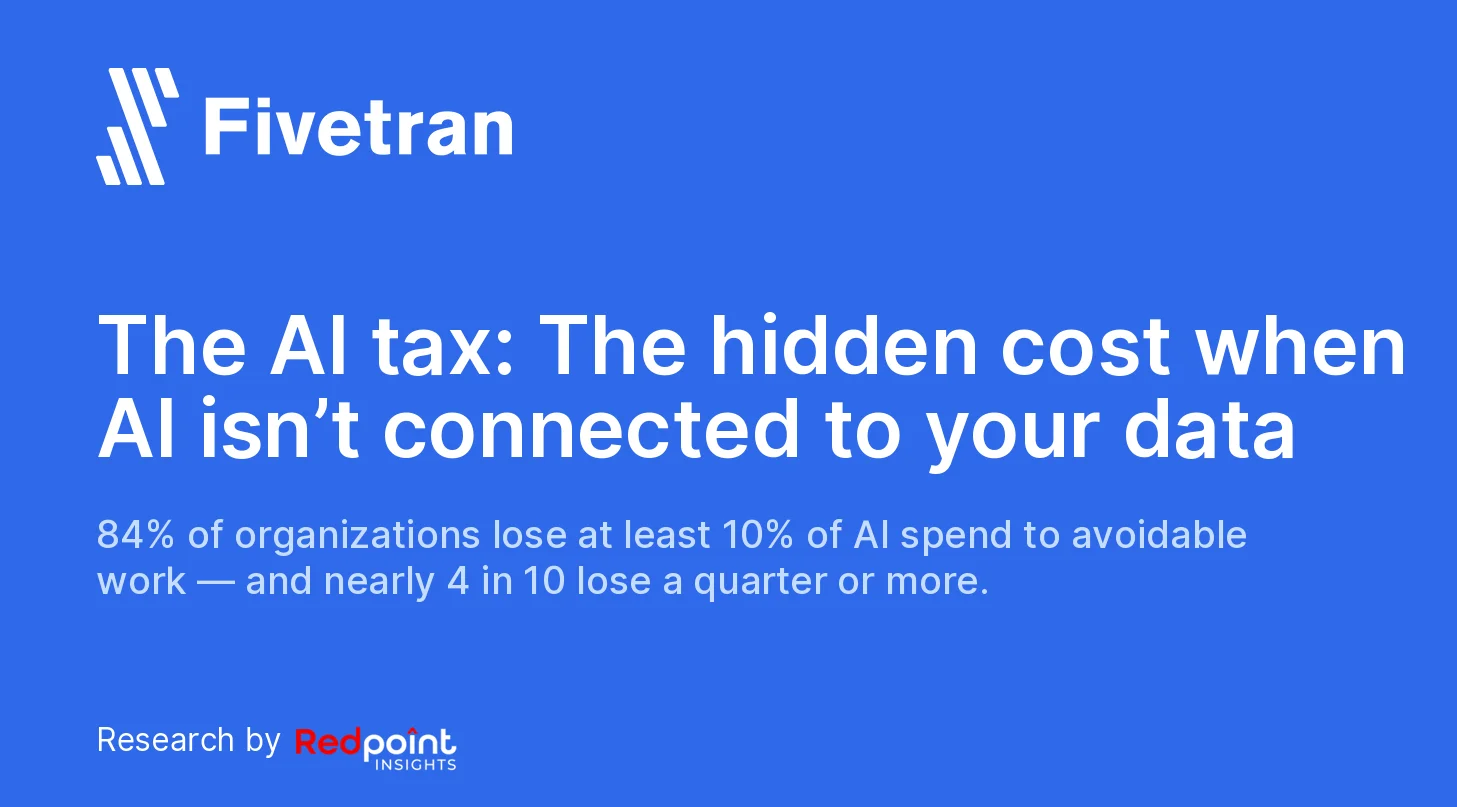
Research by Redpoint Insights for Fivetran shows that 84 percent of organizations lose at least 10 percent of their AI spend to avoidable work. For nearly four in ten, the losses reach a quarter or more.
Enterprises are investing heavily in artificial intelligence, yet a significant share of that money never turns into business value. According to new research by Redpoint Insights for data integration vendor Fivetran, 84 percent of organizations lose at least 10 percent of their AI spend to avoidable work. Nearly four in ten lose a quarter or more. The study calls this hidden cost the “AI tax,” and it is levied whenever AI is not connected to the data it depends on.
The finding puts a number on a frustration many IT leaders know well. AI models and applications are only as useful as the data they can reach. When information sits in silos, arrives late or has to be cleaned and reshaped for every new project, teams spend their time on workarounds instead of results. Pipelines are built by hand, data is copied between systems, and outputs are checked and corrected manually. None of this appears on the invoice for the AI platform, but it consumes budget, engineering hours and patience all the same.
The scale is what makes the figures notable. A ten percent loss would already be a considerable leak in any budget line, and the research suggests it is the minimum for the vast majority of organizations rather than the exception. That nearly four in ten report losses of 25 percent or more means that, for a sizeable group, a quarter of every euro or dollar earmarked for AI goes into work that better-connected data could have avoided.
The result fits a pattern in Fivetran’s recent research. In a survey of 401 data leaders conducted in early 2025, 41 percent said the lack of real-time data access prevented AI models from delivering timely insights. Another 29 percent named data silos as a blocker, and 38 percent reported higher operating costs as a consequence of failed AI projects. A 2026 readiness index found that only 15 percent of organizations were fully prepared to support agentic AI in production, even though nearly 60 percent reported investing millions to tens of millions in the technology.
The timing matters. As companies move from pilots to production, and from assistants that suggest to agents that act, the demands on the data foundation rise. Information has to be fresh, governed and traceable. An agent working with outdated or incomplete data does not merely deliver a weak answer; it may act on it. Every manual patch that compensates for a missing connection then becomes both a cost and a risk.
A sensible first step is an honest accounting. Where do teams currently spend time moving, reconciling or correcting data for AI projects, and what does that effort cost? Once that number exists, the case for automated, reliable data pipelines becomes a budgeting question rather than a purely technical one.
For the channel, the findings are a reminder that AI projects rarely stall at the model layer. Integrators and resellers who can connect, govern and maintain data pipelines may find their services in demand, and they have a stronger business case to offer than another round of pilots.

Dr. Jakob Jung is Editor-in-Chief of Security Storage and Channel Germany. He has been working in IT journalism for more than 20 years. His career includes Computer Reseller News, Heise Resale, Informationweek, Techtarget (storage and data center) and ChannelBiz. He also freelances for numerous IT publications, including Computerwoche, Channelpartner, IT-Business, Storage-Insider and ZDnet. His main topics are channel, storage, security, data center, ERP and CRM.
Contact via Mail: jakob.jung@security-storage-und-channel-germany.de