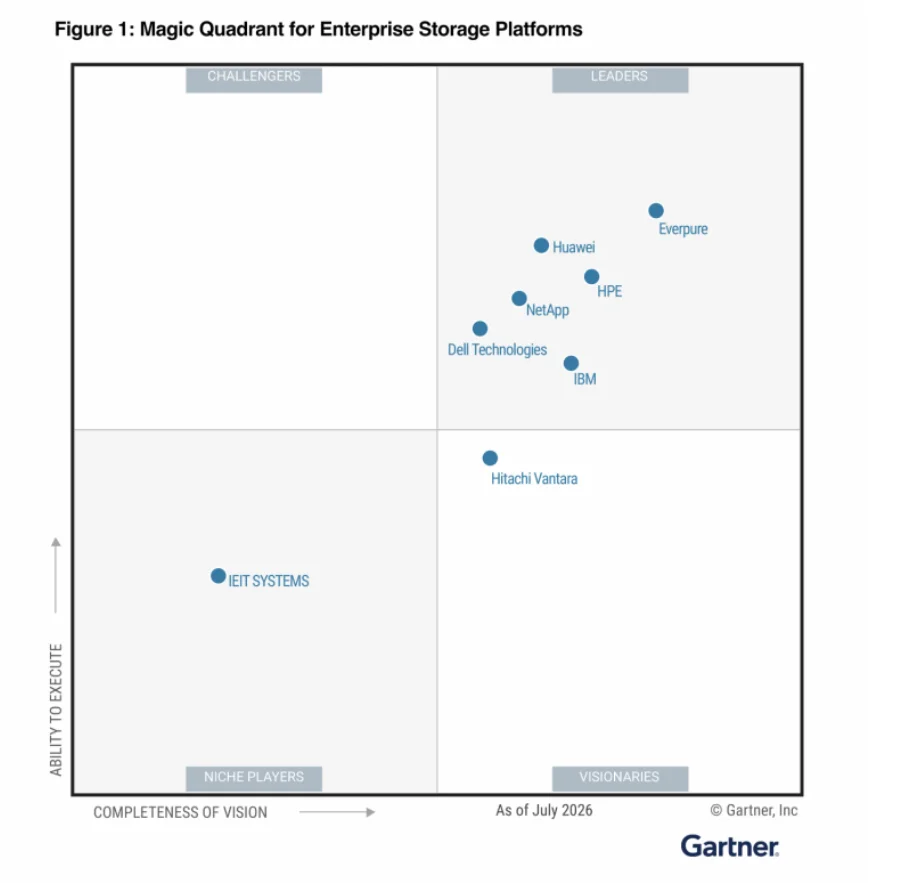
Gartner 2026 Enterprise Storage Market Magic Quadrant tracks a market reshaped by AI workloads, surging component prices and a new front line in cyber defense.
Gartner has published its 2026 Magic Quadrant for Enterprise Storage Platforms, naming Dell Technologies, Everpure, HPE, Huawei, IBM and NetApp as Leaders in a market the analyst firm describes as undergoing structural change unlike anything seen before. Hitachi Vantara was positioned as the sole Visionary, IEIT SYSTEMS as the only Niche Player, and no vendor qualified as a Challenger in this year’s edition, dated 19 August 2026.
The report, authored by Gartner analysts including Jeff Vogel and Joseph Unsworth, evaluates vendors on their ability to unify block, file and object storage under a single, centrally managed control plane — capabilities Gartner says are increasingly table stakes as enterprises consolidate infrastructure and lean on AI-driven telemetry to run it.
Among the notable shifts in this year’s line-up, Pure Storage appears under its new corporate identity, Everpure, continuing to build out what it calls its Enterprise Data Cloud vision through its Fusion platform and the recent acquisition of data-intelligence specialist 1touch. DDN, present in prior editions, has been dropped from this year’s report, while Lenovo-owned Infinidat received an honorable mention outside the formal evaluation, months after Lenovo completed its acquisition of the vendor in April 2026.
Four forces, according to Gartner, are driving the upheaval: extreme volatility in component supply chains, the shift toward production-scale artificial intelligence, hypervisor replatforming triggered by licensing changes at VMware, and the merging of data storage with cyber resilience.
On pricing, Gartner points to a sharp divergence between flash and disk economics over the past year, with the price per gigabyte of enterprise SSDs climbing more than fifteen times faster than that of nearline hard drives. The firm expects the storage-constrained, high-cost environment to persist at least through 2028, forcing IT leaders to rethink budgeting and procurement. Despite the SSD boom driven by AI demand, Gartner argues hard disks and even tape will remain essential well into the next decade as a cost-effective tier for “warm” data beneath faster, more expensive flash.
Artificial intelligence is also redefining how storage performance itself gets measured. Gartner notes that the primary bottleneck in AI infrastructure has shifted from GPU compute to the data layer, pushing buyers to weigh metrics such as cost per token and tokens per watt-hour alongside traditional capacity figures. That is pushing vendors toward “in-place” AI architectures that index, tag and vectorize data directly within the storage system, rather than moving it through separate pipelines.
Cybersecurity is the fourth pressure point. Gartner forecasts that by 2029, all storage products will need active-defense “cyberstorage” capabilities that go beyond simple recovery — up from just a quarter of products in early 2026 — as ransomware attacks grow fast and automated enough to encrypt entire file systems within minutes. The firm argues responsibility for disaster recovery is shifting from IT operations toward CISOs and risk leaders as a result.
The vendor write-ups highlight sharply different strategic bets. Dell is leaning on its AI Data Platform and a purpose-built Lightning File System validated for Nvidia’s DGX SuperPOD systems, though Gartner flags that its storage lines still run on separate architectures for structured and unstructured data. Everpure’s Evergreen//One subscription model and Pure1 telemetry draw praise for predictability, but the firm’s premium pricing and lack of a cross-platform global namespace remain cited weaknesses. Huawei combines high-density, vertically integrated hardware with early moves toward post-quantum cryptography, though geopolitical export constraints continue to limit its footprint outside its home markets.
IBM, meanwhile, is pushing agentic management deeper into its FlashSystem portfolio and embedding ransomware detection directly into its flash modules, promising threat identification within 60 seconds — even as Gartner notes the vendor still lacks a fully unified platform across structured and unstructured workloads. NetApp, for its part, is betting on cloud-native integration with AWS, Azure and Google Cloud alongside Mexico-based manufacturing designed to insulate customers from tariff swings, though its premium pricing and reliance on a separate StorageGRID product for object storage at scale draw continued criticism.
For heads of infrastructure and operations, Gartner’s guidance is direct: shift storage sourcing from capital spending to SLA-backed, consumption-based services; design AI infrastructure around in-place data processing rather than manual extract-transform-load pipelines; favor hypervisor-agnostic platforms as VMware workloads migrate elsewhere; and treat active, in-line cyberstorage defense as a baseline requirement rather than an optional extra.

Dr. Jakob Jung is Editor-in-Chief of Security Storage and Channel Germany. He has been working in IT journalism for more than 20 years. His career includes Computer Reseller News, Heise Resale, Informationweek, Techtarget (storage and data center) and ChannelBiz. He also freelances for numerous IT publications, including Computerwoche, Channelpartner, IT-Business, Storage-Insider and ZDnet. His main topics are channel, storage, security, data center, ERP and CRM.
Contact via Mail: jakob.jung@security-storage-und-channel-germany.de