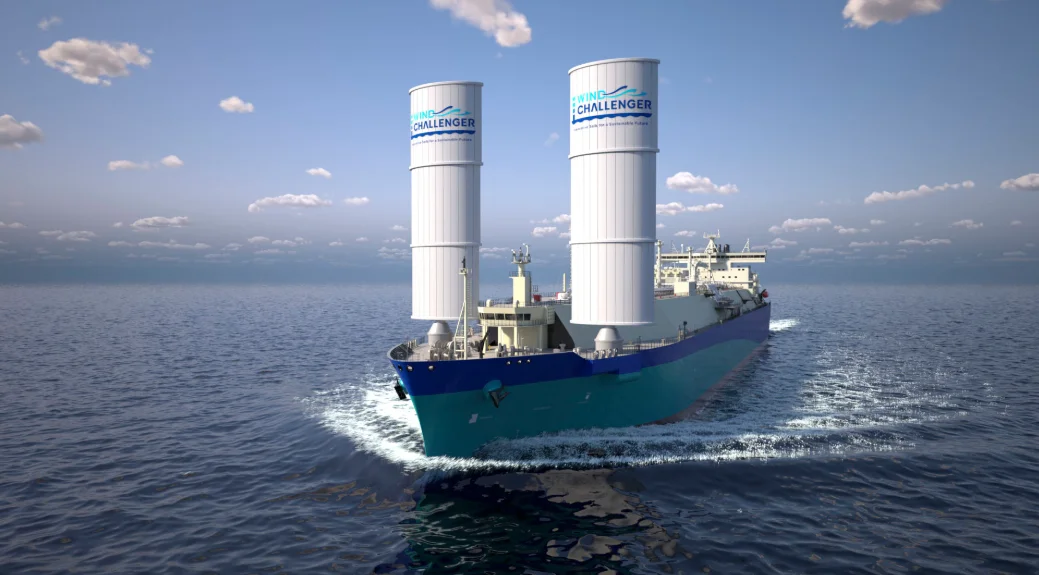
Mitsui O.S.K. Lines fuses the romance of historic seafaring with modern engineering by deploying the Wind Challenger hard sail system on a newly built membrane-type LNG carrier.
Centuries ago, wooden ships and iron men ruled the high seas, reliant entirely on unpredictable oceanic winds, rugged canvas, and the raw courage of mariners navigating into the unknown. As heavy diesel engines and fossil fuels swept away that romantic Age of Sail, the ocean’s whisper was replaced by the unrelenting thrum of machinery. Today, against the backdrop of a warming planet and an imperative to decarbonize, the maritime world comes full circle— reimagining wind not as a relic of the past, but as the cleanest propulsion of the future.
In a landmark step for international shipping, Mitsui O.S.K. Lines (MOL) is merging ancient seafaring wisdom with cutting-edge engineering through the installation of two Wind Challenger hard sails on a state-of-the-art liquefied natural gas (LNG) carrier. Scheduled for delivery in 2026, this landmark vessel represents the world’s first LNG carrier to utilize wind-assisted propulsion technology, marking a pivotal shift in how global energy fleets navigate toward lower carbon footprints.
A Blueprint for Maritime Decarbonization
As part of the comprehensive “MOL Group Environmental Vision 2.2,” the Japanese shipping giant has committed to achieving net-zero greenhouse gas (GHG) emissions by 2050. A primary pillar of this strategy relies on the widespread adoption of energy-saving technologies. Co-developed by MOL and Oshima Shipbuilding, the Wind Challenger system uses rigid, telescoping hard sails to harness wind power directly, translating natural forces into supplementary thrust.
The decision made in September 2024 to outfit a newbuild membrane-type vessel with two Wind Challenger sails reflects MOL’s aggressive deployment strategy. The company plans to launch 25 vessels equipped with Wind Challenger technology by 2030, scaling up to 80 vessels by 2035.
Engineering and Technical Safety
Building a wind-assisted LNG carrier presents distinct engineering challenges, particularly regarding structural safety and navigational line-of-sight. The vessel currently under construction at the Geoje Shipyard of Hanwha Ocean Co., Ltd. features a standard cargo capacity of 174,000 cubic meters—the most common design in today’s LNG shipping market. Because sister vessels without sails already operate globally, maintaining design compatibility was critical.
To ensure seamless operations without compromising safety, MOL, Hanwha Ocean, and classification society ClassNK conducted exhaustive risk assessments evaluating sail placement, bridge visibility, emergency protocols, and operational safety measures. Furthermore, Gaztransport et Technigaz SA (GTT), the designer of the vessel’s membrane cargo tank, performed rigorous structural evaluations. GTT verified that the structural integrity of the cargo tank remains fully intact even under the dynamic stresses introduced by the hard sails.
In August 2024, ClassNK granted Approval in Principle (AiP) for the vessel—a historic first for an LNG carrier featuring wind-assisted propulsion.
Navigational Visibility and Port Compatibility
Integrating tall sail structures onto a massive energy carrier requires innovative operational adaptations. To solve potential visibility limitations caused by the forward sail units, the vessel incorporates a fully enclosed navigation bridge complemented by an auxiliary lookout station on the fore deck.
Crucially, the strategic placement of the two Wind Challenger sails preserves the vessel’s overall tradability. Designed to minimize impact on standard membrane-type arrangements, the system allows the vessel to retain its original mooring layout. As a result, the vessel can dock seamlessly at existing global LNG terminals without requiring costly shore-side infrastructure modifications. This achievement proves that clean technology can integrate into standard global supply chains, paving the way for sustainable energy logistics.

Dr. Jakob Jung is Editor-in-Chief of Security Storage and Channel Germany. He has been working in IT journalism for more than 20 years. His career includes Computer Reseller News, Heise Resale, Informationweek, Techtarget (storage and data center) and ChannelBiz. He also freelances for numerous IT publications, including Computerwoche, Channelpartner, IT-Business, Storage-Insider and ZDnet. His main topics are channel, storage, security, data center, ERP and CRM.
Contact via Mail: jakob.jung@security-storage-und-channel-germany.de