The worldwide external enterprise storage systems market posted its strongest non-fourth-quarter revenue on record in the second quarter of 2026, according to IDC. Rising component costs and a long-deferred infrastructure refresh cycle are reshaping the competitive order, with high-end, AI-oriented systems delivering the sharpest gains.
The worldwide external OEM enterprise storage systems (ESS) market grew 33.6% year over year in the second quarter of 2026, reaching $10.3 billion in vendor revenue, according to IDC’s Worldwide Quarterly Enterprise Storage Systems Tracker, released September 10. The figure marks the second-highest quarterly total in the tracker’s history, trailing only the fourth quarter of 2025, and the highest revenue ever recorded outside a year-end quarter.
According to IDC, growth accelerated from the 28.7% rate recorded in the first quarter of 2026, extending a second consecutive quarter of acceleration after full-year 2025 closed with a comparatively modest 3.9% growth rate.
IDC attributes the surge to three reinforcing dynamics. First, the analyst firm’s tracker data and channel checks point to a demand-pull effect, with buyers increasingly moving purchases forward to lock in budget and configurations ahead of anticipated further component price increases. Second, component price increases have affected all segments — all-flash, hybrid, and HDD-only systems alike — pushing up system prices and effectively reducing the capacity customers can buy for the same spend. Third, a multi-year infrastructure refresh cycle deferred while server and AI compute spending took priority in 2024 and 2025 is now working its way through the market, particularly in the high-end segment, IDC said.
IDC traces the root cause to constrained NAND and DRAM production capacity, which continues to be prioritized toward higher-margin memory products, disproportionately affecting SSD pricing. The company does not expect meaningful relief before 2028.
By architecture, all-flash arrays (AFA) extended their lead, generating $5.4 billion in revenue, up 42.9% year over year, and accounting for 52.1% of total ESS revenue. Hybrid flash arrays (HFA) grew 25.5% to $3.9 billion, a 37.5% share, while all-HDD systems grew 22.6% to $1.1 billion, or 10.4% of the market.
Segmented by price point, high-end systems — those with an average selling price above $250,000 — surged 90.6% year over year to $2.7 billion, an acceleration from 60.7% growth in the first quarter and now representing 26.2% of the market. IDC attributes the jump to large-scale AI infrastructure storage deployments. Midrange systems, priced between $25,000 and $250,000, grew 28.2% to $6.7 billion and held 64.8% share, while entry-level systems under $25,000 declined 14.6% to $0.9 billion.
First-half 2026 revenue reached $29.6 billion, up 28.2% from $15.3 billion in the first half of 2025 — a growth rate eight times that recorded for all of 2025, according to IDC.
Natalya Yezhkova, vice president for storage and data management within IDC’s Enterprise Infrastructure group, said storage spending had trailed compute investment as enterprises prioritized accelerated server infrastructure for AI training over the past two years. As AI workloads shift from training to inferencing, she said, the bottleneck increasingly concerns how quickly organizations can put their data estates to work rather than raw computing capacity. Yezhkova added that elevated component costs are expected to persist well into 2027, sustaining pricing-driven growth alongside underlying demand from unstructured data growth, inferencing workloads, and the ongoing refresh cycle.
All nine regions tracked by IDC posted year-over-year growth in the quarter. Canada was the fastest-growing market at 77.2%, followed by Asia/Pacific excluding Japan and China (APeJC) at 73.1% and Central & Eastern Europe at 54.1%. The United States remained the largest single market, generating $3.6 billion, up 26.8%, for a 35.3% global share. Western Europe grew 42.8% to $1.9 billion, retaining its position as the second-largest region. Japan posted the slowest growth among tracked regions, at 12.9%.
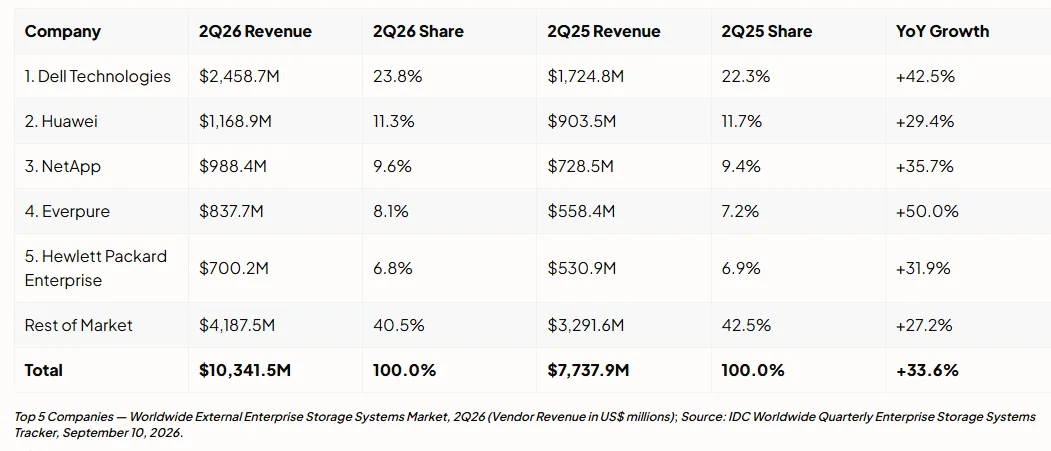
On the vendor side, Dell Technologies retained the top position with a 23.8% revenue share, up 42.5% year over year, extending share gains from the first quarter on the strength of its storage portfolio and AI-attach strategy, according to the company’s tracked figures. Huawei moved into second place with an 11.3% share and 29.4% growth. NetApp held third with a 9.6% share, growing 35.7% on its expanding all-flash business. Everpure ranked fourth with an 8.1% share but posted the fastest growth among the top five vendors, at 50.0%, which IDC attributed to continued subscription-model adoption and AI-optimized platforms. Hewlett Packard Enterprise rounded out the top five with a 6.8% share and 31.9% growth.

Dr. Jakob Jung is Editor-in-Chief of Security Storage and Channel Germany. He has been working in IT journalism for more than 20 years. His career includes Computer Reseller News, Heise Resale, Informationweek, Techtarget (storage and data center) and ChannelBiz. He also freelances for numerous IT publications, including Computerwoche, Channelpartner, IT-Business, Storage-Insider and ZDnet. His main topics are channel, storage, security, data center, ERP and CRM.
Contact via Mail: jakob.jung@security-storage-und-channel-germany.de