A new Adobe Acrobat survey of 1,500 German employees shows AI has quietly become an everyday work tool — saving time on writing, editing and translation while raising fresh questions about trust and data security.
Germany’s white-collar workforce is increasingly relying on artificial intelligence to get through the day, according to a new survey commissioned by Adobe Acrobat. More than two-thirds of respondents say AI now saves them measurable time each week, with document creation, proofreading and translation topping the list of tasks handed over to algorithms.
Of the 62 percent of Germans who work at a computer daily, many are turning to AI tools to lighten their workload, according to the survey. Sixty-seven percent of respondents said AI can save them up to eight hours of working time per week, a figure that points to how quickly generative tools have moved from novelty to routine in German offices.
The study, conducted by market research firm 3Gem on behalf of Adobe Acrobat, surveyed 1,500 adults in Germany between April 18 and 24, 2026. Researchers combined the survey with an analysis of Google search volumes for AI-related terms to build a fuller picture of how AI is used in daily work.
Administrative Tasks Lead, Creative Work Lags Behind
The results show AI is used mostly for data-heavy and administrative tasks, while creative or higher-responsibility work is delegated to AI far less often, the survey found. Writing and editing documents such as emails or reports, along with proofreading and summarizing, ranks as the most common use case at 29 percent. Translation and localization of content follows closely, cited by a quarter of respondents.
By contrast, HR and operational tasks such as recruiting, onboarding or customer support are handled by AI in only 12 percent of cases, according to the company. A further 14 percent use AI for legal, healthcare or logistics tasks — a gap that suggests trust in AI declines as work becomes more sensitive.
Industry Patterns Vary Widely
Adoption also varies by sector. Employees in business, consulting and management report the heaviest use of AI for document work, with 46 percent using it to draft or edit emails, reports and PDFs, particularly for corrections and summaries. Engineering and manufacturing follow at 42 percent, and finance at 36 percent, the survey found.
Marketing tells a different story: 36 percent of marketing professionals use AI primarily for marketing and sales activities such as content creation, personalization or visual assets, according to the data. Meanwhile, 26 percent of employees across all sectors say they do not use any AI tools at work — a sign that skepticism, or reluctance to disclose usage, remains widespread.
Document Summaries and Translation Dominate
When it comes to specific document tasks, summarizing content is the most common application at 29 percent, closely followed by translating documents or content at 28 percent. Filling out or generating forms trails at 17 percent, and creating presentations or slides sits at 18 percent, the survey found.
Time savings appear substantial regardless of task: 24 percent of respondents say AI saves them three to five hours per week, while 36 percent report saving one to two hours weekly.
Data Security Remains the Top Concern
Despite the productivity gains, the survey points to persistent unease. Data security and privacy are the biggest concerns, cited by 26 percent of respondents, followed by worries about the accuracy of AI-generated content, mentioned by 21 percent.
The concerns are shared broadly across genders: 28 percent of men and 24 percent of women named data protection and security as their top challenge, while 15 percent of men and 13 percent of women pointed to internal company policies restricting AI use as their biggest obstacle. According to Adobe, the near-parity between men and women suggests these concerns are largely independent of gender.
What Search Data Reveals
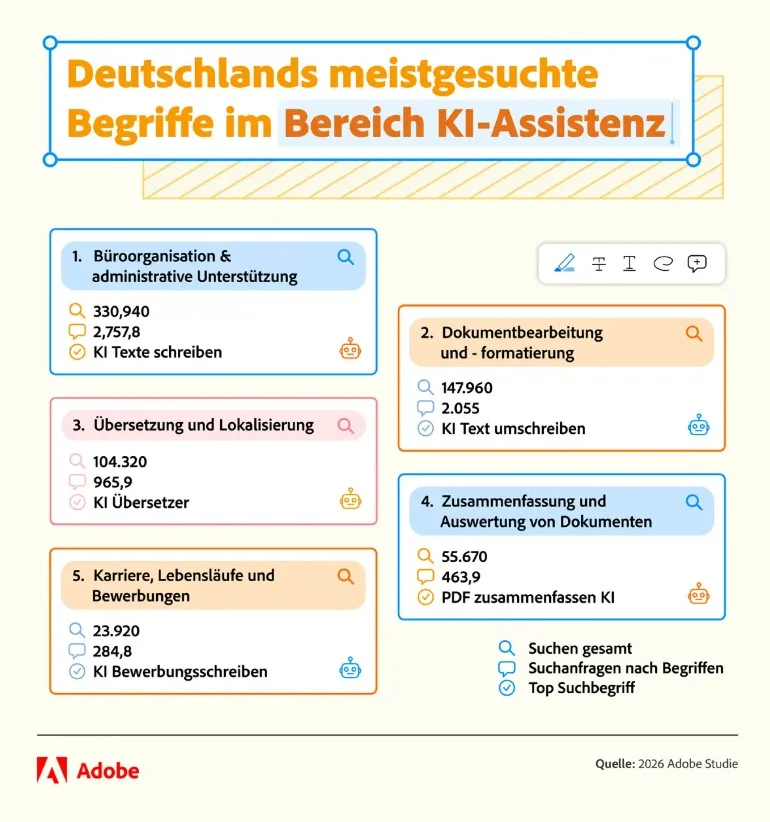
Beyond the survey, an analysis of Google search volumes offers a second lens on AI adoption. Searches related to professional writing and administrative tasks generated 330,940 queries in Germany over the past twelve months, the highest volume among the categories studied. Document editing and formatting followed with 147,960 searches, the company reported.
Regional trends diverged sharply. Düsseldorf recorded the steepest rise in searches for professional writing support, up 52.2 percent, while Duisburg saw the largest jump in searches for document editing and formatting help, up 100 percent, according to the data. Mannheim posted a 150 percent increase in searches related to careers, résumés and job applications, and Wuppertal recorded a 100 percent rise in the same category.
Finding the Right Support
The findings suggest AI has become a fixture of daily office work in Germany, particularly for writing, editing and processing information — even as questions about reliability and data protection persist. Human judgment remains essential, the survey notes, since inaccuracies and misinformation in AI output are still possible.
Adobe recommends a few practical steps to improve results: framing prompts precisely and clearly to get more relevant output, and avoiding entering confidential or sensitive information into AI systems to protect privacy. Tools such as Adobe Acrobat, the company noted, offer built-in generative AI features including automatic document summarization and an in-document AI chat function, allowing employees to streamline workflows without compromising on data protection or accuracy.

Dr. Jakob Jung is Editor-in-Chief of Security Storage and Channel Germany. He has been working in IT journalism for more than 20 years. His career includes Computer Reseller News, Heise Resale, Informationweek, Techtarget (storage and data center) and ChannelBiz. He also freelances for numerous IT publications, including Computerwoche, Channelpartner, IT-Business, Storage-Insider and ZDnet. His main topics are channel, storage, security, data center, ERP and CRM.
Contact via Mail: jakob.jung@security-storage-und-channel-germany.de