The digital transformation of B2B trade has officially entered its next phase: the transition from functional self-service portals to autonomous, AI-driven Commerce. Today, buyers demand real-time dynamic pricing, seamless ERP integration, and intelligent automation. To meet these expectations, organizations must ensure their technology stacks are “agentic ready”.
B2B commerce is facing its next major turning point. What began during the pandemic out of necessity as a digital customer interface has grown into a massive market expected to reach 33 trillion USD globally by 2031 with an annual growth rate of over 10 percent. In Germany alone, B2B e-commerce volume reached 1.9 trillion euros in 2024. However, traditional webshops are no longer sufficient. Companies are transitioning from basic digital transformation to an autonomous, agentic future.
The German-language white paper “SUCCESS IN B2B COMMERCE – Strategies and Technologies for Digital Business Processes” by dotSource SE of Jena highlights the system architectures that enable the next stage of development in digital B2B sales.
The Evolution of Maturity Levels: Ready for Autonomous Agents?
Over the last decade, B2B technology maturity has diverged significantly. Starting with basic online stores displaying custom price lists, organizations moved toward integrating CRM, ERP, and PIM systems into self-service portals. Early adopters then connected these tools into Digital Experience Platforms (DXP) for unified customer journeys.
The latest evolution demands a new benchmark: “Agentic Readiness”. Systems, data models, and processes must be structured so intelligent AI agents can operate autonomously across purchasing and sales workflows. Research by dotSource and ECC Cologne highlights that over 50 percent of corporate leaders prioritize AI agents at executive levels, with 78 percent expecting clear cost savings in procurement.
System Architectures Under Review
To support autonomous agents and real-time personalization, traditional monolithic enterprise software reaches its boundaries. While enterprise suites offer stability for standard cases, extensive customization involves heavy effort.
Modular MACH architectures (Microservices, API-first, Cloud-native, Headless) address this challenge. They enable independent replacement and orchestration of components via APIs. For B2B businesses dealing with complex buying centers, custom approval flows, or AI-driven pricing engines, composable architecture provides the necessary flexibility and scalability.
Additionally, technologies such as mobile applications for field reps and customers alongside self-service portals relieve internal sales teams from manual routine operations.
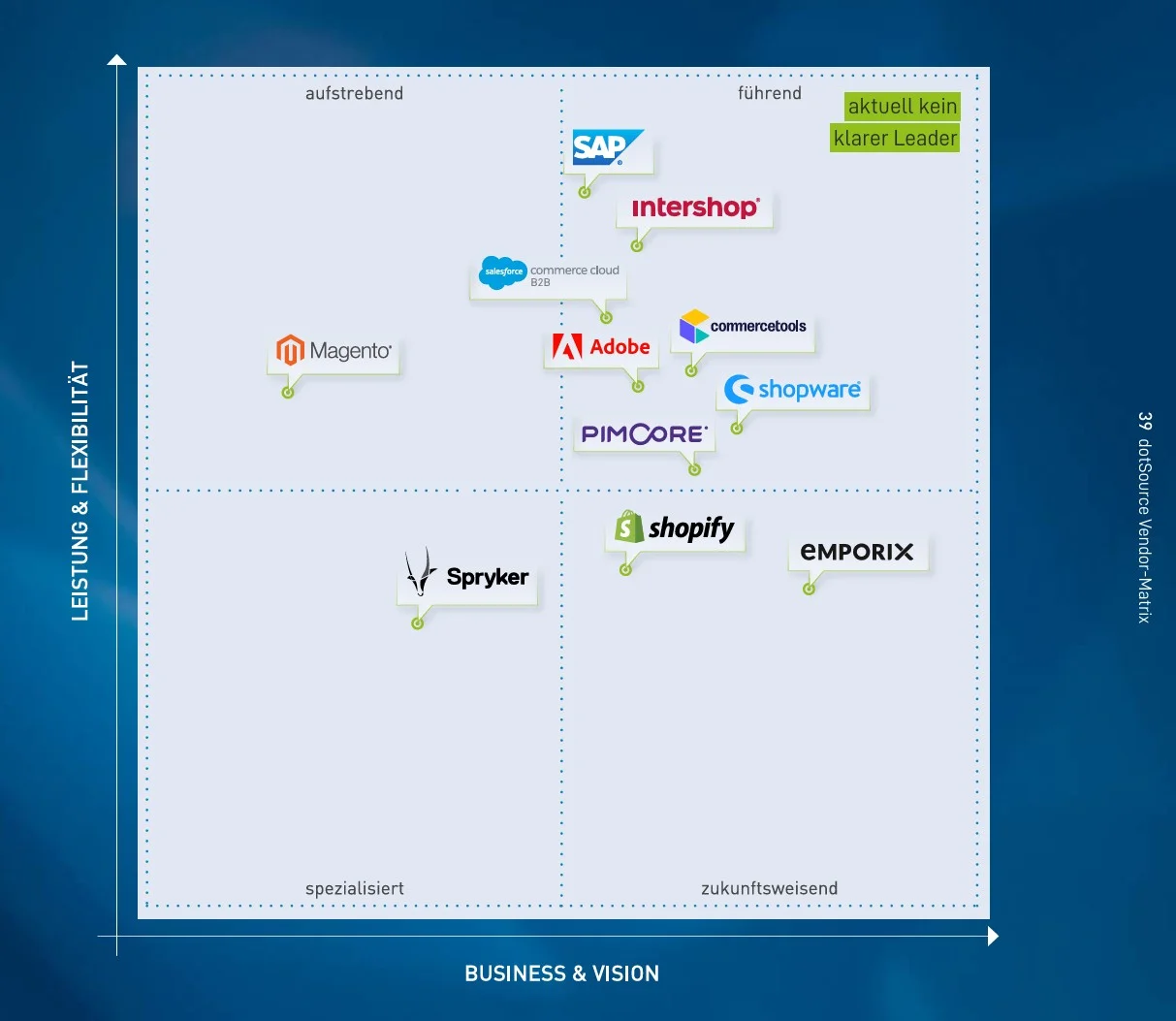
Comparing the Provider Landscape
Selecting the right B2B platform requires strategic evaluation[cite: 1]:
- Salesforce B2B Commerce delivers deep CRM integration and packages AI agent use cases via “Agentforce Commerce”
- SAP Commerce Cloud remains a cornerstone for enterprise-scale integration with S/4HANA environments.
- Intershop offers robust B2B native functions powered by AI copilots for buyers and merchants.
- commercetools leads composable commerce implementations and offers tools like “AI Hub” to supply structured data to AI platforms.
- Shopware provides high flexibility in the DACH market through no-code tools and AI-supported customer journeys.
- Spryker excels in complex B2B2X and marketplace environments via a modular framework.
Conclusion: Building the Foundation for Tomorrow
Technology alone does not guarantee business results. Sustainable growth in B2B commerce requires clean data foundations, connected systems, and aligned cross-channel strategies. Preparing existing architecture to be “agentic ready” is key to staying ahead in automated procurement ecosystems.

Dr. Jakob Jung is Editor-in-Chief of Security Storage and Channel Germany. He has been working in IT journalism for more than 20 years. His career includes Computer Reseller News, Heise Resale, Informationweek, Techtarget (storage and data center) and ChannelBiz. He also freelances for numerous IT publications, including Computerwoche, Channelpartner, IT-Business, Storage-Insider and ZDnet. His main topics are channel, storage, security, data center, ERP and CRM.
Contact via Mail: jakob.jung@security-storage-und-channel-germany.de