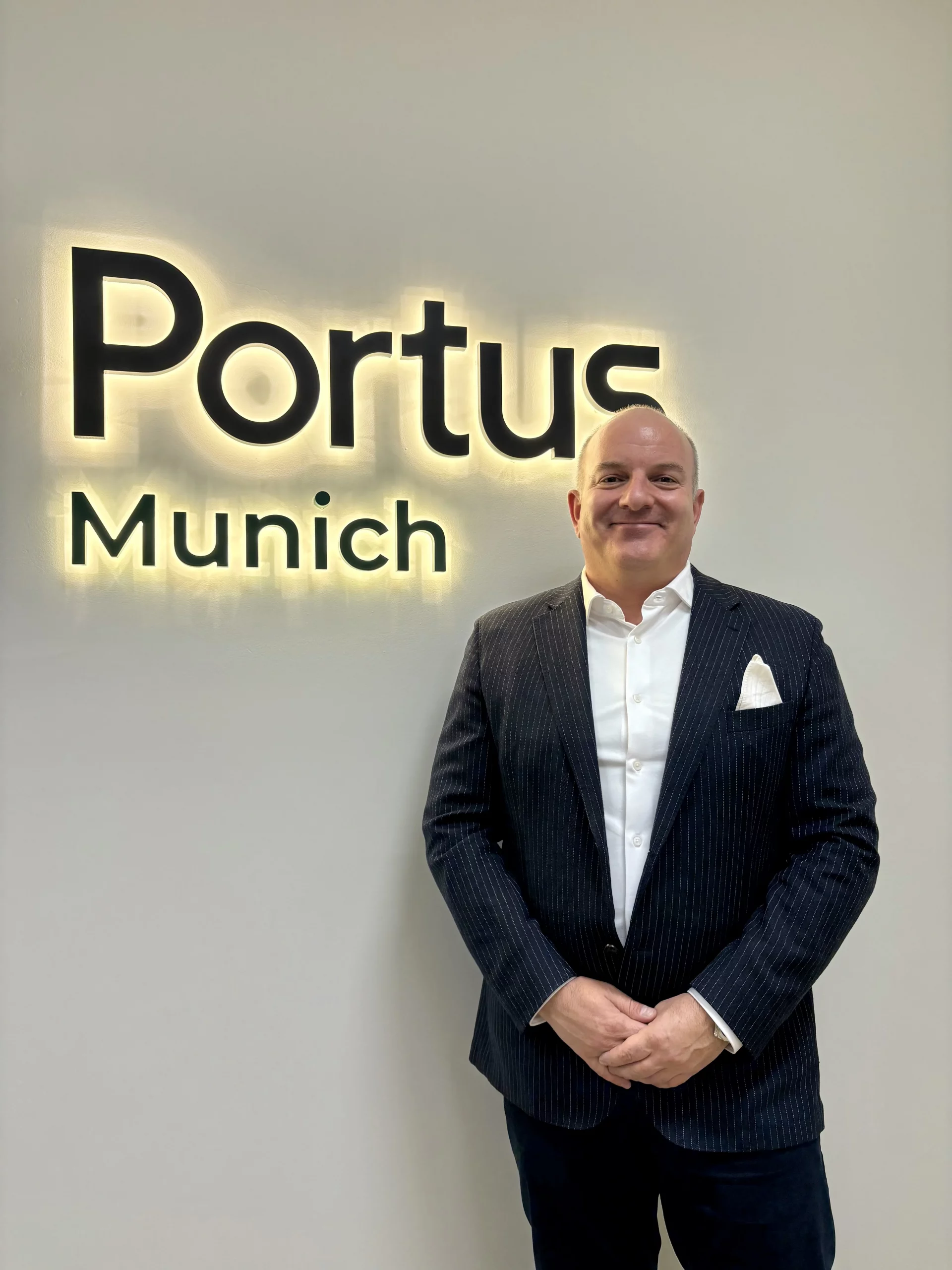
Richard Pimper is the new COO and CTO at Portus Data Centers. The industry expert – most recently in a leadership position at Huawei – speaks with Carolina Heyder about the transformation of the data center market, rising power requirements, energy efficiency, the expansion strategy of the colocation provider in the DACH region, and why local infrastructure is strategically indispensable for companies.
Carolina Heyder (CH): Congratulations on your new role. You have more than 25 years of experience in the industry, most recently as Vice President and Chief Technology Officer for Digital Power at Huawei. What do you bring to Portus Data Centers?
Richard Pimper (RP): I bring comprehensive expertise at the intersection of technology, operations, and economic efficiency. Additionally, I have worked for American, European, and Chinese companies, and as a non-Chinese citizen, I held one of the highest hierarchical positions at Huawei in Europe. This means I understand the technological ecosystems of these markets, their management cultures, and their differences. In our global world, where technology providers from different parts of the world compete in the same markets, this understanding is a clear advantage. Throughout my career, I have restructured, built, and scaled companies several times – and this is exactly where I am contributing at Portus Data Centers.
CH: Why are the functions of COO and CTO being combined? What synergies are created by this?
RP: The decision was both pragmatic and strategic. We have around 100 employees at three locations: Luxembourg, Munich, and Hamburg. The company is currently in a targeted restructuring phase where technical management and operational activities are closely intertwined. As COO, I am responsible for ongoing operations; as CTO, for the IT strategy and technology roadmap. These areas have many overlaps. I am even involved in the sales process because customers contribute significantly to determining which technologies we develop further. We have a holistic view of the market and our target audience.
CH: What are your concrete goals at Portus Data Centers, and where are you starting?
RP: Portus Data Centers aims to establish itself as the largest independent mid-scale provider in the DACH market. We are not a hyperscaler; we are close to the companies that need scalable, secure, and energy-efficient infrastructure. We plan for up to 40 to 50 megawatts per site: large enough for our customers, yet flexible enough for individual requirements. We follow a clear “buy-and-build” strategy: acquiring existing properties with potential, expanding them, and simultaneously building new facilities on adjacent land. Munich demonstrates this in practice: alongside the existing data center, “MUC2” is currently being built in Kirchheim with an additional 5.5 MW, which will bring the site’s future total capacity to 7 MW.
CH: The data center market has changed. Which developments are shaping it most strongly, and how is Portus positioning itself?
RP: We are at a turning point. The market is experiencing several shifts simultaneously: an unprecedented increase in demand due to AI workloads, a sharp rise in energy requirements, stricter sustainability requirements, and the pursuit of digital sovereignty. These factors reinforce each other and present a challenge. At the same time, opportunities are emerging. Companies that previously operated their own data centers are realizing that running outdated on-premises infrastructure is neither economically nor technologically sensible. That is where we come in. Our value-add lies in proximity to the customer, highly networked and scalable infrastructure, and independence. We are not part of a global corporation, and for many customers, that is a decisive criterion.
CH: The AI boom is driving the need for computing power to enormous heights. How does this affect your infrastructure planning and capacity requirements?
RP: AI clearly has an influence because it specifically changes what customers need from us. In discussions with companies—across various industries—we find they are increasingly demanding AI-capable infrastructure: higher power densities, specific cooling concepts, and lower latencies to backbone networks. This naturally flows into our planning. Regarding liquid cooling, for example, there isn’t just one solution, but several variants, from rear-door heat exchangers to direct liquid cooling at the CPU. Before we make a decision, we conduct intensive technical discussions with the customer: Which server generations are they currently using? What are they planning for three years from now? This depth of engagement is characteristic of our approach.
CH: The European Data Centre Association mentions in its current “State of European Data Centres” report that electricity, not money, is the biggest obstacle. 67 percent of respondents see power access as their greatest challenge. Do you agree, and how is this problem solved?
RP: Absolutely. The massive increase in energy demand—driven by AI, cloud, and digitalization—hits infrastructure that simply wasn’t designed for it. The problem is not so much the absolute electricity supply in Europe, but its distribution: capacity is often not where the demand is. Transmitting from A to B is costly, time-consuming, and regulatorily complex. In Germany, it is further complicated by the fact that the approval process for new power lines and substations takes a long time. There are several solutions: first, cooperation with local energy providers. In Germany, there are already models where municipal utilities work with colocation operators to provide power capacity. Second, on-site generation, such as battery storage and, in the future, our own energy production to reduce grid dependency. Third, site selection: we strictly check sites for available power before we even talk about land or permits. This excludes some cities but opens up new options. And finally, the social dimension: data centers are often seen as power guzzlers, but they can give back a lot to local infrastructure, such as through waste heat recovery for district heating networks. A well-managed data center can thus create real value for a community.
CH: Growing energy demand on one side, sustainability goals on the other. How do you secure capacity without burdening the environmental balance?
RP: This is not an “either-or” question; it’s a design task. Our group demonstrably sources 100% renewable energy. For our cooling concept, we rely on free air cooling, which works in Hamburg about 90% of the year and in Munich a large part of the time, with clear economic benefits: our PUE (Power Usage Effectiveness) is significantly below the industry average. For customers with their own sustainability goals, this is a major argument. Furthermore, we are planning toward on-site energy generation with battery storage, photovoltaics, and partners from the energy industry. For us, sustainability is not a compliance issue but an economic lever.
CH: With the data center expansion in Munich, you are doubling the space and quadrupling the capacity. Will you be ready by early 2027?
RP: Yes, we are on schedule. The building itself will be completed this year. The formal handover will take place in early 2027. This is the brownfield-greenfield pattern in its purest form: we use existing infrastructure, grid connections, and operational structures and build scalably upon them. Munich is therefore a showcase for our entire expansion strategy.
CH: You are expanding simultaneously in Hamburg and Luxembourg. Is this purely customer-driven or are there strategic reasons?
RP: Both, and they aren’t contradictory. Immediate expansion is customer-driven: we have demand, we have secured the land, we are building. In Hamburg, we are developing Hamburg 4, a new building with more than 12 megawatts, which is particularly attractive due to the site’s outstanding telecommunications connectivity. Luxembourg is considered a European gateway and is interesting for customers who want to build redundancy within the EU without relying on a second German data center. We secure land and power connections before we know which specific customer will come. This is a deliberate bet on future demand. Given the market dynamics, this makes sense. Anyone who waits today for a customer to come with an inquiry and only then looks for land and power has already lost.
CH: You repeatedly emphasize regional proximity—why is it so important for Portus Data Centers?
RP: Not every company wants to or can concentrate its critical infrastructure in Frankfurt, for example. The capacity situation there is strained anyway. Our locations in Munich, Hamburg, and Luxembourg are economic heavyweights with their own large corporate landscapes. Local presence means short latency paths, direct personal customer relationships, and the opportunity to physically visit the data center and inspect one’s own hardware. For strictly regulated industries like financial services or healthcare, this is a must. Then there is data sovereignty. In a German data center operated by a European company, German law and the GDPR apply without any room for interpretation. That is a decisive criterion.
CH: Let’s talk about future plans. Are further projects in Germany and neighboring markets planned? Are you going on a “shopping tour” soon?
RP: We are indeed active and looking around. We have clear criteria for this. First and foremost is available power, which means: no power, no discussion. Equally decisive is the possibility of securing additional building land directly next to an acquisition object to implement our brownfield-greenfield strategy. The permit situation and the political environment must also be right. In some cities, power is available, but the community doesn’t want a data center. We will enter where we can create value with our experience, at strategic locations in Germany and neighboring countries.

Carolina Heyder is a business analyst and moderator with extensive experience in the German and international IT market. She has worked for many years at renowned European trade publishers such as WEKA Fachmedien, Vogel IT Medien, Springer, and Aspencore. She creates content for both web and print media and is an expert in front of the microphone and camera. Thanks to her fluency in German, English, and Spanish, as well as her Chilean roots, she brings a global and intercultural perspective to topics such as cybersecurity, artificial intelligence, digital transformation, sustainability, and other key areas of the IT sector.