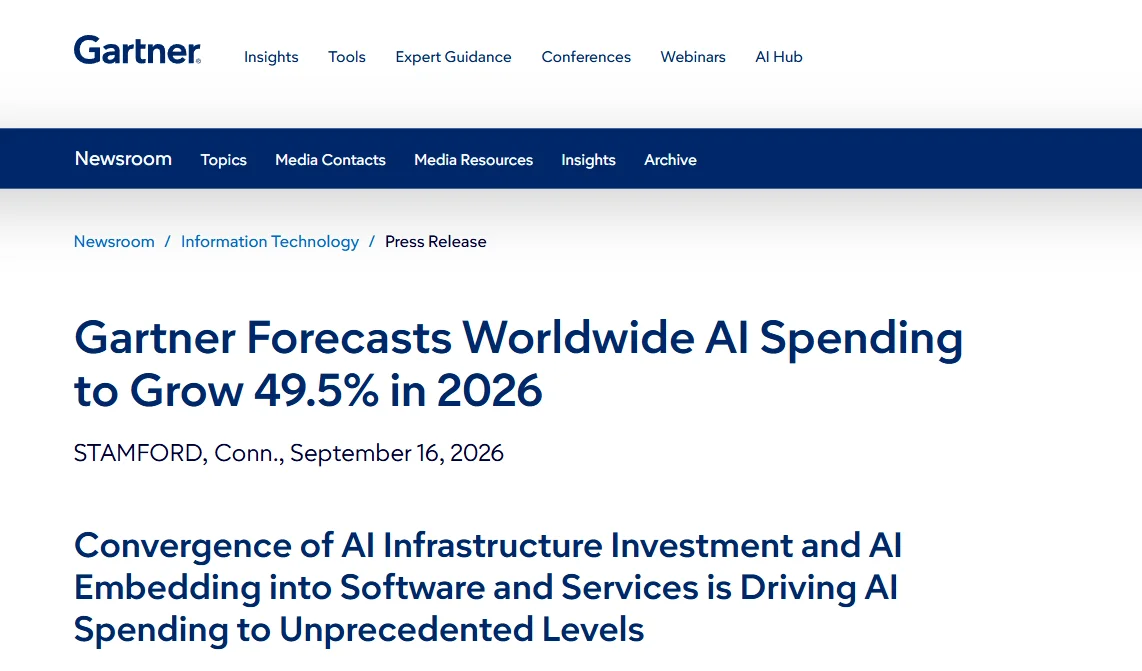
Gartner, Inc. forecasts worldwide AI spending will reach $2.7 trillion in 2026. According to the company, growth is driven by heavy investment in AI infrastructure and the increasing embedding of AI features into existing enterprise software.
Worldwide spending on artificial intelligence (AI) is forecast to reach $2.7 trillion in 2026, according to a new forecast from Gartner, Inc. That represents a year-over-year increase of 49.5%, the company said. As the business and technology insights firm reported on September 16, 2026, from Stamford, Connecticut, two parallel developments are pushing spending to unprecedented levels: heavy investment in AI infrastructure and the growing embedding of AI capabilities into existing software and services.
“Demand for AI infrastructure — including AI-optimized IaaS, AI-optimized servers, AI network fabric, AI processing semiconductors and devices — to support anticipated future workloads remains strong and inelastic to pressures from memory-related pricing increases,” said John-David Lovelock, Distinguished VP Analyst at Gartner, according to the company. The buildout of AI data center capacity is the largest infrastructure project humanity has ever undertaken, Lovelock added. Capacity growth from hyperscalers and service providers purchasing AI-optimized servers is expected to remain the single largest area of spending.
In the software market, vendors across different software categories are rapidly embedding agentic AI within their existing products, Gartner said, in order to maintain relevance and defend against new cross-functional agents. With generative AI (GenAI) firmly in the Trough of Disillusionment on the Gartner Hype Cycle in 2026, enterprises are increasingly relying on simpler, embedded AI features from their incumbent software providers to improve operational efficiency, automate workflows, strengthen customer engagement and support decision-making.
According to Gartner’s forecast, AI infrastructure remains the largest spending category, projected to grow from $981.9 billion in 2025 to $1.484 trillion in 2026 and $1.978 trillion in 2027. AI services are expected to rise from $434.0 billion to $576.5 billion in 2026, while AI software spending is forecast to grow from $288.2 billion to $461.6 billion. Smaller segments show markedly higher percentage growth: AI agents and assistants are projected to grow from $16.5 billion to $29.2 billion, and generative AI models from $13.0 billion to $28.3 billion.
Lovelock said enterprises are turning to service providers less often for large-scale business transformation, and more often for smaller, indirect projects aimed at exploiting AI features already present in their incumbent software. Risks such as vendor lock-in, data sovereignty and runaway costs are not deterring buyers from adopting these proprietary capabilities, he said. The combination of transformation and indirect projects is forecast to drive a $1.2 trillion opportunity in AI services by 2030.
Compared with its previous forecast, Gartner has raised its short-term growth outlook for AI application development platforms from 28% to 39% for 2026, as enterprises, software providers and services firms increasingly seek to build custom AI applications tailored to their needs. For model providers, pressure to offer more cost-efficient models aligned with enterprise use cases is opening a small but growing opportunity for domain-specific language models (DSLMs). Accordingly, the 2026 growth rate for generative AI models has been raised from 110% to 117%. Over the longer term, Gartner has also separated cross-functional agents and assistants from the AI software category and added consumer agents and assistants to the forecast, to better illustrate the emerging opportunity in this area. Gartner clients can find more detailed figures through 2030 in the report “Forecast: AI Spending, Worldwide, 2025-2030, 2Q26.”
Table 1: Worldwide AI Spending by Market, 2025-2027 (Millions of U.S. Dollars)
| Market | 2025 | 2026 | 2027 |
| AI Services / KI-Services / Servicios de IA | 434.046 | 576.481 | 745.655 |
| AI Cybersecurity / KI-Cybersicherheit / Ciberseguridad de IA | 25.920 | 51.347 | 85.997 |
| AI Software / KI-Software / Software de IA | 288.168 | 461.637 | 656.353 |
| AI Agents and Assistants / KI-Agenten und -Assistenten / Agentes y asistentes de IA | 16.481 | 29.219 | 65.472 |
| Generative AI Models / Generative KI-Modelle / Modelos de IA generativa | 13.021 | 28.266 | 51.620 |
| AI Platforms for Data Science and ML / KI-Plattformen für Data Science und ML / Plataformas de IA para ciencia de datos y ML | 19.405 | 26.445 | 35.552 |
| AI Application Development Platforms / KI-Anwendungsentwicklungsplattformen / Plataformas de desarrollo de aplicaciones de IA | 6.885 | 9.541 | 12.478 |
| AI Data / KI-Daten / Datos de IA | 826 | 3.126 | 6.480 |
| AI Infrastructure / KI-Infrastruktur / Infraestructura de IA | 981.920 | 1.484.397 | 1.977.685 |
| Total AI Spending / KI-Ausgaben gesamt / Gasto total en IA | 1.786.671 | 2.670.460 | 3.637.292 |
Quelle / Source: Gartner (September 2026)
Gartner expects the trend of embedding AI features into existing enterprise software to continue in the coming years, while the buildout of AI infrastructure remains the single largest category of worldwide IT spending. Global AI spending is projected to reach $3.637 trillion by 2027.

Dr. Jakob Jung is Editor-in-Chief of Security Storage and Channel Germany. He has been working in IT journalism for more than 20 years. His career includes Computer Reseller News, Heise Resale, Informationweek, Techtarget (storage and data center) and ChannelBiz. He also freelances for numerous IT publications, including Computerwoche, Channelpartner, IT-Business, Storage-Insider and ZDnet. His main topics are channel, storage, security, data center, ERP and CRM.
Contact via Mail: jakob.jung@security-storage-und-channel-germany.de