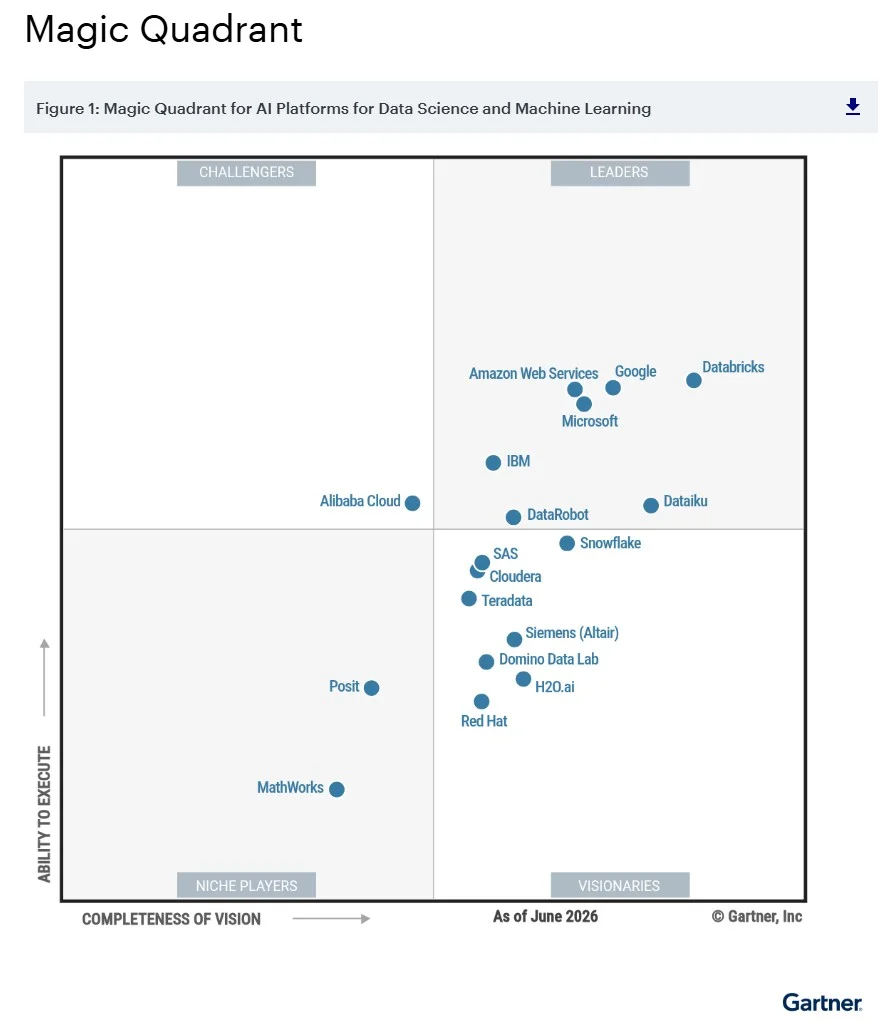
Enterprise AI is shifting from isolated models to autonomous agents. Gartner’s latest Magic Quadrant reveals which platforms are positioned to lead this transformation—and where gaps remain.
As organizations race to embed artificial intelligence deeper into daily operations, the platforms that support data science and machine learning are evolving at high speed. Gartner’s Magic Quadrant for AI Platforms for Data Science and Machine Learning, published 22 June 2026, captures a market now defined by end-to-end model and agent development, robust governance, and support for both classic machine-learning techniques and generative AI. Leaders responsible for AI strategy must evaluate vendors not only on traditional capabilities but on their readiness for agentic systems that can make autonomous decisions.
The market for AI platforms supporting data science and machine learning (DSML) has expanded beyond pure model training into comprehensive environments that manage the full life cycle of models and AI agents. According to Gartner, these platforms enable data preparation, model building, deployment, monitoring and governance. They serve both expert practitioners and business users through a mix of code-first environments, low-code interfaces and AI assistance.
Strategic planning assumptions underscore the urgency of this shift. By 2027, Gartner expects half of data analysts to be retrained as data scientists while many data scientists move into AI engineering roles. Organizations will deploy far more small, task-specific models than general-purpose large language models. Demand for AI engineers is projected to triple relative to data scientists. By 2028, at least 15 percent of day-to-day work decisions could be made autonomously by agentic AI—up from virtually zero in 2024.
In the 2026 Magic Quadrant, seven vendors occupy the Leaders quadrant: Amazon Web Services, Databricks, Dataiku, DataRobot, Google, IBM and Microsoft. These providers combine mature product portfolios with clear strategies for generative AI, multi-agent systems and enterprise-scale operations. AWS emphasizes its partner ecosystem, AgentCore framework and specialized infrastructure such as Trainium chips. Databricks focuses on unified governance through Unity Catalog and rapid feature development around Agent Bricks. Dataiku stresses architectural flexibility and integrated risk management.
DataRobot highlights hybrid and air-gapped deployment options together with strong customer support. Google positions Vertex AI (now part of Gemini Enterprise Agent Platform) as a full-stack offering independent of other providers. IBM differentiates through comprehensive governance that extends to third-party models and advanced retrieval-augmented generation techniques. Microsoft leverages a vast model catalog and context layer within Fabric IQ to support diverse personas.
Alibaba Cloud stands as the sole Challenger, recognized for high-performance infrastructure, continuous Qwen model releases and significant capital investment in advanced AI. Its geographic concentration and learning curve for non-technical users remain noted limitations.
A substantial group of Visionaries—including Cloudera, Domino Data Lab, H2O.ai, Red Hat, SAS, Siemens (Altair), Snowflake and Teradata—demonstrate differentiated approaches. Many emphasize hybrid or sovereign deployments, composite AI that blends machine learning with optimization and simulation, or specialized agent tooling. Niche Players MathWorks and Posit continue to serve highly specialized engineering and code-first analytical communities, respectively.
Across the evaluation, several themes recur. Platforms must support multimodal data, reproducible environments, lineage tracking and multiple Ops disciplines (MLOps, AgentOps and others). Governance and guardrails have moved from optional to mandatory as agentic systems gain autonomy. Buyers face trade-offs around cost predictability, hybrid-cloud support, composite-AI workflows and the pace of feature releases.
New entrants Posit, Red Hat, Siemens (following its acquisition of Altair) and Teradata reflect the market’s broadening scope, while Alteryx was dropped after inclusion-criteria adjustments. Vendors are assessed on both Ability to Execute and Completeness of Vision, with particular weight given to product capabilities, market understanding and innovation in generative and agentic AI.
For AI and analytics leaders, the message is clear: selecting a platform now requires forward-looking assessment of agent life-cycle management, cross-persona collaboration and the ability to combine classic data-science techniques with modern generative capabilities. The platforms that succeed will be those that turn the growing volume of models and agents into reliable, governed business value.

Dr. Jakob Jung is Editor-in-Chief of Security Storage and Channel Germany. He has been working in IT journalism for more than 20 years. His career includes Computer Reseller News, Heise Resale, Informationweek, Techtarget (storage and data center) and ChannelBiz. He also freelances for numerous IT publications, including Computerwoche, Channelpartner, IT-Business, Storage-Insider and ZDnet. His main topics are channel, storage, security, data center, ERP and CRM.
Contact via Mail: jakob.jung@security-storage-und-channel-germany.de