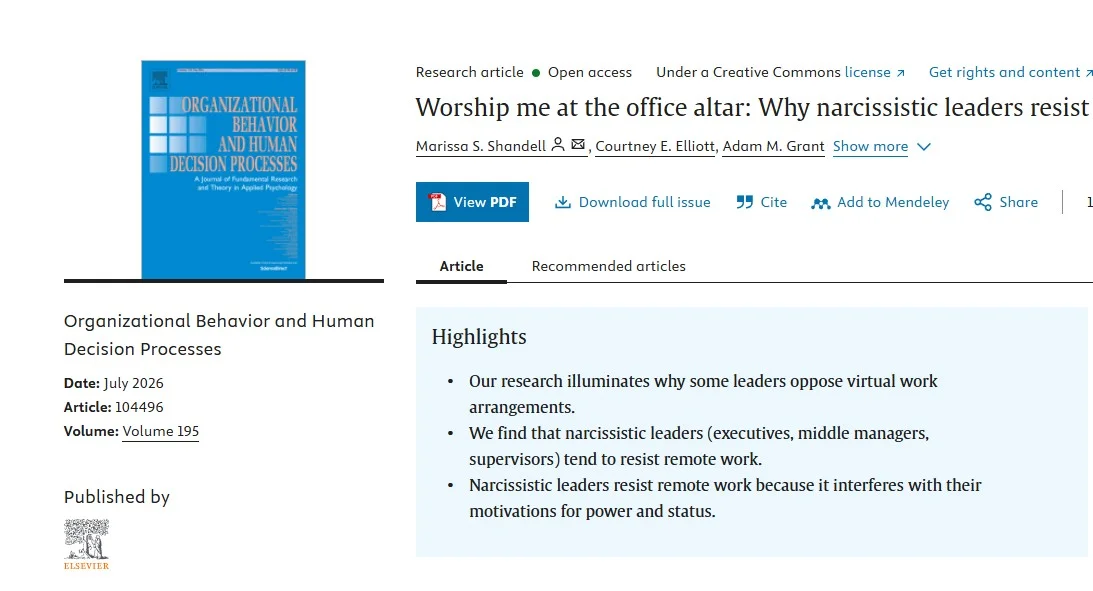
New research reveals that leaders high in narcissism strongly oppose flexible and remote arrangements—not primarily for productivity reasons, but because virtual work threatens their needs for power and status.
As companies debate return-to-office mandates years after the COVID-19 pandemic, a growing body of evidence points to a surprising factor driving resistance: leader personality. Narcissistic executives and managers are more likely to push for in-person work, viewing remote setups as barriers to the admiration and control they crave.
The Personality Roots of Return-to-Office Mandates
The shift to remote work during the pandemic forced many leaders to adapt. Yet while some embraced flexibility, others issued strict mandates to bring employees back. According to a 2026 study published in Organizational Behavior and Human Decision Processes by Marissa S. Shandell, Courtney E. Elliott, and Adam M. Grant, leader narcissism is a key driver of this opposition.
Drawing on the extended agency model of narcissism and media richness theory, the researchers argue that remote work disrupts the rich, in-person interactions narcissists rely on to assert dominance and garner admiration. In-person environments offer abundant nonverbal cues, immediate feedback, and opportunities for physical presence that virtual platforms cannot fully replicate.
Study 1: Fortune 500 CEOs
An archival analysis of 259 CEOs showed that unobtrusive narcissism indicators—larger photo sizes in annual reports, bigger signatures, and higher relative compensation—predicted stronger public resistance to remote work early in the pandemic. This effect was partially explained by proxies for power (board chair roles) and status motivations (external board seats), particularly in industries not reliant on frontline workers.
Study 2: Broader Leader Survey
A preregistered three-wave survey of 359 U.S. leaders replicated the findings. Narcissism predicted remote work resistance, mediated by power and status motivations, even after controlling for the Big Five traits, Dark Triad elements, and trust in employees.
Study 3: Experimental Evidence
In a preregistered experiment with 546 leaders, inducing state narcissism increased resistance to remote work, primarily through heightened power motivation.
Why Remote Work Threatens Narcissists
Narcissists seek agency—the drive to expand and assert the self. Remote work, with its leaner communication channels, introduces ambiguity, delays, and reduced visibility. Leaders lose easy dominance displays (eye contact, gestures, physical presence) and immediate narcissistic supply from employee deference. Employees gain autonomy, which can feel like a threat to hierarchical control.
Power-motivated narcissists struggle with reduced monitoring and influence. Status-motivated ones miss the clear signals of admiration possible in face-to-face settings. The result: stronger preference for office-based work to restore these dynamics.
Importantly, the research distinguishes narcissism from general concerns about productivity or collaboration. While those factors matter, self-centered motivations play a distinct role.
Implications for Organizations
These findings challenge assumptions that resistance stems solely from operational needs. Narcissistic leaders may frame mandates as business necessities while protecting personal ego needs. Companies should consider personality in leadership selection and succession, promote humble leadership, and design hybrid policies that balance flexibility with connection—without catering to individual status cravings.
As remote work stabilizes at around 25% of U.S. paid hours, understanding these dynamics helps organizations navigate the “great attraction” versus attrition debate more effectively.

Dr. Jakob Jung is Editor-in-Chief of Security Storage and Channel Germany. He has been working in IT journalism for more than 20 years. His career includes Computer Reseller News, Heise Resale, Informationweek, Techtarget (storage and data center) and ChannelBiz. He also freelances for numerous IT publications, including Computerwoche, Channelpartner, IT-Business, Storage-Insider and ZDnet. His main topics are channel, storage, security, data center, ERP and CRM.
Contact via Mail: jakob.jung@security-storage-und-channel-germany.de