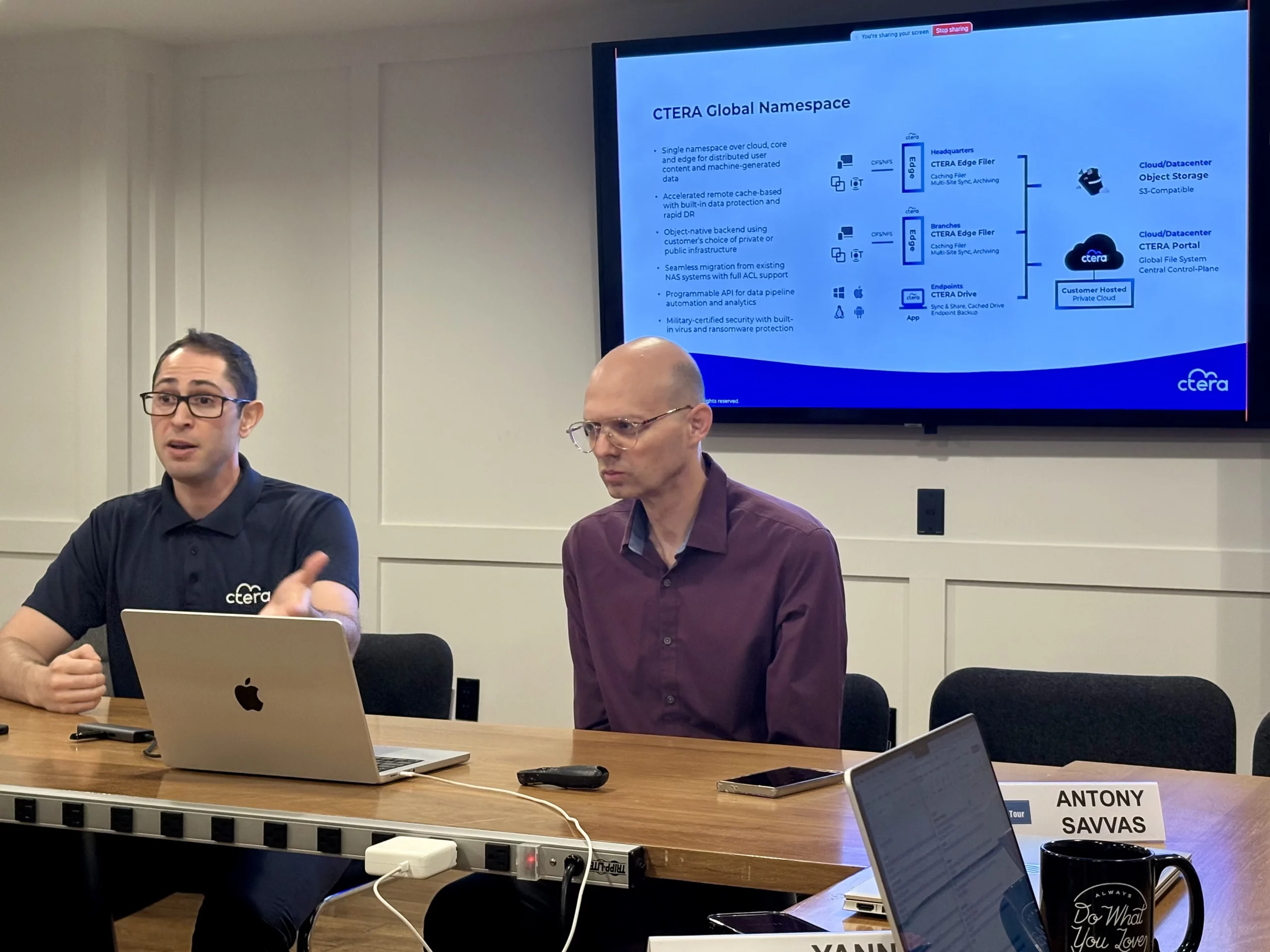
AI pipelines are drowning in duplicated data and costly synchronization jobs. A converged storage architecture like CTERA Fusion Direct that natively supports both file and object interfaces could eliminate these inefficiencies, empowering faster training and more capable AI agents.
In the race to scale artificial intelligence, organizations are confronting an unexpected obstacle—not in algorithms or compute power, but in how data is stored and accessed. Many enterprises maintain duplicate copies of massive datasets: one in traditional file systems for structured workflows and another in object storage for high-throughput AI training. This architectural compromise is proving unsustainable.
Let’s take a fictional medium-sized financial service provider to illustrate the problem. The weekly retraining of fraud detection models is based on structured data from NFS shares. The GPU clusters, on the other hand, read the data from Amazon S3. Result: An automated job copies terabytes between the systems on Sunday nights. At 4 TB, it was manageable. With 40 TB, synchronization takes 30 hours, delays training cycles, and leaves expensive hardware unused.
This scenario is common. AI workloads straddle incompatible paradigms. File storage offers hierarchical directories, POSIX semantics, atomic operations, and fine-grained permissions—essential for human teams, applications, and increasingly, AI agents. Object storage provides flat namespaces, extreme scalability, parallel access, and high durability, making it ideal for distributed training.
The duplication carries heavy costs: doubled storage footprints, complex pipelines, governance headaches, and engineering resources wasted on synchronization rather than innovation. Traditional fixes—file gateways, hierarchical namespaces on object stores, or FUSE mounts—introduce performance penalties and incomplete semantics.
AI agents exacerbate the issue. These systems excel at navigating directories, editing files, running tests, and maintaining state—behaviors that map naturally to file-system primitives. Forcing them onto flat object stores requires reconstructing structure via key prefixes, increasing latency and token consumption. As LlamaIndex suggests, “files are all you need” for many agentic workflows, yet massive-scale durability demands object foundations.
The solution lies in convergence: a single underlying dataset exposed through both file and object interfaces simultaneously. CTERA Fusion Direct exemplifies this approach. It stores data once in a format optimized for object-scale durability and throughput while providing genuine file system semantics where needed. Data written through the file interface (such as NFS) becomes instantly readable via object protocols (S3-compatible), with no copying, staging, or translation layer in the critical path.
This means the Sunday sync job disappears entirely. NFS shares and S3 buckets become two consistent views of the same dataset. Upstream services update records incrementally with atomic operations and permissions, while GPU clusters access training data in parallel at full speed. The three engineers previously dedicated to maintaining sync infrastructure can now focus on model development.
This unified architecture preserves key benefits of both worlds: POSIX compliance, directory navigation, and locking for agents and applications, alongside massive parallel I/O and 11-nines durability characteristics of object storage. It eliminates the need for compromise solutions and directly addresses the pain points of modern AI pipelines.
Such unified systems promise structural advantages: simpler pipelines, higher GPU utilization, better agent performance, and stronger governance. For organizations serious about AI at scale, the question shifts from “file or object?” to “can this platform serve both natively?”
The era of Sunday-night syncs need not define AI infrastructure. By rethinking storage as a unified fabric—with solutions like CTERA Fusion Direct—enterprises can remove a major constraint on their intelligent systems.

Dr. Jakob Jung is Editor-in-Chief of Security Storage and Channel Germany. He has been working in IT journalism for more than 20 years. His career includes Computer Reseller News, Heise Resale, Informationweek, Techtarget (storage and data center) and ChannelBiz. He also freelances for numerous IT publications, including Computerwoche, Channelpartner, IT-Business, Storage-Insider and ZDnet. His main topics are channel, storage, security, data center, ERP and CRM.
Contact via Mail: jakob.jung@security-storage-und-channel-germany.de