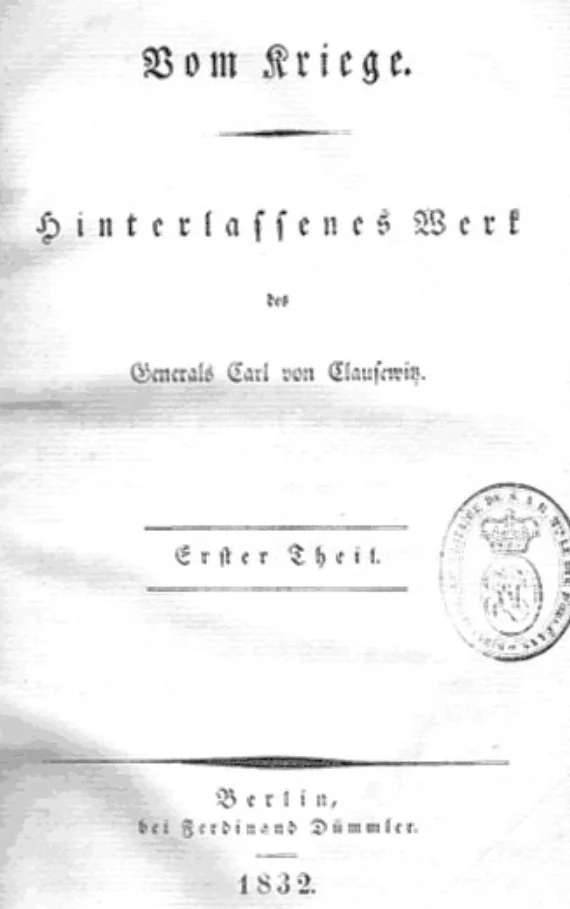
Artificial intelligence promises to clear the battlefield of uncertainty. Yet Carl von Clausewitz’s insights into friction, fog, and the political nature of war remain essential guides for strategy in an era of algorithms, autonomous systems, and information warfare.
Nearly two centuries after Carl von Clausewitz’s groundbreaking work *On War*, military planners continue to grapple with its core ideas. Today, the debate centers on whether artificial intelligence can finally dispel the “fog of war” and eliminate friction. Although the term “fog of war” does not originate with Clausewitz, it is already embedded in his fundamental concept. In Clausewitz’s own words: “Finally, the great uncertainty of all data in war is a peculiar difficulty, because all action is, so to speak, carried out in mere twilight, which, moreover, not infrequently—like fog or moonlight—gives things an exaggerated size and a grotesque appearance.” Experience from recent conflicts shows that AI is changing the character of warfare, but leaves its essence and the uncertainties that still exist untouched.
Modern armed forces have long sought information superiority. From the sensor networks of the Vietnam War, through the Revolution in Military Affairs of the 1990s, to today’s AI-powered targeting systems such as Project Maven, the aspiration has remained the same: to see everything, understand everything, and strike faster than the enemy can react. Proponents dreamed of a “single pane of glass” that would dispel the fog of war.
Reality proved to be more persistent. Clausewitz described friction as the sum of minor incidents, coincidences, and human limitations that cause performance to fall short of plans. The fog of war encompasses both physical uncertainty and cognitive confusion. Adversaries actively thicken this fog through camouflage, deception, and digital manipulation such as deepfakes, data poisoning, and algorithmic influence operations.
AI introduces two new layers of fog. First, the information space itself has become a contested battlefield. Faked videos and narratives can inflame public opinion and exert pressure on leaders, but their strategic impact is often overestimated. Second, the drive for speed—from detection to the destruction of the enemy—exacerbates the risks. Systems that compress targeting cycles increase efficiency but can also lock in outdated or flawed intelligence. In Gaza, AI-supported target databases produced high numbers of neutralized enemy targets but also contributed to civilian casualties. Audits by the Israel Defense Forces (IDF) remained superficial.
Friction cannot be eliminated through technology alone, partly because humans remain in the loop with all their cognitive limitations and political agendas. Nonlinear dynamics, incomplete information, and the competitive nature of war make absolute transparency an illusion. What matters is the relative balance of friction between the parties.
The “center of gravity” concept is facing similar pressures. In the era of professionalized warfare, it offered a useful analogy for concentrated strength. Industrialized and now digitized warfare—with multi-domain operations, global reach, cyber, space, and the electromagnetic spectrum—makes it far more difficult to identify individual or even multiple centers of gravity. Planners need broader analytical tools that map strengths, weaknesses, critical capabilities, and vulnerabilities across domains, rather than forcing a outdated model to fit.
Yet Clausewitz’s deeper insight remains valid. War continues to be a political act, a duel of opposing wills, shaped by passion, chance, and reason. AI can process vast amounts of data, accelerate decision-making cycles, and enable “precision on a massive scale,” but it does not capture political motives or strategic context. Overreliance on algorithmic speed risks decoupling the “grammar” of warfare from its political logic and fostering misjudgments and escalation.
The practical path involves human-machine teamwork that preserves political judgment, robust verification of AI results, adaptive procurement, and military training that builds AI expertise. Ukraine’s ongoing innovation in drones and software demonstrates how technology can be utilized without sacrificing strategic prudence. Speed is sometimes decisive; at other times, deliberate scrutiny prevents costly mistakes.
Clausewitz knew that the best strategies accept friction and plan accordingly. In the age of AI, this lesson is not outdated; rather, it has become even more urgent.
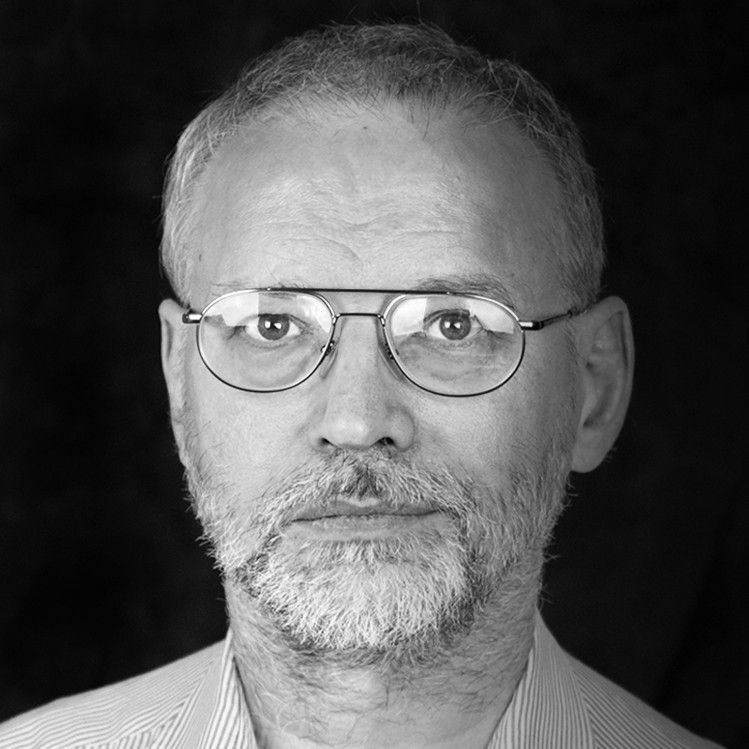
Dr. Jakob Jung is Editor-in-Chief of Security Storage and Channel Germany. He has been working in IT journalism for more than 20 years. His career includes Computer Reseller News, Heise Resale, Informationweek, Techtarget (storage and data center) and ChannelBiz. He also freelances for numerous IT publications, including Computerwoche, Channelpartner, IT-Business, Storage-Insider and ZDnet. His main topics are channel, storage, security, data center, ERP and CRM.
Contact via Mail: jakob.jung@security-storage-und-channel-germany.de