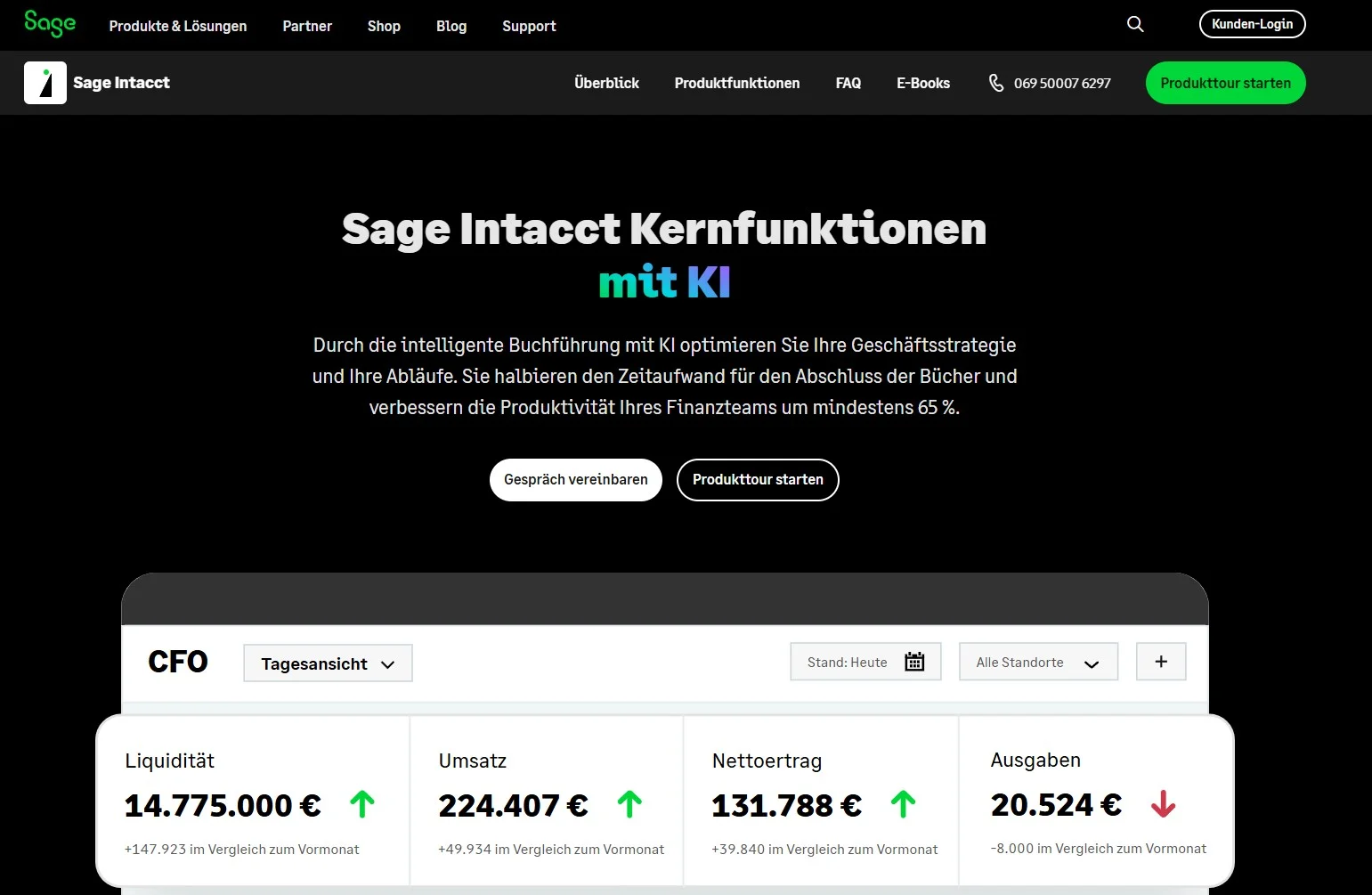
Sage has added several AI-powered features to its cloud financial management platform Intacct, covering accounts receivable and payable, procurement, and financial analysis. The update is aimed at automating recurring manual tasks in finance departments.
Software vendor Sage has added several AI-powered features to its cloud-based financial management platform Intacct. The updates primarily affect accounts receivable and payable, procurement, and financial analysis, and are intended to automate recurring manual tasks in finance departments.
The expansion comes amid growing pressure on finance teams to make decisions faster and manage cash flow more precisely. According to a study by market research firm Gartner, increasing the productivity of finance staff ranks among the top priorities for 88 percent of CFOs in 2026. Sage states that finance teams are often slowed down by siloed systems and manual processes.
Margarita Olshanskaia, the product manager responsible for the development, describes the approach as follows: the company does not integrate AI for its own sake, but focuses on controlled, transparent applications that provide concrete value for day-to-day work.
The following features are now available in Sage Intacct:
Close Automation with Close Analytics automates the month-end close and monitors it continuously. The feature is intended to replace manual spreadsheets and checklists. Close Analytics provides data-based insight into the closing process, identifying bottlenecks and surfacing the performance of individual business units as well as historical trends.
The Customer Payment Portal is a self-service platform that lets customers view, download, and directly settle open invoices, historical records, and order status. It supports credit card, direct debit, and digital wallet payments, as well as partial payments and automatic payment plans for recurring subscriptions. Companies can also send payment links for outstanding invoices.
With AP Automation: 3-Way Matching, the system links invoices, purchase orders, and receiving documents, comparing prices, quantities, and totals. Discrepancies at the line-item level are flagged for review before payment.
AI Line-Level Matching extends invoice review in accounts payable: instead of only checking the total amount of a supplier invoice, the AI automatically compares each individual line item with the corresponding entries from the purchase order and goods receipt.
Through Cash Intelligence: Payment Reminders, the system sends automated email reminders to speed up incoming payments and increase transparency around outstanding receivables.
Custom Approvals in Purchasing lets teams configure condition-based approval workflows for purchasing. Rules can be defined using fields such as vendor, amount, department, location, or category, so that transactions are routed to the appropriate approver.
Finally, the AI-powered Import Agent is designed to simplify the import of complex financial data. Instead of rigid, predefined CSV templates, finance teams can clean, adjust, and structure external data directly in the system using natural-language commands. According to Sage, the feature is particularly relevant for data migrations, company acquisitions, and regular reconciliation with third-party systems.
Sage positions the additions as a step toward shifting finance departments away from pure data administration and toward a more strategically oriented role within the company. By automating operational tasks such as invoice review, reconciliation, and approval processes, the company says teams should gain more time for activities like liquidity planning and supporting growth decisions.
The new features are available to existing Sage Intacct customers depending on their licensing model and module scope. Sage did not provide specific details on pricing or availability in individual country markets in its announcement. Companies interested in using the features can contact their existing Sage representative or an implementation partner.
The expansion is part of a broader industry trend in which financial software vendors are increasingly building AI features directly into existing ERP and accounting systems rather than offering them as separate add-on tools. Whether, and to what extent, the promised time savings materialize in practice will likely become clear only once customers have used the new features more widely.

Dr. Jakob Jung is Editor-in-Chief of Security Storage and Channel Germany. He has been working in IT journalism for more than 20 years. His career includes Computer Reseller News, Heise Resale, Informationweek, Techtarget (storage and data center) and ChannelBiz. He also freelances for numerous IT publications, including Computerwoche, Channelpartner, IT-Business, Storage-Insider and ZDnet. His main topics are channel, storage, security, data center, ERP and CRM.
Contact via Mail: jakob.jung@security-storage-und-channel-germany.de