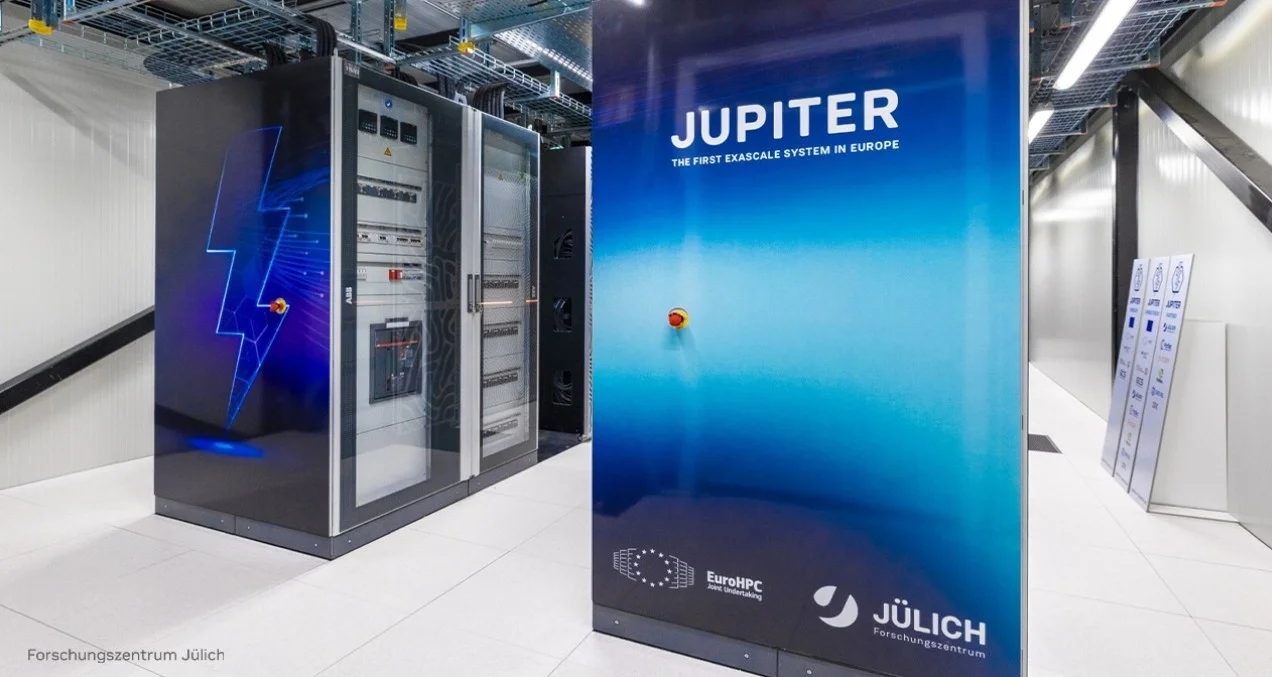
Germany is significantly expanding its high-performance computing landscape, led by Europe’s first exascale system, JUPITER, and the development of new AI factories to support researchers across climate science, neuroscience, and industrial engineering.
At the ISC High Performance 2026 conference in Hamburg, Germany, the international supercomputing community highlighted a major expansion of European computational power, deeply anchored in German research institutions. Central to this development is JUPITER, Europe’s first exascale supercomputer located at Forschungszentrum Jülich, which has entered active production across diverse scientific fields. Concurrently, a broader national expansion is underway with the development of new “AI factories” designed to secure sovereign infrastructure for both academic and industrial applications.
The Operational Impact of JUPITER
The JUPITER supercomputer, deployed at the Jülich Supercomputing Centre (JSC), utilizes NVIDIA Grace Hopper Superchips and Quantum-X800 InfiniBand networking. Ranked No. 5 on the latest TOP500 list of the world’s fastest supercomputers, the system represents a shift from theoretical capability to active scientific production, demonstrated by four primary projects:
- Neuroscience: The Jülich Brain Atlas project, alongside Helmholtz AI and partner institutions, utilized JUPITER to train “CytoNet,” a foundation model for brain microarchitecture analysis. The model processed 6.5 petabytes of data from 21 post-mortem brains using 4,096 Grace Hopper Superchips, completing training in under five days to map cellular-scale brain structures. The next phase involves integrating open models, including NVIDIA Nemotron 3 120B, to build multimodal AI assistants for automated experimental interrogation.
- Climate Modeling: A collaborative team including the Max Planck Institute for Meteorology, the German Climate Computing Centre (DKRZ), the University of Hamburg, ETH Zurich, and CSCS developed a novel ICON configuration. Running on 20,480 Grace Hopper Superchips, the model simulated a coupled Earth system—incorporating ocean, atmosphere, land, biogeochemistry, and the full carbon cycle—at a 1-kilometer global resolution. The system achieved a world record by simulating 146 days of climate data within a 24-hour compute window.
- Telecommunications: In March 2026, Ericsson and Forschungszentrum Jülich launched a collaboration leveraging JUPITER to train and test large-scale AI models for 5G evolution and future 6G networks. The initiative focuses on brain-inspired, energy-efficient architectures for complex network operations at the radio edge.
- Quantum Simulation: Researchers at JSC and the NVIDIA Application Lab achieved a universal 50-qubit quantum computer simulation via the JUQCS-50 simulator. The breakthrough relied on JUPITER’s coherent CPU-GPU memory architecture, which allows data exceeding GPU memory boundaries to spill into CPU memory with minimal performance degradation, surpassing the previous 48-qubit record.
Expansion of Germany’s AI Factories
Beyond JUPITER, Germany is establishing dedicated AI infrastructure to support over 3 million researchers across Europe. Out of a record 35 new NVIDIA-powered AI supercomputers in development continentally, key German installations include:
| System Name | Institution / Location | Infrastructure Specifications | Performance Targets | Focus Areas |
| HammerHAI | High-Performance Computing Center Stuttgart (HLRS) | >850 GPUs via NVIDIA GB200 NVL4 systems, Quantum-X800 InfiniBand | ~8 exaflops AI training, 15 exaflops AI inference | Engineering simulation, secure industrial workflows, LLM inference |
| Blue Swan | Friedrich-Alexander University (FAU) Erlangen & LRZ | 1,000 GPUs via NVIDIA GB200 NVL4 systems, Quantum-2 InfiniBand | 11 exaflops AI training, 22 exaflops AI inference | Bavaria’s foundation model initiative, robotics, health research, perception |
Michael Resch, director of HLRS, noted that HammerHAI functions as Germany’s first national AI factory, aimed at providing secure infrastructure to accelerate real-world engineering and scientific breakthroughs. In Bavaria, Science Minister Markus Blume confirmed that Blue Swan represents the largest GPU cluster at any German university, designed to meet European standards for autonomous foundation models.
Industrial and Quantum Advancements
The integration of accelerated computing extends directly into German industrial engineering and hybrid computing paradigms. Siemens Energy has deployed the Siemens Xcelerator portfolio, accelerated by NVIDIA technologies, to optimize gas turbine burners engineered to run on 100% hydrogen. Managing complex physics, extreme heat, and combustion dynamics via digital twins reduced simulation times by up to 77%, accelerating design validation cycles.
In the quantum sector, German institutions are formalizing hybrid quantum-classical frameworks. Fraunhofer FOKUS is leading the integration of the open, qubit-agnostic NVIDIA CUDA-Q platform with “Eclipse Qrisp,” a quantum programming language initiated at the institute. This integration enables researchers to write complex quantum algorithms that can be simulated, optimized, and compiled seamlessly across hybrid systems.
At the infrastructure foundation, the ISC rankings confirmed that NVIDIA technologies power 81% (401 systems) of the TOP500 and dominate the Green500 efficiency list, where Grace Hopper architecture captures the top four positions across Germany, France, and the UK, led globally by France’s KAIROS system.

Dr. Jakob Jung is Editor-in-Chief of Security Storage and Channel Germany. He has been working in IT journalism for more than 20 years. His career includes Computer Reseller News, Heise Resale, Informationweek, Techtarget (storage and data center) and ChannelBiz. He also freelances for numerous IT publications, including Computerwoche, Channelpartner, IT-Business, Storage-Insider and ZDnet. His main topics are channel, storage, security, data center, ERP and CRM.
Contact via Mail: jakob.jung@security-storage-und-channel-germany.de