As companies invest heavily in artificial intelligence, challenges in data infrastructure continue to limit progress. Starburst’s approach emphasizes federated access over large-scale data migration.
Enterprises face a persistent gap between ambitious AI goals and the practical realities of their data environments. Slow data preparation cycles, fragmented sources, and concerns over governance and context hinder the deployment of reliable AI systems. A presentation by Korbinian Zollner, Director of Solution Architects at Starburst, examined these issues during a Munich Data Breakfast event on June 10, 2026.
The divide between business expectations and IT capabilities remains a central challenge in digital transformation. Business units demand rapid insights and immediate responses to changing conditions, while IT departments manage complex, distributed data landscapes involving cloud, on-premises, and hybrid systems. Traditional approaches that rely on centralizing data into warehouses or lakes often require months of preparation, including sourcing, cleaning, deduplication, and consolidation.
Starburst, a company with roots in the open-source Presto query engine developed at Facebook in 2012, positions itself as a provider of federated data access solutions. After rebranding to Trino in 2020 and launching Starburst Galaxy in 2021, the company offers both fully managed cloud services and self-managed enterprise deployments. Its platform functions as a SQL query engine that connects to diverse data sources—including lakes, warehouses, and operational databases—without requiring full data movement.
This federation model aims to address key pain points. Connectors enable queries across AWS, Azure, Google Cloud, Oracle, and other systems. Security features are integrated rather than added later, supporting governance in hybrid environments. The company reports strong market traction, including a $100 million annual recurring revenue milestone, partnerships with Dell, NVIDIA, Accenture, Deloitte, and others, and significant adoption in Europe, where Germany ranks as its third-largest market.
The relevance to AI is particularly pronounced. While investments flow primarily into coding and model development, structured data remains the foundational “ground truth” for enterprise AI. Many AI initiatives stall due to insufficient data access, missing business context, and limited trust in outputs. Starburst highlights that effective AI requires not only performant models but also reliable data foundations that deliver context and governance.
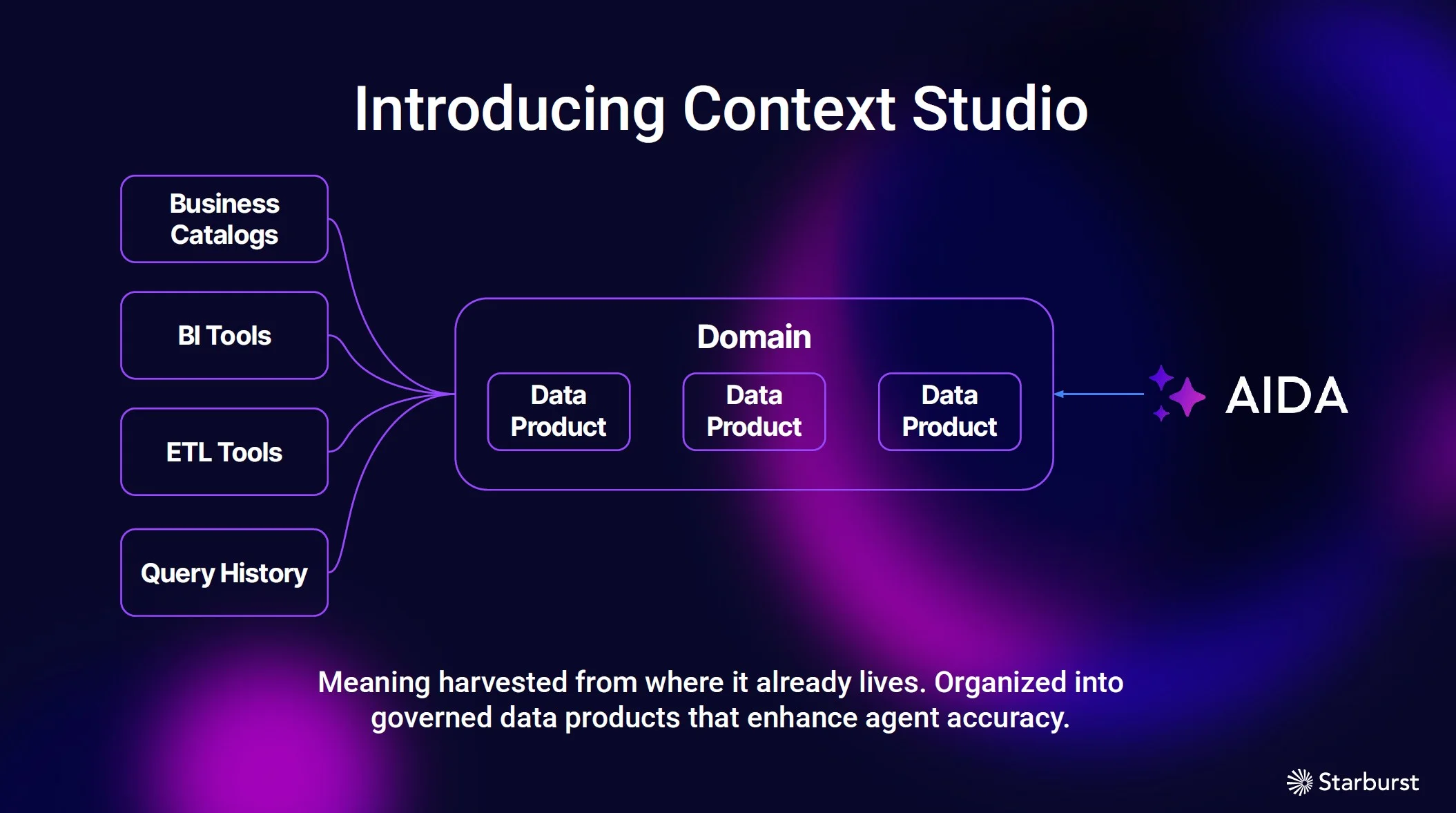
Recent developments include Context Studio and the AIDA agent. Context Studio harvests meaning from existing business catalogs, BI tools, ETL processes, and query history to create governed data products. AIDA, available now, functions as an agentic interface that can interpret natural language queries, support workflows, and potentially augment or replace traditional BI tools. It can be customized, embedded, and white-labeled for specific organizations, with internal use at Starburst demonstrating productivity gains.
The company’s innovation roadmap focuses on four pillars: a flexible data foundation, performant analytics engine, enterprise context layer, and trusted agentic interface. This structure seeks to enable AI readiness without extensive replatforming, maintaining data sovereignty and optionality across open formats like Apache Iceberg.
Analysts note that data gravity and application volatility create ongoing costs and risks for enterprises. Federated platforms like Starburst’s offer one response by stabilizing access across distributed estates. However, challenges persist, including competition from hyperscalers (Microsoft Fabric, AWS Redshift, Google BigQuery) and other analytics providers. Starburst emphasizes complementarity with tools like Databricks and Snowflake, particularly for large-scale, on-premises, or hybrid scenarios.
In summary, while AI dominates technology discussions, sustainable progress depends on addressing underlying data infrastructure. Approaches centered on intelligent access and federation may help bridge the gap between aspiration and execution in enterprise environments.

Dr. Jakob Jung is Editor-in-Chief of Security Storage and Channel Germany. He has been working in IT journalism for more than 20 years. His career includes Computer Reseller News, Heise Resale, Informationweek, Techtarget (storage and data center) and ChannelBiz. He also freelances for numerous IT publications, including Computerwoche, Channelpartner, IT-Business, Storage-Insider and ZDnet. His main topics are channel, storage, security, data center, ERP and CRM.
Contact via Mail: jakob.jung@security-storage-und-channel-germany.de