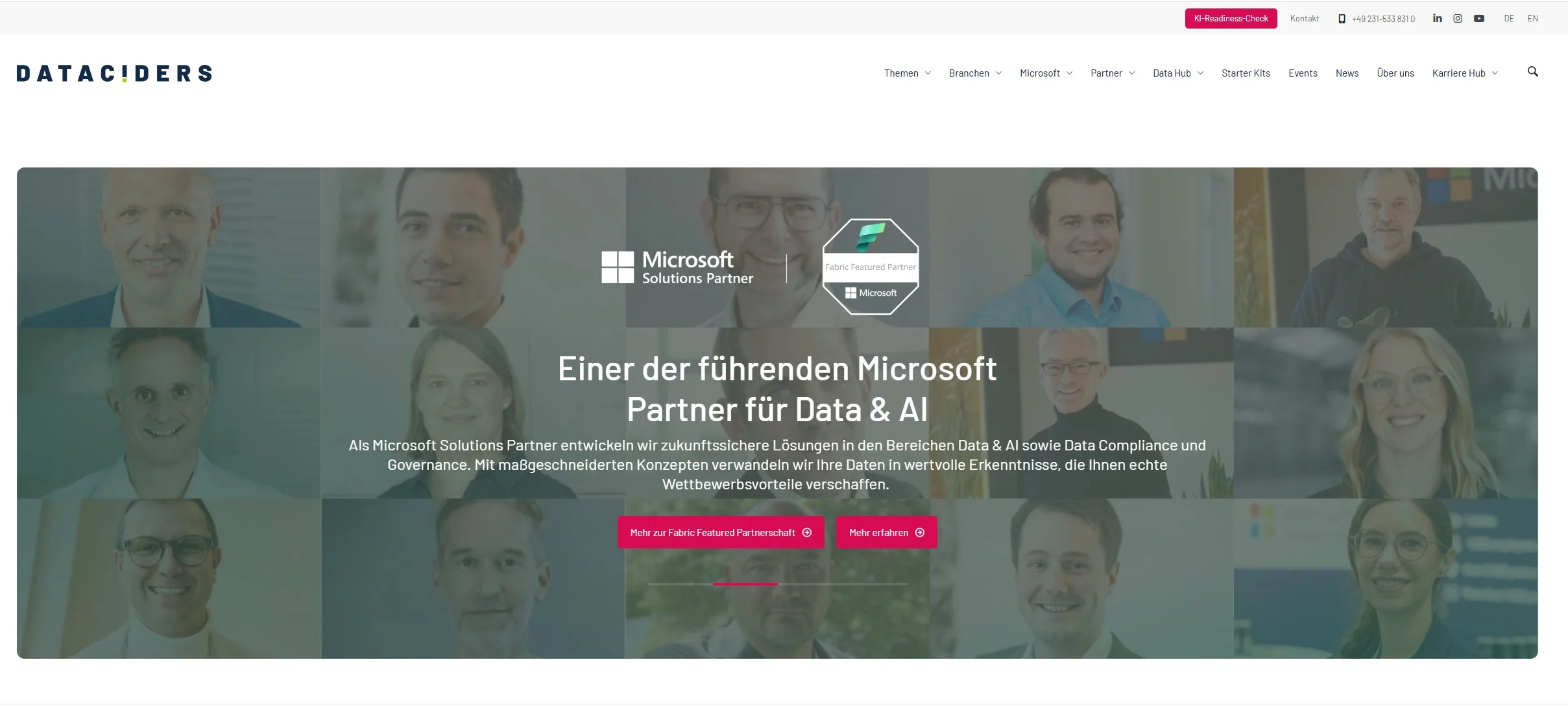
Dataciders achieved two Microsoft specializations (Analytics on Azure, AI on Azure) and Microsoft Fabric Featured Partner status in quick succession — demonstrating how structured audit preparation with distributor ADN drives measurable growth.
The IT industry is evolving at a pace that increasingly devalues broad, generalist competence. Cloud complexity, automation, and the industrial use of artificial intelligence demand clearly defined expertise from service providers. In the Microsoft ecosystem, this is reflected in a certification system that not only requires rigorous quality proof from partners but also offers concrete benefits in return: access to funding, co-selling programs, and greater visibility with potential clients.
For IT services company Dataciders, strengthening this profile was a strategic objective — and an organizational challenge. How the company addressed it offers a practical example of coordinated growth within a regulated partner environment.
A Company With a Clear Growth Strategy
Dataciders is an established provider of data and AI solutions in the German-speaking market. Around 1,000 specialists work across twelve locations, serving more than 100 enterprise clients — including numerous companies in the top-50 tier. In 2024, Dataciders realigned its growth strategy, placing the deliberate expansion of its Microsoft business at the center.
“We see the Microsoft ecosystem as a core driver of digital transformation. By systematically expanding our activities, we enable scalable, data-driven innovation for our clients,” explains Dr. Gero Presser, CEO of Dataciders.
As a first step, the company targeted the Analytics on Azure and AI on Azure specializations — both directly aligned with its core competencies. Dataciders operates dedicated teams for Microsoft Fabric, Databricks, and AI Foundry topics, and had an extensive track record of client projects to draw on.
The Challenge: Demonstrating Competence in a Structured Way
Earning a Microsoft specialization requires passing an audit that examines real client projects for technical quality, security, and adherence to Microsoft best practices. Requirements are extensive, and documentation standards are demanding.
Dataciders faced a specific organizational challenge: the group comprises ten legal entities in Germany plus additional units in Austria and Bulgaria — each with its own workflows, documentation structures, and project references. The technical depth was there; what was missing was a unified presentation that would be transparent, comparable, and verifiable in an audit.
ADN as Structural and Audit Partner
To address this systematically, Dataciders brought in value added distributor ADN. The Bochum-based company supports Microsoft partners through its “How to Specialize” program, guiding them through the entire audit process — from interpreting requirements to preparing for the examination itself.
ADN’s methodology combines two modules: a strategic Cloud Foundation for alignment and planning, and a practice-oriented module in which concrete client projects are documented across all relevant implementation phases. In the Dataciders engagement, ADN also took on the role of an independent review body through a pre-audit.
“ADN helped us translate our technical expertise consistently into Microsoft’s structure and terminology,” says Markus Kottwitz, Partner Manager Microsoft at Dataciders. “That coaching was a key factor in achieving the specializations at the required level of quality.”
Damian Bieniek, Cloud & Partner Solution Architect at ADN, notes: “Dataciders approached this in an extremely structured way. The commitment, clarity of goals, and consistency throughout the process were remarkable.”
Execution: A Coordinated Project Across Multiple Locations
Over several weeks, approximately 20 team members from Berlin, Dortmund, Munich, and Nuremberg worked closely together on audit preparation. Teams from the Competence Center Data & Process and the company-wide Microsoft initiative provided technical, organizational, and documentary contributions to building the required evidence.
For Analytics on Azure, Dataciders prepared three analytics platforms built on Microsoft Fabric and Databricks — covering everything from design through development, deployment, and client handover. For AI on Azure, Microsoft requires proof of complete AI implementation processes. Dataciders presented multiple projects: a chatbot development, an automated document recognition system for the legal sector, a validation model for image material in psychological testing, and two migrations of on-premise systems to modern Azure architectures.
The pre-audit with ADN deliberately applied critical pressure: experts simulated realistic examination scenarios and asked probing questions. The result: Dataciders passed both official audits without a single finding. The review team noted it as one of the most thoroughly structured audits they had assessed.
Impact: Visibility, Funding Access, and Internal Process Quality
By achieving the specializations, Dataciders also attained Microsoft Fabric Featured Partner status — currently held by around 30 companies in Germany. The specializations additionally unlock Microsoft funding programs with a value of up to $75,000 per client, covering workshops, discovery phases, and technical proofs of concept.
“We’re already seeing that our Microsoft business has gained significant momentum. The share of total revenue is currently around 25 percent — with a clearly rising trend. The additional visibility and the funding programs are opening access to projects and clients that simply weren’t reachable before,” says Kottwitz.
Internally, the audit process drove lasting standardization: project methodologies, team handovers, and documentation standards were unified and professionalized across the entire group — a foundation that will ease future certification efforts.
Outlook: Additional Specializations and Deeper Distributor Partnership
Dataciders plans to continue on this path. Additional Microsoft specializations are already in preparation. In parallel, the company is building out its role as a “frontier firm” — an organization that not only implements Microsoft technologies for clients but deploys them comprehensively in its own operations.
The partnership with ADN remains central to this strategy. Dataciders is increasingly consolidating its licensing business with ADN and is pursuing joint growth in the CSP segment.

Dr. Jakob Jung is Editor-in-Chief of Security Storage and Channel Germany. He has been working in IT journalism for more than 20 years. His career includes Computer Reseller News, Heise Resale, Informationweek, Techtarget (storage and data center) and ChannelBiz. He also freelances for numerous IT publications, including Computerwoche, Channelpartner, IT-Business, Storage-Insider and ZDnet. His main topics are channel, storage, security, data center, ERP and CRM.
Contact via Mail: jakob.jung@security-storage-und-channel-germany.de