As autonomous AI agents and complex cloud environments rewrite enterprise security, HYCU introduces complete protection for Azure DevOps alongside AI-driven visibility tool HYCU aiR Graph, as shown on IT Press Tour.
At the IT Press Tour in in Ljubljana, Slovenia , HYCU, Inc. has announced the general availability of HYCU R-Cloud for Azure DevOps. The new integration brings full-surface, granular data protection to Microsoft’s popular DevOps suite, complementing HYCU’s expanding AI resilience capabilities, including the newly introduced HYCU aiR Graph platform.
A Shift in DevOps Security
Azure DevOps serves as the operational backbone for over 30,000 enterprise organizations across financial services, healthcare, and public sectors. While traditional backup vendors treat DevOps protection purely as a repository issue, native tools leave substantial exposure gaps. Native retention limits—such as 28 days for deleted organizations or 30 days for repositories—often fail to cover complex interdependencies. Crucially, items deleted using destructive parameters bypass the recycle bin completely, leaving organizations vulnerable to permanent data loss.
“When teams think about protecting Azure DevOps, they think about repositories,” noted Anant Chintamaneni, Chief Product Officer at HYCU. “Repositories are the easy part. The real risk lives in the pipeline definitions, the process templates, the wiki that’s a Git repo with a service layer bolted on top. Miss any of that and you can restore every file and still hand a team a project they can’t work in.”
Complete Delivery System Protection
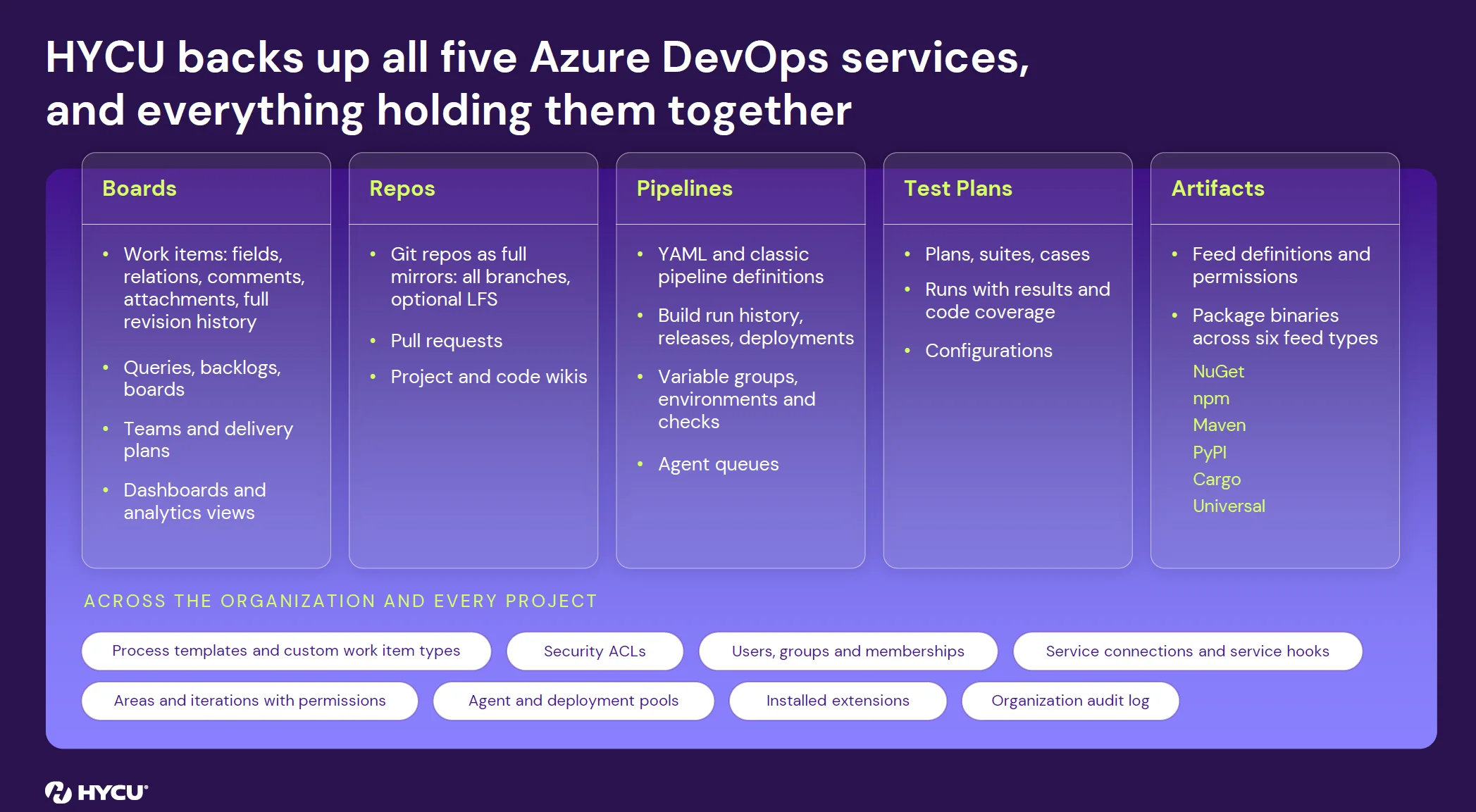
HYCU R-Cloud for Azure DevOps addresses these vulnerabilities by protecting the platform as an interconnected ecosystem rather than isolated files. Across all five core Azure DevOps services—Repos, Boards, Pipelines, Test Plans, and Artifacts—HYCU captures not only raw assets but also custom work item schemas, variable groups, service connections, and complete revision histories.
Key features of the new integration include:
- Schema-Aware Backups: Preserves custom work item types and process templates so projects recover with their original structures intact.
- Granular and In-Place Recovery: Restores individual work items, repositories, pipelines, or entire organizations without disrupting unaffected workflows.
- Immutable, Customer-Owned Storage: Ensures backups land directly in customer-managed storage utilizing WORM and Object Lock immutability to prevent unauthorized deletion.
- Audit-Ready Evidence: Exports build histories, release logs, and organization audit trails with custom retention periods independent of Azure DevOps windows.
Countering the Era of Agentic Risk The launch follows preview demonstrations at the 69th IT Press Tour in Ljubljana, Slovenia, where HYCU executives highlighted the emerging threats posed by autonomous AI agents. As read/write AI assistants operate inside organizational perimeters at machine speed, misinstructions, standing credential abuse, or agent hallucinations can wipe out critical databases and backups within seconds.
To address these non-human identity risks, HYCU showcased HYCU aiR Graph, a discovery and visualization platform designed to map interactions between SaaS applications, code repositories, and autonomous AI agents. By providing real-time visibility into OAuth scopes, active identities, and unmonitored agent activity, HYCU bridges the gap between proactive governance and rapid disaster recovery.
“Most vendors treat DevOps protection as a repository problem because repositories are what’s visible,” said Philippe Nicolas, Market Watcher at Coldago Research. “HYCU is making the case that the real unit of protection is the delivery system itself. Competitors built for the artifact while HYCU built for the system.”
With this release, Azure DevOps joins Microsoft 365, Entra ID, Azure, and GitHub under HYCU’s unified data protection policy framework, reinforcing the vendor’s position in enterprise SaaS resilience.
Pricing and Sales
- HYCU AiR Graph (Free Standalone Tier): The visualization tool that maps non-human AI identities, agents, OAuth scopes, and application estates is provided 100% free of charge to any customer or organization.
- Core Data Protection / Workload Pricing: Customers pay for underlying backup and recovery by purchasing specific workload integrations through the HYCU Marketplace (e.g., per workload or per integrated SaaS application).
- HYCU AiR Platform Uplift Fee: Rather than charging on a per-query or per-agent usage basis—which could result in escalating costs if agents go rogue—HYCU charges a flat 25% platform uplift fee on top of what the customer pays for underlying data protection. This flat fee unlocks full access to AI/agentic recovery, HYCU AiR, DSPM, data classification, and natural language cyber intelligence capabilities.
- Sales & Channel Strategy: HYCU is a 100% channel-driven company. HYCU AiR and core data protection services are sold through:
- Traditional VARs/Distributors (3-tier channel model).
- Dell (available directly on Dell’s enterprise price list).
- Cloud Hyperscaler Marketplaces (AWS, Microsoft Azure, Google Cloud).
- Managed Service Providers (MSPs), who can offer HYCU AiR as a managed service to end customers.
Engineering & R&D Strategy
- Ljubljana Engineering Hub: The presentation took place directly at HYCU’s main R&D and engineering center in Ljubljana, Slovenia, where core platform architecture—including HYCU AiR and graph-visualization capabilities—is actively developed.
- Decoupled Architecture: HYCU built AiR natively into its platform using a lightweight graph engine and metadata layer. By separating metadata intelligence from bulk backup payload transfers, HYCU enables real-time relationship mapping (identities, agents, and OAuth permissions) without heavy storage or network overhead.
Business Model & Risk Management
- Predictable Monetization vs. “Runaway Agent Risk”: HYCU highlighted that consumption-based pricing (charging per query or per LLM execution) creates unpredictable billing for enterprise security teams. If an autonomous agent enters a loop or requires hundreds of reasoning steps, per-query pricing incurs massive unexpected costs. The 25% flat platform uplift fee was specifically designed to mitigate this risk while guaranteeing predictable margins.
- Free Tier Strategy as a Growth Engine: Offering HYCU AiR Graph (formerly R-Graph) for free acts as a top-of-funnel customer acquisition tool. It exposes hidden SaaS shadow IT, unmonitored non-human identities, and gaps in enterprise backup coverage, which directly drives adoption of paid backup workloads.
Strategic Partnerships
- Deep Co-Engineering with Dell: Beyond standard VAR distribution, HYCU highlighted its strategic co-engineering relationship with Dell. Dell sales representatives can sell HYCU directly off Dell’s enterprise price list to protect multi-cloud, SaaS, and agentic AI workloads alongside Dell PowerProtect ecosystems.
- Hyperscaler Co-Sell Alignment: Cloud marketplaces (AWS, Azure, Google Cloud) allow enterprise IT teams to purchase HYCU workloads and the 25% AiR platform uplift using existing committed cloud spend (e.g., AWS EDP commitments).

Dr. Jakob Jung is Editor-in-Chief of Security Storage and Channel Germany. He has been working in IT journalism for more than 20 years. His career includes Computer Reseller News, Heise Resale, Informationweek, Techtarget (storage and data center) and ChannelBiz. He also freelances for numerous IT publications, including Computerwoche, Channelpartner, IT-Business, Storage-Insider and ZDnet. His main topics are channel, storage, security, data center, ERP and CRM.
Contact via Mail: jakob.jung@security-storage-und-channel-germany.de