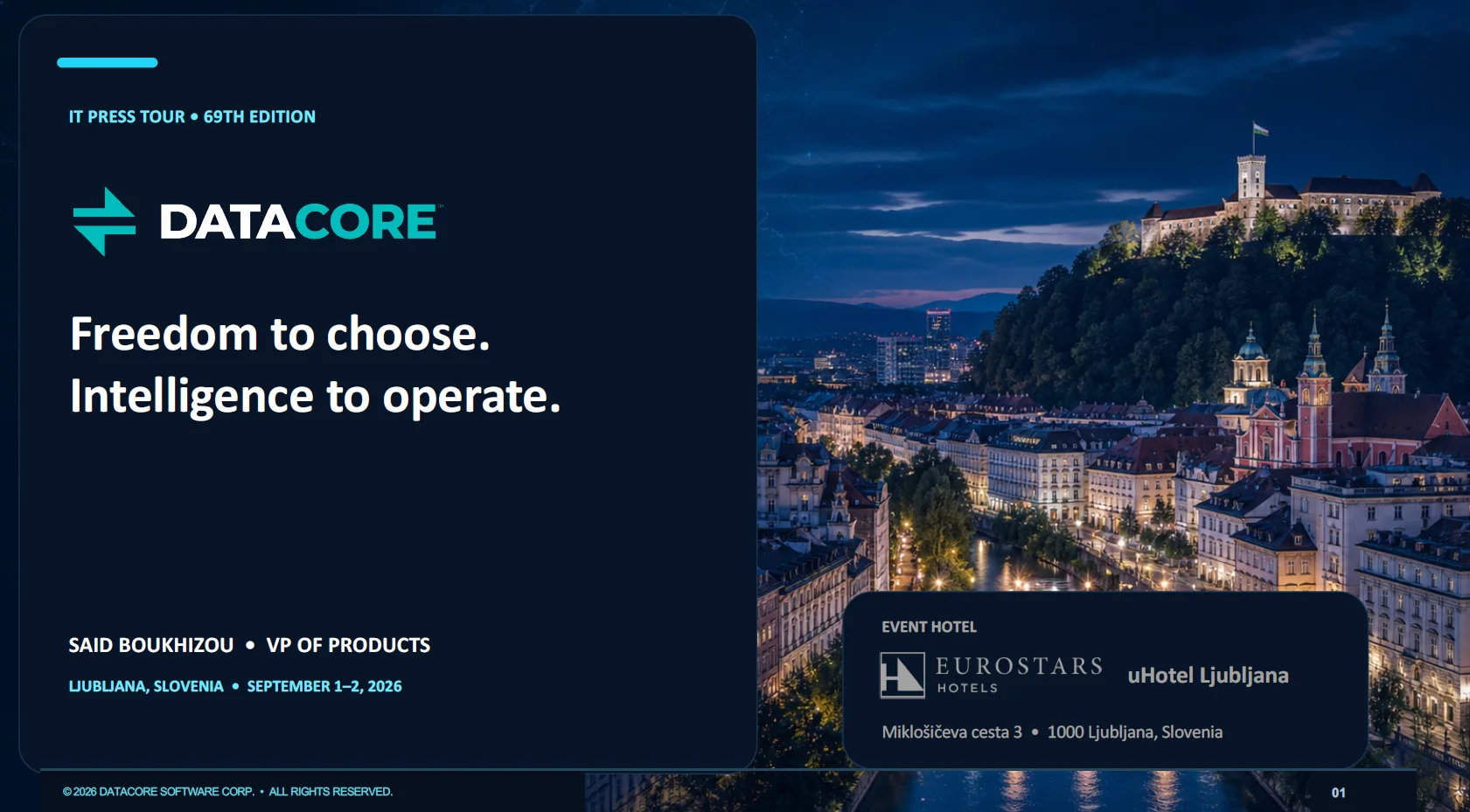
At the IT Press Tour in Ljubljana, DataCore outlined how hardware and hypervisor independence, recent acquisitions, and a unified platform with agentic AI address VMware disruption, hardware shortages, cyber resilience, and the explosion of AI-driven data.
In a detailed session at the 69th IT Press Tour in Ljubljana on 1–2 September 2026, Said Boukhizou, DataCore’s VP of Products, framed the company’s evolution as a strategic journey from pure freedom of choice to autonomous, intelligent storage operations. Speaking to European journalists, he positioned DataCore not as another storage vendor but as an enabler of customer control in an era defined by Broadcom’s VMware acquisition, server scarcity, regulatory pressure, and AI-driven data growth.
Boukhizou opened with the company’s foundational principle: freedom. DataCore’s software-defined approach has long allowed customers to select any qualified x86 server, mix brands and generations (including refurbished systems), switch hypervisors without rewriting the data layer, and deploy across core, edge, or cloud without lock-in. “No lock-in. No forced reset,” the slides stated. Supported hypervisors include VMware ESXi, Microsoft Hyper-V, Proxmox, Xen, XCP-ng, and KVM. Data remains accessible via standard protocols such as SCSI and object storage; the company deliberately avoids proprietary encapsulation.
This freedom has become operationally critical. Hardware lead times exceeding 20 weeks and rapidly rising prices have stalled projects, particularly in the public sector where procurement cycles routinely exceed short quotation validity windows. By allowing customers to reuse existing servers or mix available hardware, DataCore turns scarcity into resilience. The same independence applies to the virtualization layer. Organizations exiting VMware can retain their data-services stack while migrating compute to Proxmox or Hyper-V; a built-in conversion tool assists VM movement. Proxmox adoption, Boukhizou noted, has surged more than 200 percent in conversations with customers.
Market forces have multiplied the challenge. Data centers are no longer the sole center of data. Core, edge, cloud-native, and AI workloads demand different performance, economics, and resilience models—creating plurality that makes freedom more valuable yet harder to operate. Four simultaneous pressures reshape strategy: AI and high-performance computing (where data movement becomes the bottleneck), cyber resilience (recovery must be designed in from the start), compliance (evidence and audit trails are now operational requirements under NIS2, DORA, and the Cyber Resilience Act), and distributed IT (edge sites cannot assume local expertise).
DataCore responded by expanding its portfolio through targeted acquisitions—Caringo (Swarm object storage), MayaData (Kubernetes/container storage, now Puls8), StarWind (Linux-based edge and ROBO solutions), and others focused on media and HPC. The goal was depth in specialized use cases rather than a single monolithic product. Integration of people, processes, and technology is now complete. Customers experience a single go-to-market, support, and management plane.
The next chapter is a unified platform operated by agentic AI, scheduled for formal reveal at the company’s partner conference later in September 2026. The agent observes telemetry across capacity, performance, resiliency, compliance, and lifecycle; correlates events; recommends actions; and, with human approval, can execute workflows such as tiering cold data from expensive NVMe to object storage. Three permission modes keep control with the operator: read-only monitoring, limited operational actions, and elevated support privileges. Customers may use DataCore’s trained skills model or bring their own LLM (OpenAI, Anthropic, Mistral, Gemini, or local models such as Kimi). Dark-site and air-gapped options are planned.
Boukhizou stressed pragmatism over hype. Full autonomy is not the objective for primary storage protecting hospitals, factories, or financial systems. “Always human in the loop,” he said. The agent reduces mean time to resolution by pre-correlating logs and context before tickets reach support—an obsession driven by customer satisfaction rather than marketing claims.
Real-world examples underscored the approach. ArcelorMittal runs SANsymphony under VMware in France and Hyper-V in Spain for continuous steel-production applications while using Swarm for immutable long-term storage of environmental telemetry required by regulators. Supermarket chains and pharmaceutical plants deploy isolated edge instances to shrink attack surfaces. Over 10,000 customer logos and more than half a million nodes (excluding dark sites such as cruise ships and military installations) form the installed base.
The message was clear: freedom without operational intelligence is incomplete. By combining hardware and platform independence with a single control plane and carefully scoped agentic assistance, DataCore aims to let customers choose their stack, operate it efficiently, optimize costs, and evolve without forced resets—exactly the resilience required when infrastructure strategy is being rewritten on multiple fronts at once.

Dr. Jakob Jung is Editor-in-Chief of Security Storage and Channel Germany. He has been working in IT journalism for more than 20 years. His career includes Computer Reseller News, Heise Resale, Informationweek, Techtarget (storage and data center) and ChannelBiz. He also freelances for numerous IT publications, including Computerwoche, Channelpartner, IT-Business, Storage-Insider and ZDnet. His main topics are channel, storage, security, data center, ERP and CRM.
Contact via Mail: jakob.jung@security-storage-und-channel-germany.de
The shift from infrastructure freedom to agentic AI operations is an interesting direction for modern data management. I especially like the focus on hardware and hypervisor independence, as it can help organizations adapt to changing infrastructure needs without unnecessary lock-in. Combining this flexibility with human-controlled agentic AI could also improve operational efficiency while maintaining security an