Chinese backup-and-recovery vendor Vinchin presented its enterprise data-protection platform and international expansion plans at IT Press Tour #68 in Boston, positioning itself as a lower-cost alternative to Veeam and similar vendors.
At the 68th edition of the IT Press Tour in Boston, Chengdu-based Vinchin Technology presented its data-protection and disaster-recovery platform to an international press audience. The session, led by Director of Sales Minnie Du and Overseas Technical Director Neil Zhuo, covered the company’s global market strategy, licensing model, product architecture, and a product roadmap that extends through the end of 2027. The presentation also surfaced a pointed question about the political dimension of European procurement of Chinese-origin software — a challenge the company acknowledged directly.
Vinchin Technology, founded in 2015 and headquartered in Chengdu, China, operates in the enterprise data-protection segment with a product called Vinchin Backup & Recovery. The company reports a partner network spanning more than 60 countries, end customers in more than 100 countries, over 30,000 completed project implementations, and more than six million protected workloads. Its headcount stands at 200–500 employees, roughly half of whom work in research and development.
The company has been recognised as a “Strong Performer” in the Gartner Peer Insights Voice of the Customer report for two consecutive years. Vinchin positions itself as a vendor addressing three distinct market segments: large enterprises with complex IT environments and high-availability requirements; small and medium businesses looking for affordable, manageable backup; and cloud service providers seeking to offer Backup-as-a-Service (BaaS) and Disaster Recovery as a Service (DRaaS).
PRICING AND LICENSING
One of the recurring themes of the Boston session was pricing. During the Q&A, Vinchin representatives offered direct comparisons: against Commvault, the company claims a per-virtual-machine cost roughly 50 percent lower; against Veeam, the differential is cited at approximately 30 percent. These figures were provided verbally and have not been independently verified.
The licensing structure is a deliberate differentiator. While Veeam and most legacy vendors offer only subscription models, Vinchin retains a perpetual licence option — a one-time purchase granting indefinite use rights. Annual maintenance fees apply from the second year onward. The company states these fees represent between 20 and 40 percent of the equivalent annual subscription cost. A second tier, the subscription licence, is priced per virtual machine on an annual basis. The two models differ structurally: the perpetual licence is tied to the number of physical CPU sockets, while the subscription licence is counted per workload, meaning organisations with rapid VM growth may find subscription costs escalate faster over time.
PRODUCT ARCHITECTURE
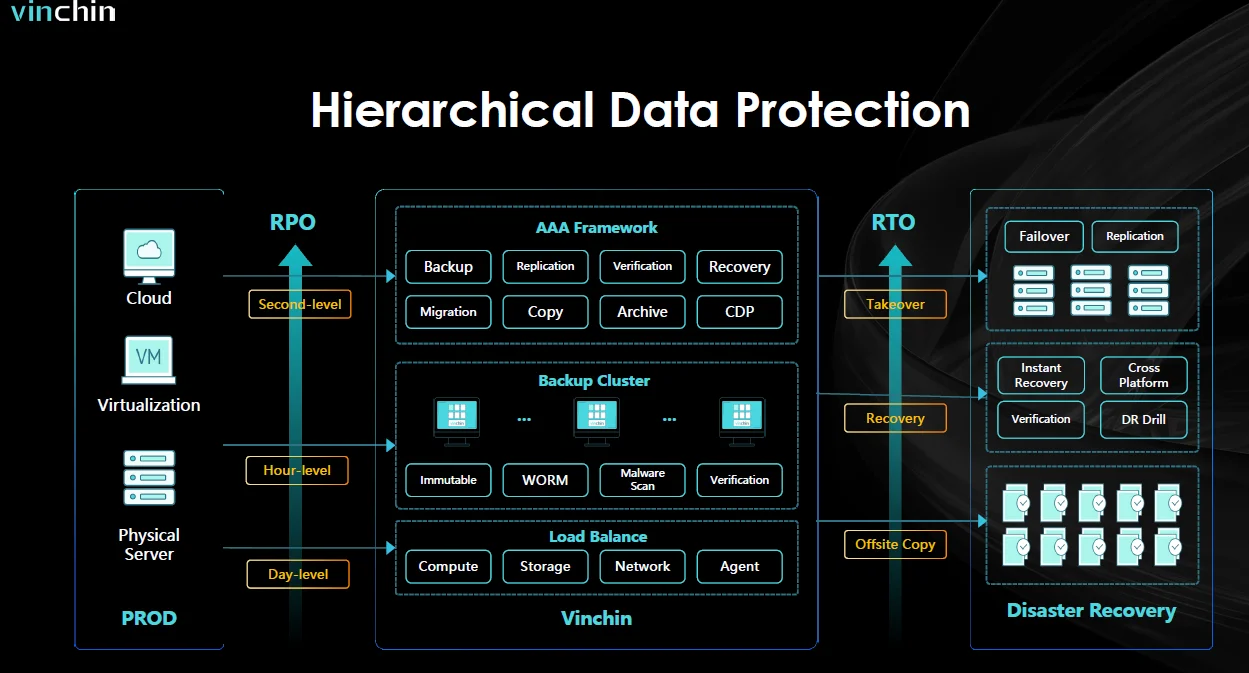
Vinchin Backup & Recovery is built around three components. The Master Server provides centralised management and can be deployed as an all-in-one appliance on physical or virtual hardware. Slave Nodes extend computational capacity for larger environments or remote-office deployments. Agents and Proxies handle communication and data transfer for specific scenarios — notably, VMware backup operates agentlessly via the hypervisor API, without requiring an agent inside each protected VM.
The platform’s compatibility matrix is broad. On the virtualisation side it supports VMware, Microsoft Hyper-V, Citrix, Red Hat oVirt, Oracle Linux Virtualization Manager, Proxmox, Huawei, H3C, ZStack, Sangfor, and Arcfra. Operating system coverage includes Windows, CentOS, Red Hat, Debian, Ubuntu, SuSE, Oracle Linux, and Rocky Linux. Supported databases include Oracle, SQL Server, PostgreSQL, MySQL, and MariaDB. SaaS-layer coverage extends to Microsoft Exchange Server and Exchange Online. The platform currently supports public-cloud backup for AWS and Huawei Cloud instances; Google Cloud Platform and Oracle Cloud Infrastructure are not yet on the compatibility list, a gap acknowledged by the presenters. When asked about Verge.io, a KVM-based US hypervisor gaining traction as a VMware alternative, Vinchin stated it is under evaluation.
SECURITY AND DATA INTEGRITY
Vinchin articulates its security posture around an extended 3-2-1-1-0-0 backup framework: three copies of data, on two different storage media, with one copy off-site, one copy in immutable storage, zero data errors confirmed through automated verification, and zero trust access to prevent unauthorised operations. The immutable backup implementation works at the kernel level, using an I/O monitor that restricts write access to backup storage exclusively to the Vinchin backup process. Integration options include WORM storage, cloud object-lock, tape libraries, and third-party WORM appliances.
Automated backup verification runs backups through a sandboxed “DR Lab” environment — an embedded KVM-based virtualisation layer within the Vinchin server — to confirm that each backup can actually boot and operate. Verification checks include screenshot capture, heartbeat monitoring, ping tests, and malware scanning. This eliminates the need to consume production resources or third-party virtualisation infrastructure during verification. The malware scan component uses both an embedded engine and optional third-party engines, following an identify-mark-isolate-clean workflow.
USE CASES
Two enterprise case studies were presented in detail. The first involved a financial institution managing more than 20,000 VMs on Huawei FusionCompute while executing a migration away from VMware. The Vinchin solution provided multi-node parallel backup, a unified management console, cross-platform disaster recovery between VMware and FusionCompute, and immutable audit logs meeting banking-sector compliance requirements. The second case involved a large Belarusian telecommunications operator backing up more than 2,000 VMs across a hybrid VMware and ZStack environment. The key differentiator cited was Vinchin’s ability to manage both hypervisors from a single console with LAN-free backup and cross-platform DR.
ROADMAP
The published roadmap runs in three phases. By Q4 2026: Nutanix AHV support, VMware storage snapshot integration, synthetic full backup, and OceanProtect WORM integration. In Q2 2027: agentless real-time VMware replication, disk-level exclusion controls in the web interface, backup data expiration management, expanded X2X migration tooling, and support for GoldenDB and AIX-plus-Oracle databases. By Q4 2027: a dedicated migration product covering virtualisation, server, and file workloads; GaussDB and OceanBase database support; integration with Alibaba Cloud and Azure; and an AI assistant for guided troubleshooting and recovery guidance.
EUROPEAN MARKET AND GEOPOLITICAL HEADWINDS
A Spanish attendee raised the question of whether Vinchin encounters resistance in the European public sector, given that EU institutions have moved to limit reliance on Chinese technology vendors. Vinchin’s response outlined a two-track approach: first, OEM cooperation with local European partners who can rebrand the product and engage government customers directly; second, a compliance-and-reference argument citing ISO certifications and existing deployments at globally recognised institutions, including the University of Southern California, Cancer Research UK’s Manchester Institute, and the City of San Gabriel in California. The company acknowledged that some European government prospects remain unwilling to proceed regardless of these measures, and indicated it would continue exploring alternative cooperation models.
Vinchin’s go-to-market model is channel-first. Its existing European partner references include IT56 GmbH in Germany, Mediatec and Chips in Italy, CDI (Cours Diffusion Infrastructure) in France, and Taurus in Spain. For the US market, the company confirmed partners including Comprehensive Computers and ICE Systems.
Dr. Jakob Jung is Editor-in-Chief of Security Storage and Channel Germany. He has been working in IT journalism for more than 20 years. His career includes Computer Reseller News, Heise Resale, Informationweek, Techtarget (storage and data center) and ChannelBiz. He also freelances for numerous IT publications, including Computerwoche, Channelpartner, IT-Business, Storage-Insider and ZDnet. His main topics are channel, storage, security, data center, ERP and CRM.
Contact via Mail: jakob.jung@security-storage-und-channel-germany.de