Growing operational complexity is forcing organizations to rethink how they manage infrastructure across data centers, cloud environments and edge deployments. As IT teams face increasing demands with limited resources, automation, interoperability and centralized management are emerging as key factors for improving efficiency while supporting long-term digital transformation.
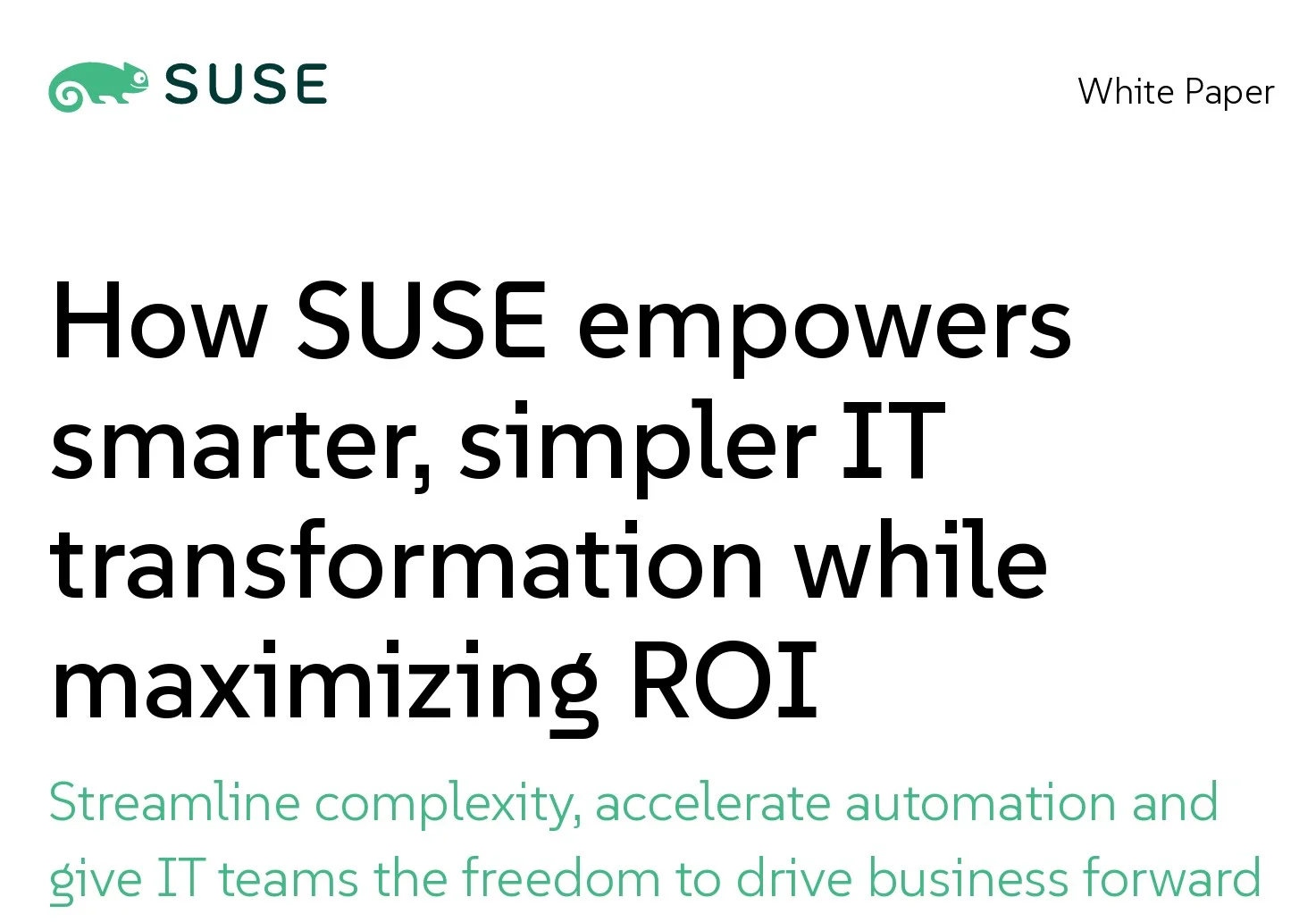
According to the recent SUSE white paper “How SUSE empowers smarter, simpler IT transformation while maximizing ROI” the time to take action has arrived: For many organizations, digital transformation is no longer defined by adopting new technologies alone. Increasingly, success depends on an organization’s ability to manage growing operational complexity while maintaining security, availability and cost control. As hybrid infrastructures expand across data centers, multiple cloud platforms and edge environments, IT departments are under pressure to deliver faster services without proportionally increasing budgets or staffing. Recent industry discussions suggest that simplifying IT operations may now be as important as introducing new technologies.
The role of enterprise IT has changed considerably over the past decade. Infrastructure teams are expected not only to maintain stable operations but also to support cloud-native development, artificial intelligence initiatives, cybersecurity requirements and increasingly distributed workloads. At the same time, organizations continue to demand shorter deployment cycles and greater business agility.
This combination has exposed the limitations of traditional infrastructure management. Manual maintenance, fragmented monitoring tools and isolated operational processes consume valuable resources while making it more difficult to respond quickly to changing business requirements. Rather than enabling innovation, many IT departments spend significant time maintaining existing systems.
According to the SUSE white paper, organizations can address these challenges by reducing operational complexity through open, interoperable infrastructure and greater automation. The report argues that simplifying lifecycle management, system maintenance and application deployment enables IT teams to focus more resources on strategic projects instead of routine administration.
Automation is presented as one of the primary drivers of operational efficiency. Routine activities—including patch management, updates and infrastructure maintenance—can increasingly be standardized through automated workflows. Beyond reducing manual effort, automation also helps improve consistency across environments while lowering the risk of configuration errors that frequently contribute to outages or security vulnerabilities.
Visibility across increasingly diverse infrastructures represents another major challenge. Many enterprises now operate combinations of Linux platforms, virtual machines, Kubernetes clusters and public cloud services. Without centralized monitoring, identifying performance issues or security incidents becomes increasingly difficult. Comprehensive observability, combined with predictive analytics, allows organizations to identify potential problems earlier and reduce recovery times when incidents occur.
Interoperability has also become an important consideration. Modern enterprise applications frequently span multiple cloud providers while integrating on-premises infrastructure and edge systems. Proprietary platforms may introduce operational silos that complicate management and increase long-term dependency on individual vendors. Open technologies and standardized management approaches seek to reduce these barriers by enabling organizations to manage heterogeneous environments through unified operational processes.
Edge computing introduces an additional layer of complexity. Remote deployments often operate under bandwidth limitations and require reliable remote administration. Automated maintenance, centralized policy management and simplified deployment models can reduce operational overhead while improving consistency across geographically distributed systems. Customer examples referenced in the white paper describe shorter deployment times and improved scalability following the adoption of simplified edge management approaches.
Artificial intelligence is creating further operational demands. Beyond deploying AI models, organizations must address governance, security, compliance and lifecycle management. As AI projects move from experimentation into production, infrastructure platforms capable of supporting standardized provisioning, monitoring and security controls are becoming increasingly important components of enterprise IT strategies.
Ultimately, many organizations are shifting their attention from simply expanding technology portfolios toward improving operational efficiency. Simplifying infrastructure management, increasing automation and improving interoperability may help IT departments allocate more time to innovation while maintaining reliable day-to-day operations. Rather than viewing digital transformation solely as the adoption of new technologies, enterprises increasingly appear to regard operational simplicity as a strategic capability that supports long-term business resilience.

Dr. Jakob Jung is Editor-in-Chief of Security Storage and Channel Germany. He has been working in IT journalism for more than 20 years. His career includes Computer Reseller News, Heise Resale, Informationweek, Techtarget (storage and data center) and ChannelBiz. He also freelances for numerous IT publications, including Computerwoche, Channelpartner, IT-Business, Storage-Insider and ZDnet. His main topics are channel, storage, security, data center, ERP and CRM.
Contact via Mail: jakob.jung@security-storage-und-channel-germany.de