IDC Research shows that 79% of cloud buyers already operate multicloud environments. Those who do it strategically achieve positive ROI twice as fast — and are far better positioned for the GenAI era.
The idea of spreading workloads across multiple cloud providers was once considered a niche concern of large enterprises. According to IDC’s Q3 2024 Cloud Pulse Survey, nearly four in five organizations are already operating or deploying a multicloud strategy. The question is no longer whether to go multicloud, but how to do it well — and what happens to those who delay.
From lock-in anxiety to open architecture
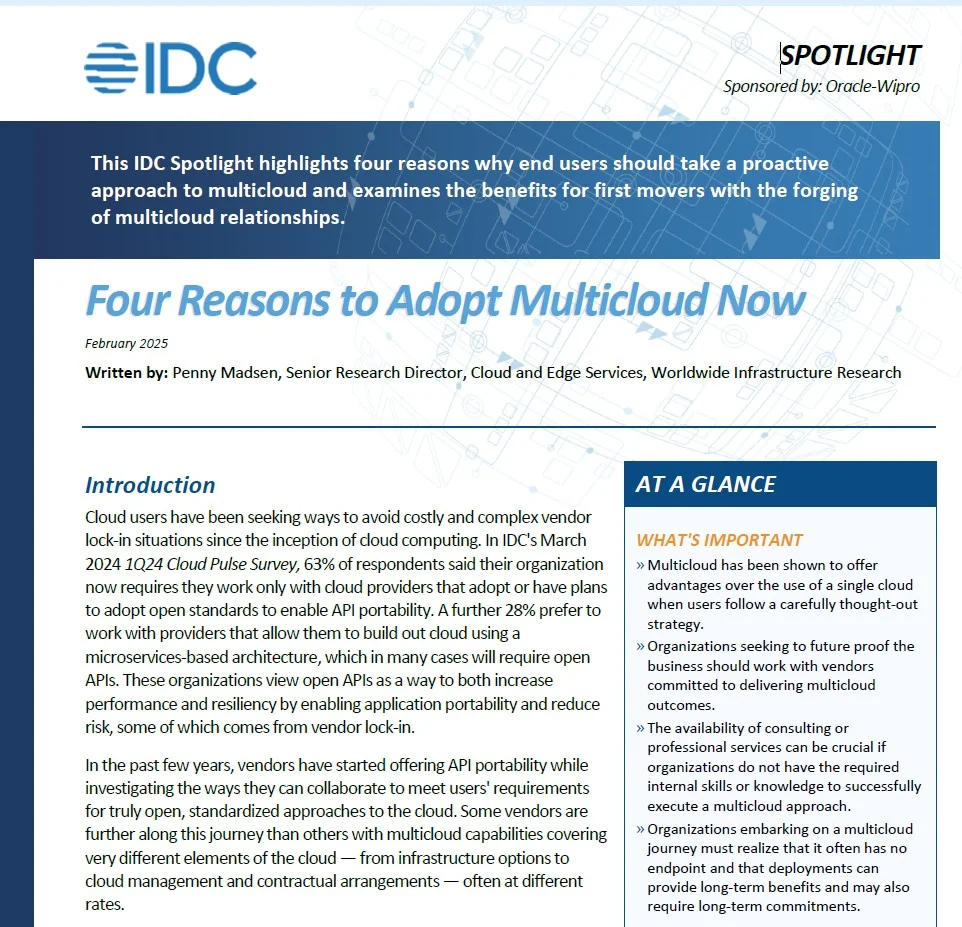
Since the early days of cloud computing, organizations have sought ways to escape the constraints of vendor lock-in. A dependency on a single provider creates fragility: pricing power shifts to the vendor, migration becomes costly, and innovation is limited by one ecosystem’s roadmap. IDC data from March 2024 shows that 63% of organizations now require their cloud providers to adopt open standards for API portability, and a further 28% prioritize microservices-based architectures that inherently demand open APIs.
This shift reflects a broader maturation of cloud strategy. Organizations no longer select providers purely on infrastructure price or raw compute performance. They evaluate the degree to which a provider enables movement — of data, applications, and workloads — across platforms. Interoperability has become a procurement criterion.
What multicloud actually means
Multicloud is frequently conflated with hybrid cloud, but the two are distinct. Hybrid cloud connects on-premises infrastructure with a public cloud environment. Multicloud demands interoperability across different providers’ platforms simultaneously. This requires IT operational model consistency, the capacity to port applications across environments, and the governance structures to manage it securely.
In practice, multicloud considerations extend well beyond IT operations. Billing models, licensing frameworks, and contractual arrangements must reflect the flexibility that multicloud promises. Without this alignment, what begins as an agility initiative can quickly become a financial and administrative burden. Professional services and consulting partners play a critical role here, helping organizations identify best practices and navigate the options that multiply as they scale.
Four reasons to move now
IDC’s research identifies four core drivers that make a proactive multicloud approach strategically sound at this moment.
The first is return on investment. Cloud buyers in IDC’s quarterly Cloud Pulse surveys report achieving positive ROI twice as fast as those operating single-cloud environments. Multicloud users are more likely to integrate capabilities such as automation, observability, FinOps practices, and container-based portability — tools that compound in value across the wider IT estate.
The second driver is resilience. Disaster recovery and backup are consistently ranked as the leading cloud investment priorities, above even application availability. Regulatory pressure is accelerating this: governing bodies across multiple industries are increasingly imposing uptime requirements and vendor diversification mandates. Multicloud provides the architecture to meet these obligations while retaining flexibility over cost and performance trade-offs.
The third driver is future-proofing. With 82% of cloud buyers currently modernizing or transforming existing cloud environments, the decisions made today establish the foundations for the next wave of technology — including generative AI. Organizations that build interoperable multicloud architectures are better positioned to integrate new AI capabilities without costly infrastructure overhauls. Multicloud users are also more likely to direct IT budgets toward new initiatives rather than maintenance.
The fourth driver is access to best-of-breed services. No single provider excels across every workload, geography, or technology domain. Multicloud enables organizations to select the most capable provider for each requirement. As generative AI accelerates the pace of technological change — from compute hardware to application layers — the ability to move between providers and access diverse model ecosystems becomes a competitive necessity.
Challenges that cannot be ignored
The benefits are real, but so are the obstacles. Among organizations that have adopted multicloud without achieving true interoperability, 34% have not yet identified how multicloud genuinely helps their business, while 32% are still working to resolve sovereignty and privacy concerns. These findings, from IDC’s Q1 2024 Cloud Pulse Survey, point to a gap between intent and execution that professional guidance can help close.
Management complexity grows with each additional provider. Teams must develop skills in automation and observability. Licensing clarity becomes essential. And securing internal budget for new multicloud programs requires building a business case that speaks to leadership in terms of KPIs, risk reduction, and long-term ecosystem value — not just technical architecture.
The GenAI factor
Generative AI is reshaping how organizations think about cloud infrastructure. When IDC asked organizations what matters most when selecting a GenAI partner, responses emphasized hardware diversity, access to a broad range of large language models, and the capacity of cloud providers to partner with other industry players. Vendors are responding: hyperscalers are building multicloud interoperability into their platforms in direct response to the AI demand signal. The organizations that have already built multicloud foundations will be the ones best placed to capitalize on this shift.
Selecting the right partner
IDC recommends that organizations approach partner selection with structured criteria. Infrastructure and workload requirements should be assessed in advance. Different business units — IT, finance, and legal — must understand how multicloud affects their processes. Security and resilience postures need reconsideration in a multi-provider context. And vendors should be evaluated not only on their current capabilities but on their roadmap commitments to open APIs, standards bodies, and certifications that reduce long-term risk.
Multicloud is not a destination. It is a continuous operating model that demands ongoing investment, organizational alignment, and strategic partner relationships. The organizations that treat it as such — rather than as a one-time migration — are the ones consistently reporting faster ROI, stronger resilience, and a clearer path to the technologies that will define the next decade.

Dr. Jakob Jung is Editor-in-Chief of Security Storage and Channel Germany. He has been working in IT journalism for more than 20 years. His career includes Computer Reseller News, Heise Resale, Informationweek, Techtarget (storage and data center) and ChannelBiz. He also freelances for numerous IT publications, including Computerwoche, Channelpartner, IT-Business, Storage-Insider and ZDnet. His main topics are channel, storage, security, data center, ERP and CRM.
Contact via Mail: jakob.jung@security-storage-und-channel-germany.de