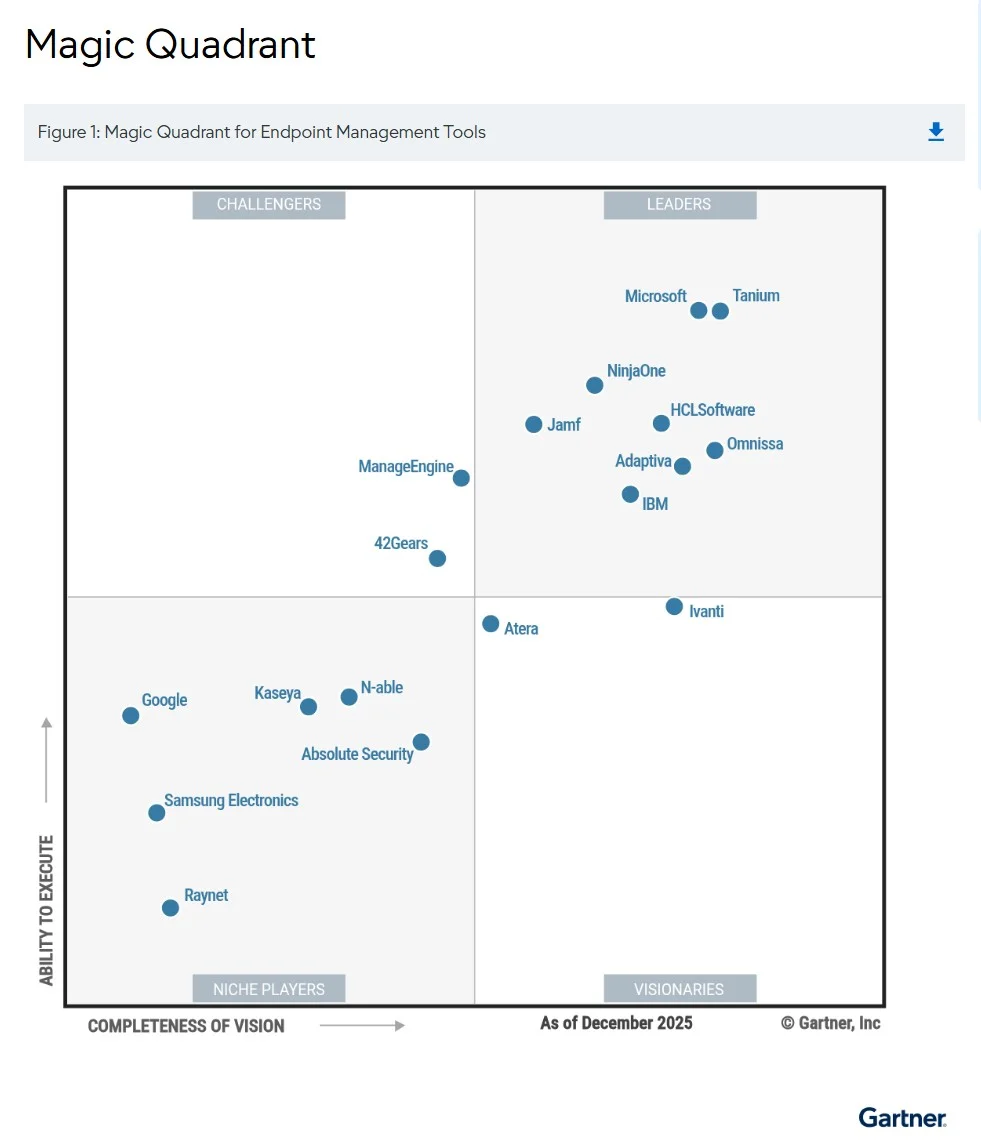
In its first-ever Magic Quadrant dedicated to endpoint management, Gartner has mapped out a market in transition — one where patching, configuration and device provisioning are steadily being handed over to AI-driven automation.
Gartner’s first-ever Magic Quadrant for Endpoint Management Tools, published on 5 January 2026, sets a clear marker for the industry: by 2029, more than half of organizations will rely on autonomous endpoint management (AEM) capabilities within their advanced device management platforms, up from just 15 percent today, according to the analyst firm.
The report, authored by Tom Cipolla, Lina Al Dana and colleagues, evaluates vendors that provide configuration management, patching and deployment of operating systems and applications across computers and mobile devices. Gartner defines endpoint management tools as platforms that must, at minimum, support agent-based or agentless management of Windows, macOS, iOS/iPadOS and Android, and operate as turnkey SaaS offerings with role-based access controls.
Eight vendors landed in the Leaders quadrant: Adaptiva, HCLSoftware, IBM, Jamf, Microsoft, NinjaOne, Omnissa and Tanium. According to Gartner, these providers combine the broadest capability sets with the strongest roadmaps, larger installed bases and coverage across the most geographies and industries.
Microsoft’s Intune remains the default choice for many organizations given its bundling with Microsoft 365 licenses, and the company recently announced that select Intune Suite capabilities will move into the E3 and E5 subscription tiers. However, Gartner notes recurring client complaints about unpredictable latency affecting reporting, policy synchronization and application deployment, alongside a steep learning curve.
IBM’s MaaS360 stood out for its use of machine learning and generative AI, including the MaaS360 Advisor feature, which delivers tailored security and productivity insights and generates predictive analytics. Jamf, long regarded as the standard for Apple device management, recently extended support to Android following customer demand, though the vendor was not GAAP-profitable as of the second quarter of 2025, reporting a net loss of 20.9 million US dollars.
Omnissa, the entity formerly known as VMware End-User Computing, is the only vendor recognized as a Leader in both the endpoint management and digital employee experience (DEX) Magic Quadrants. The company has weathered ownership changes, having been acquired by Broadcom in November 2023 before an independent buyout by KKR in July 2024, and is now working to rebuild client trust following related service disruptions.
Two vendors, Atera and Ivanti, were placed in the Visionaries quadrant for strong strategic vision paired with gaps in scale or platform breadth. Atera leans heavily into AI-driven, agentic workflows through its Atera leans heavily into AI-driven, agentic workflows through AI Copilot and Robin (formerly known as IT Autopilot) tools, while Ivanti offers broad platform coverage but has faced scrutiny over a series of exploitable vulnerabilities in its legacy Endpoint Manager product.
42Gears and ManageEngine were named Challengers, offering strong technology and execution but lacking the vision or scale to compete with the Leaders. Six providers — Absolute Security, Google, Kaseya, N-able, Raynet and Samsung Electronics — were classified as Niche Players, each serving specific segments, geographies or use cases rather than the broad market.
Notably for the DACH region, Germany-headquartered Raynet was recognized for its deep roots in the German, Austrian and Swiss markets and its strength in IT asset management, though Gartner flagged limited macOS support and a lack of published pricing information as constraints on its broader competitiveness.
To even qualify for this year’s ranking, vendors needed at least 5 million active endpoints under management, excluding trial or freemium deployments, and a top-20 placement in Gartner’s Customer Interest Indicator for the market. Providers that fell short, including Automox, Fleet, Hexnode and Germany’s Aagon, were listed as Honorable Mentions rather than formally rated.
Among the Niche Players, strategic postures vary widely. Google’s Endpoint Management is bundled into Workspace subscriptions at no extra cost but remains basic outside of ChromeOS management, while Samsung’s Knox Suite manages the single largest device fleet in the study, at over 2.2 million endpoints, concentrated on Galaxy hardware.
Beyond the vendor rankings, Gartner’s report underscores structural shifts reshaping the endpoint management market. Windows still accounts for more than 90 percent of the client PC operating system market, keeping it the default priority for most vendors, while enterprise mobile management for iOS and Android has become largely commoditized. Meanwhile, growing adoption of hybrid and remote work is pushing demand toward SaaS-hosted, location-agnostic patching and management tools.
Looking ahead, Gartner expects autonomous endpoint management to expand beyond patch automation into configuration and policy management over the next several years, driven largely by IT departments’ and managed service providers’ inability to scale staffing to match growing device fleets. The firm advises organizations to weigh their own automation readiness, endpoint volume, integration needs and regulatory requirements carefully before selecting a platform — cautioning that the most feature-rich tool is not automatically the best fit for every IT organization.

Dr. Jakob Jung is Editor-in-Chief of Security Storage and Channel Germany. He has been working in IT journalism for more than 20 years. His career includes Computer Reseller News, Heise Resale, Informationweek, Techtarget (storage and data center) and ChannelBiz. He also freelances for numerous IT publications, including Computerwoche, Channelpartner, IT-Business, Storage-Insider and ZDnet. His main topics are channel, storage, security, data center, ERP and CRM.
Contact via Mail: jakob.jung@security-storage-und-channel-germany.de