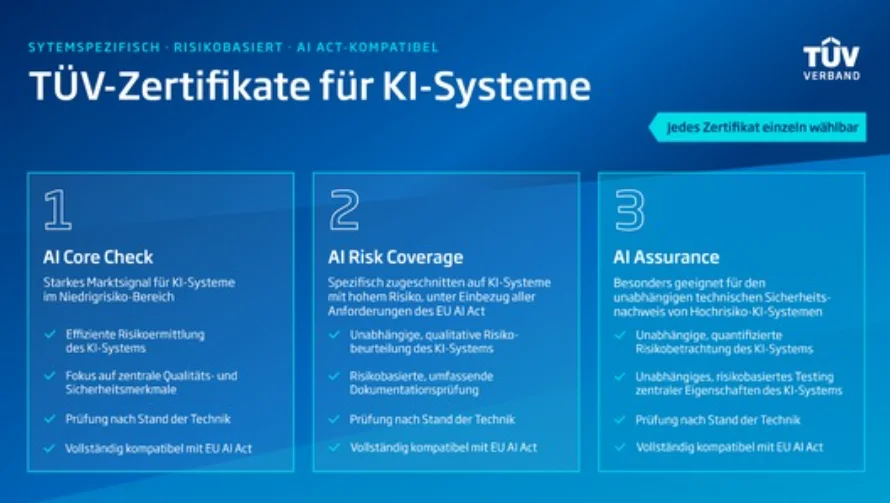
TÜV organizations are developing a joint framework for the independent assessment of AI systems. Three certification levels are intended to provide different testing approaches depending on the application and risk profile. Initial procedures are being tested with pilot partners, with market introduction planned for the end of 2026.
The Technischer Überwachungsverein (TÜV) has a history spanning 160 years and is best known in Germany for its quality assurance of motor vehicles. Artificial intelligence is increasingly being used in business and everyday life. At the same time, concerns about incorrect results, bias and other risks associated with AI systems are growing. According to a study by the TÜV Association, 79 percent of German citizens are concerned about unpredictable risks from AI. Trust is also limited among users of AI applications: only 53 percent of users surveyed believe that the results and answers generated by such systems are correct.
For companies, this creates a need to demonstrate not only the technical capabilities of AI systems but also their quality, safety and ability to manage risks. The TÜV organizations intend to address this need with a joint certification framework. Manufacturers and providers of AI systems are expected to be able to obtain independent verification that their systems meet defined quality and safety requirements.
Marc Fliehe, head of Digitalization and AI at the TÜV Association, describes trust as an important factor in the continued adoption of artificial intelligence. Companies need to be able to demonstrate to customers, business partners and users that their AI systems operate reliably and safely. The proposed certification is intended to provide an independent and traceable form of evidence.
Testing Based on Application and Risk
The need for independent testing also reflects the wide range of AI applications. AI systems are already used in industrial production processes, medical diagnostics, driver assistance systems and recruiting software. Depending on the application, errors can have consequences for people, companies or technical processes.
AI systems also have specific risk characteristics. Their results may systematically disadvantage certain groups, for example. Systems can also behave unreliably when confronted with situations that were not sufficiently considered during development.
At the same time, the European AI Act is establishing a binding regulatory framework for artificial intelligence. According to the TÜV Association, companies also need ways to independently demonstrate the quality and safety of their AI systems. Certification could provide customers and business partners with additional information when assessing such systems.
Three Certification Levels
The proposed framework consists of three AI certifications that differ in scope, testing depth and methodology. The appropriate certification is intended to depend on the application and the level of assurance required.
The first certification is aimed at AI systems that do not formally fall into the high-risk category under the European AI Act. It focuses on basic quality and safety requirements.
The second certification is open to AI systems in general. It includes a structured AI-specific risk assessment. The implementation of requirements is reviewed on the basis of documentation and through on-site assessments at the manufacturer.
The third certification adds independent technical testing of selected characteristics of an AI system. This is intended to allow a more detailed assessment of system performance and reliability.
Dr. Christoph Poetsch, Head of AI Quality and Ethics at TÜV AI.Lab, says the differentiated approach reflects the varying requirements of AI systems. Both standalone AI applications and AI components integrated into technical products are to be assessed according to their specific application and risk profile.
Pilot Phase Underway
The framework is being developed by the TÜV Association together with TÜV AI.Lab and the TÜV organizations. The TÜV Association is coordinating the project. TÜV AI.Lab is responsible for developing the technical foundations, including testing requirements and test catalogs. Experts from the TÜV organizations contribute experience from testing, certification and the practical assessment of AI systems.
The planned certifications are currently being tested with pilot partners under real-world conditions. The pilot phase is intended to determine how the testing requirements and procedures perform in practical applications. Findings from the pilots will be incorporated into the further development of the program.
The TÜV Association plans a phased introduction of the AI certifications for the end of 2026. The framework is intended to be compatible with the requirements of the European AI Act while adding risk-based and technical testing aspects.
The proposed certification framework would therefore complement statutory requirements with an additional mechanism for assessing AI systems. Its significance for companies will depend in part on the extent to which customers, business partners and users require independent evidence of AI quality, safety and reliability.
Dr. Jakob Jung is Editor-in-Chief of Security Storage and Channel Germany. He has been working in IT journalism for more than 20 years. His career includes Computer Reseller News, Heise Resale, Informationweek, Techtarget (storage and data center) and ChannelBiz. He also freelances for numerous IT publications, including Computerwoche, Channelpartner, IT-Business, Storage-Insider and ZDnet. His main topics are channel, storage, security, data center, ERP and CRM.
Contact via Mail: jakob.jung@security-storage-und-channel-germany.de