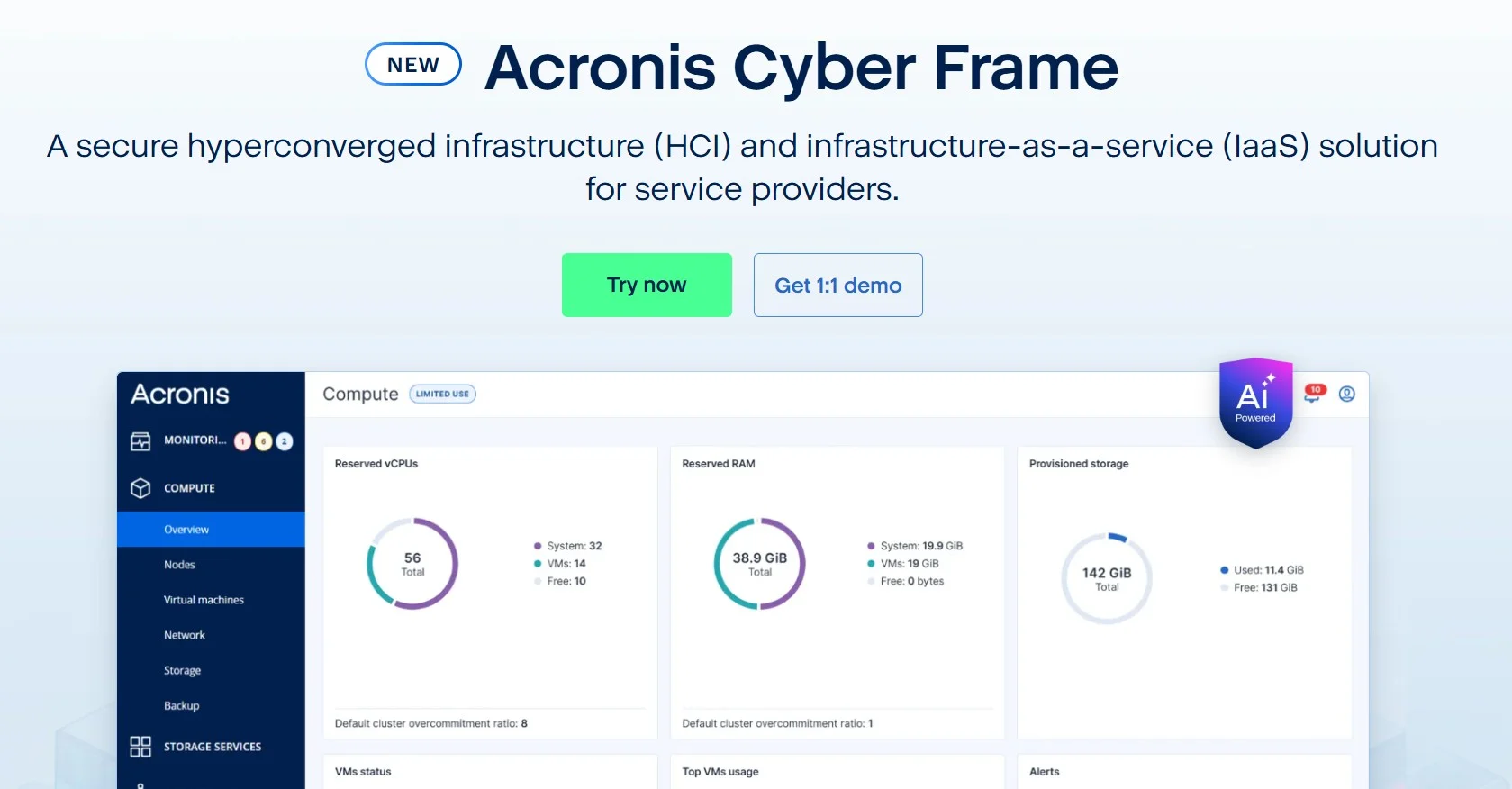
Rising hyperscaler costs, increasing data sovereignty requirements, and the need for greater infrastructure control are creating new challenges for service providers. With Acronis Cyber Frame, Acronis has introduced a platform that combines hyperconverged infrastructure and Infrastructure-as-a-Service in a single solution.
Acronis has expanded its portfolio with the launch of Acronis Cyber Frame. The platform is designed for managed service providers (MSPs), cloud service providers (CSPs), hosting providers, and telecommunications companies that need to deliver infrastructure services while meeting security, scalability, and operational efficiency requirements. The solution combines hyperconverged infrastructure (HCI), Infrastructure-as-a-Service (IaaS), cyber protection, and management and automation capabilities within a unified environment.
The market for cloud and infrastructure services is currently undergoing significant changes. Many service providers are facing rising operational costs linked to hyperscaler environments. At the same time, demand for regional and sovereign cloud services is increasing across industries, as organizations seek greater control over data residency and compliance requirements. As a result, providers are looking for ways to operate infrastructure more independently while improving margin predictability.
With Acronis Cyber Frame, the company aims to consolidate multiple infrastructure and security functions into a single platform. Service providers can centrally deploy, manage, and secure virtual machines, networking components, and storage resources. The platform also integrates backup, disaster recovery, security management, and remote monitoring and management capabilities.
According to Acronis, the native integration of these functions is intended to reduce operational complexity. Instead of relying on multiple disconnected tools, providers can use a unified platform. This approach is expected to simplify administration processes while accelerating the deployment of new services.
The platform supports different operating models. “Acronis Cyber Frame Cloud” provides a fully hosted option designed to enable rapid market entry without major upfront infrastructure investments. In addition, “Acronis Cyber Frame Local” allows partners to operate infrastructure independently, providing greater control over performance, data location, and economic conditions.
The two deployment models are intended to address varying regulatory requirements. Data sovereignty, regional storage, and compliance have become increasingly important for many organizations. Service providers are therefore under growing pressure to adapt infrastructure to national or industry-specific regulations.
Another focus of the platform is multi-tenancy and support for white-label services. This enables service providers to offer their own branded services while isolating different customer environments. The platform also includes self-service functions and operational tools for day-to-day infrastructure management.
From a technology perspective, Acronis Cyber Frame is based on OpenStack and KVM technologies developed in collaboration with Virtuozzo. The company’s approach is intended to reduce dependency on proprietary hypervisors and provide a more open infrastructure architecture. For service providers, this could become particularly relevant when replacing legacy virtualization environments.
In the cloud and infrastructure services market, providers are under pressure to balance operational efficiency with technological flexibility. Alongside cost considerations, factors such as security, availability, and automation are becoming increasingly important. Infrastructure platforms must therefore remain scalable while also addressing regional compliance and data protection requirements.
Scott Harrison, Cybersecurity Solution Specialist at Grey Matter, sees the integration of infrastructure and security capabilities as a way to simplify operational models. By combining virtual machines, networking, storage, disaster recovery, and security capabilities within one platform, organizations may reduce operational complexity and consolidate workflows.
Acronis also points to changing market requirements. According to Gaidar Magdanurov, President at Acronis, many service providers are currently reassessing their infrastructure strategies and seeking solutions that better align with their business models. Combining infrastructure, protection, and management within an integrated platform is intended to simplify operations and improve the economic efficiency of infrastructure services.
With Acronis Cyber Frame, the company is positioning itself in a market segment where data sovereignty, platform consolidation, and reduced vendor lock-in are becoming increasingly important. For service providers, this development may indicate growing demand for integrated platform models, particularly in environments where infrastructure, security, and operations need to work more closely together.

Carolina Heyder is a business analyst and moderator with extensive experience in the German and international IT market. She has worked for many years at renowned European trade publishers such as WEKA Fachmedien, Vogel IT Medien, Springer, and Aspencore. She creates content for both web and print media and is an expert in front of the microphone and camera. Thanks to her fluency in German, English, and Spanish, as well as her Chilean roots, she brings a global and intercultural perspective to topics such as cybersecurity, artificial intelligence, digital transformation, sustainability, and other key areas of the IT sector.