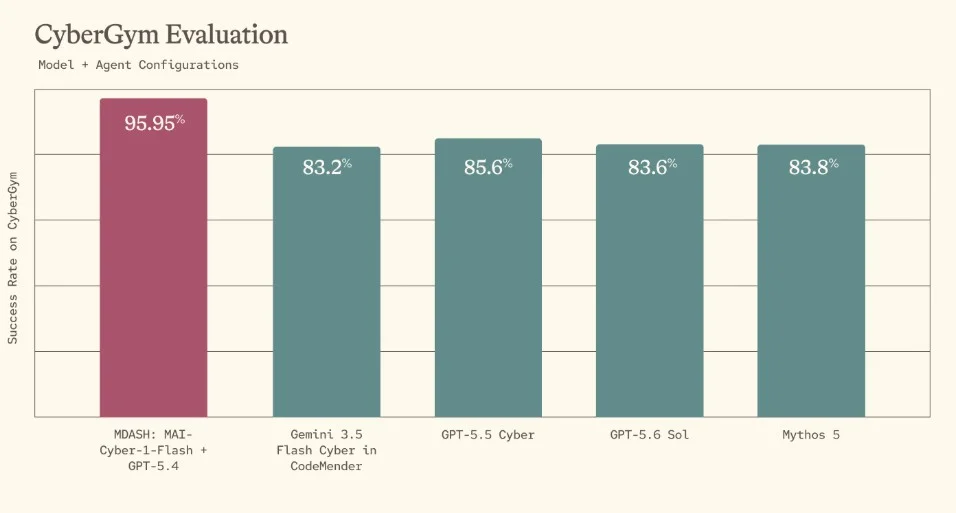
Microsoft has introduced MAI-Cyber-1-Flash, a new in-house security model integrated into its MDASH defense platform, claiming performance gains and cost savings that could reshape how enterprises hunt for software vulnerabilities.
Microsoft has entered the increasingly crowded field of AI-driven cybersecurity with the introduction of MAI-Cyber-1-Flash, a compact model built specifically to identify vulnerabilities in complex codebases. The announcement, made by Microsoft AI leaders Mustafa Suleyman and Hayete Gallot, positions the new model as a core component of MDASH, the company’s multi-agent vulnerability identification and remediation harness.
According to Microsoft, the rationale behind the launch is straightforward: as AI lowers the cost of discovering software flaws, attackers are scaling their reconnaissance faster than traditional, periodic security scanning can keep pace. The company argues that the conventional model — scan occasionally, patch eventually — is no longer sufficient, and that defenders need models purpose-built for continuous, high-volume vulnerability hunting.
Benchmark claims
Microsoft states that the unified MDASH system, combining MAI-Cyber-1-Flash with the larger GPT-5.4 model, achieved a 95.95 percent success rate on CyberGym, a benchmark the company describes as an industry standard for evaluating how AI systems reason over large codebases to uncover genuine vulnerabilities. By comparison, Microsoft reports that four unnamed competing systems scored between 83.2 and 85.6 percent on the same benchmark. The company also claims the combined system outperforms Anthropic’s Mythos model by 12 percentage points on the same test — though independent verification of these figures was not available at the time of publication.
A tiered approach to cost and performance
Central to Microsoft’s pitch is a tiered architecture: MAI-Cyber-1-Flash is designed to efficiently handle up to 90 percent of security tasks, freeing the more expensive GPT-5.4 model for the remaining 10 percent of cases that require deeper reasoning. Microsoft says this division of labor produces a 50 percent cost reduction compared to its prior best MDASH configuration, which relied on a combination of GPT-5.4, GPT-5.4 mini, and GPT-5.3 Codex.
Alongside the new model, Microsoft is launching Perception, an agentic security system composed of teams of AI agents designed to continuously monitor, patch, and close emerging threat vectors within MDASH. The company says Perception will eventually adopt MAI-Cyber-1-Flash for a broader range of security workflows beyond vulnerability remediation.
Model, data, harness
Microsoft frames its approach around three pillars. The model itself, MAI-Cyber-1-Flash, is described as a compact, code-heavy system derived from the company’s MAI-Thinking-1 lineage and built in-house on curated data. On the data side, Microsoft points to what it calls a decisive advantage: decades of security telemetry generating what the company says amounts to trillions of daily signals across identity, endpoint, cloud, and network layers, alongside a record of real-world exploits and remediations. The third pillar, the MDASH harness itself, reportedly comprises more than 100 agents tuned by security specialists to find, validate, and remediate vulnerabilities, feeding directly into the new Perception system.
Safety and governance measures
Microsoft says MAI-Cyber-1-Flash — as the company’s first dedicated cyber model — underwent security-first calibration during development, including evaluation by Microsoft’s internal AI Red Team, automated and expert-led adversarial testing, and an independent third-party assessment. On the deployment side, the company states that MDASH provides enterprise customers with role-based access controls, tenant isolation, encryption, auditability, and sandboxed execution environments without internet access.
Microsoft further points to what it describes as a continuous reinforcement learning loop spanning its security operations: data drawn from the Microsoft Security Response Center, attack and defense telemetry across identity, endpoint, cloud, data, browser, and application layers, and what the company says totals more than 100 trillion security signals daily across 1.6 million customers. Microsoft says this feedback loop — connecting specific actions to measurable outcomes — will continue to drive iterative improvements to its cyber models.
The launch underscores an intensifying race among major technology vendors to embed specialized AI models directly into security operations, as enterprises face growing pressure to match the speed of AI-assisted attacks with equally fast, automated defenses.

Dr. Jakob Jung is Editor-in-Chief of Security Storage and Channel Germany. He has been working in IT journalism for more than 20 years. His career includes Computer Reseller News, Heise Resale, Informationweek, Techtarget (storage and data center) and ChannelBiz. He also freelances for numerous IT publications, including Computerwoche, Channelpartner, IT-Business, Storage-Insider and ZDnet. His main topics are channel, storage, security, data center, ERP and CRM.
Contact via Mail: jakob.jung@security-storage-und-channel-germany.de