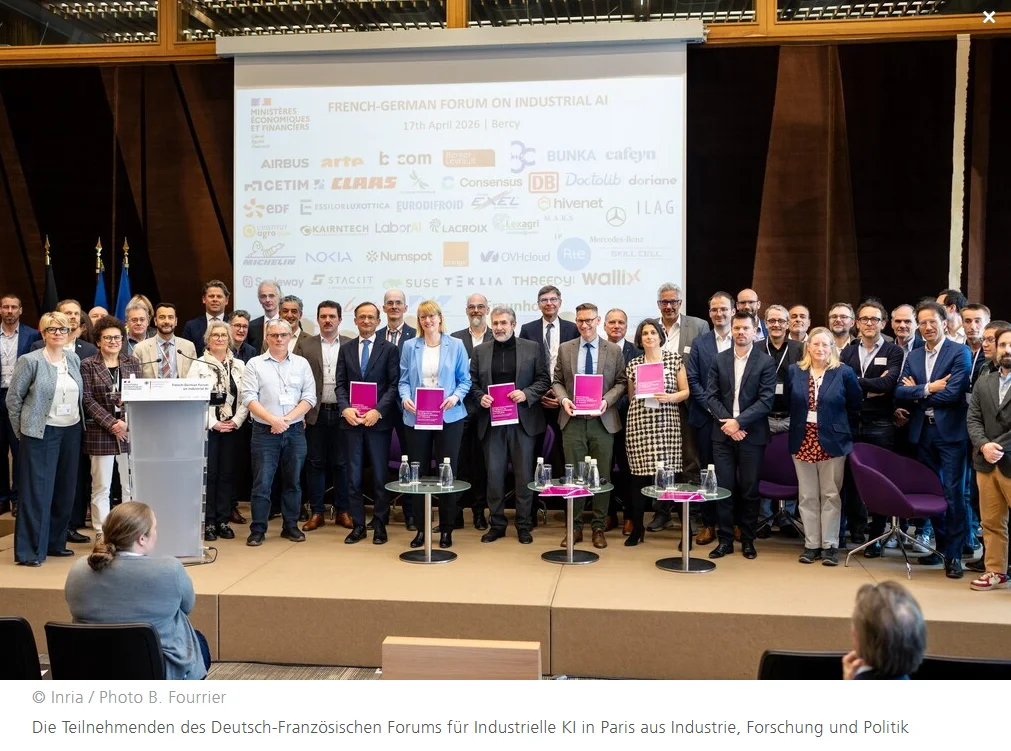
With the official handover of a joint final report to the governments of Germany and France, the German-French AI Dialogue has sent an unambiguous message: Europe must become technologically sovereign, economically competitive, and regulatorily trustworthy in the field of Artificial Intelligence. The report, produced by Fraunhofer, Inria, and IMT, outlines seven strategic fields of action and is addressed equally to industry, academia, and policymakers.
A Historic Moment at the French Ministry of Finance
On April 17, 2026, the French Ministry of Economy and Finance in Paris hosted an event with the potential to shape Europe’s AI landscape for years to come. At the German-French Forum for Industrial AI, the final report of the bilateral AI Dialogue was officially handed over to senior government representatives: Thomas Courbe, Director General for Enterprise on the French side, and Dr. Beate Baron, Head of Industrial Policy at Germany’s Federal Ministry for Economic Affairs and Energy.
The report was presented by the leaders of three renowned research organizations: Bruno Sportisse (President and CEO of Inria), Boris Otto (Director of Fraunhofer ISST and Chair of the Fraunhofer IUK Technology Alliance), and Cécile Dubarry (Executive President of IMT). Their joint presentation underscored that technological strength, economic policy thinking, and scientific excellence must go hand in hand.
Broad Foundation: Over One Hundred Stakeholders Involved
The report is the result of an extensive dialogue process initiated in January 2025 under the leadership of the French Embassy in Berlin. Through dedicated sector workshops, more than one hundred experts from industry, applied research, and universities in both countries were engaged. They identified concrete use cases and investment priorities for AI in Europe—results first presented to the public at the Adopt AI Summit in November 2025.
The common challenges identified are multifaceted: reducing regulatory barriers, strengthening AI infrastructure, expanding European computing capacity, securing access to renewable energy, and upskilling the workforce. Both nations are firmly committed to promoting AI solutions that are not only high-performing but also trustworthy.
Seven Fields of Action – A Clear Compass for Industry
The report is structured around seven complementary strategic fields of action, each providing a structured overview of needs and levers to be activated at the European level:
- Digital and IT Infrastructure: Building robust European cloud, network, and computing systems with a focus on interoperability and energy efficiency.
- State Sovereignty and Legal Framework: Harmonizing innovation, competitiveness, and sovereignty in implementing European AI and data regulations.
- Healthcare: Accelerating AI adoption through better data access, interoperability, and validated solutions to improve care and system efficiency.
- Manufacturing: Integrating AI into industrial processes, especially in SMEs and the Mittelstand, to optimize production, increase resilience, and build competencies.
- Media: Protecting information sovereignty and business models; regulating the use of journalistic content for AI training.
- Energy: Using AI to optimize energy systems and support the transition to more sustainable, lower-emission models—including through dedicated large language models (LLMs).
- Agriculture and Food: Leveraging AI for greater performance, traceability, and sustainability across agricultural and food value chains.
Feeding into IPCEI AI: Strengthening European Projects
The report is not conceived as an academic paper but as a basis for action. Its proposals are intended to feed directly into IPCEI AI (Important Project of Common European Interest), contributing to the design and consolidation of strategic industrial projects at the European level. By translating industry needs directly into roadmaps and funding programs, it aims to strengthen Europe’s competitiveness in the global AI race.
The combined expertise of the three organizations in technical innovation as well as economic and governance models for data-driven value creation is seen as a powerful complement to the European Commission’s ‘European AI Continent’ strategy.
A Signal for Europe
The German-French AI Dialogue is more than a bilateral project—it is a signal to all of Europe. At a time when the United States and China are investing massively in AI, Germany and France are demonstrating that a shared European path is possible: sovereign, competitive, and values-based.
Dr. Jakob Jung is Editor-in-Chief of Security Storage and Channel Germany. He has been working in IT journalism for more than 20 years. His career includes Computer Reseller News, Heise Resale, Informationweek, Techtarget (storage and data center) and ChannelBiz. He also freelances for numerous IT publications, including Computerwoche, Channelpartner, IT-Business, Storage-Insider and ZDnet. His main topics are channel, storage, security, data center, ERP and CRM.
Contact via Mail: jakob.jung@security-storage-und-channel-germany.de