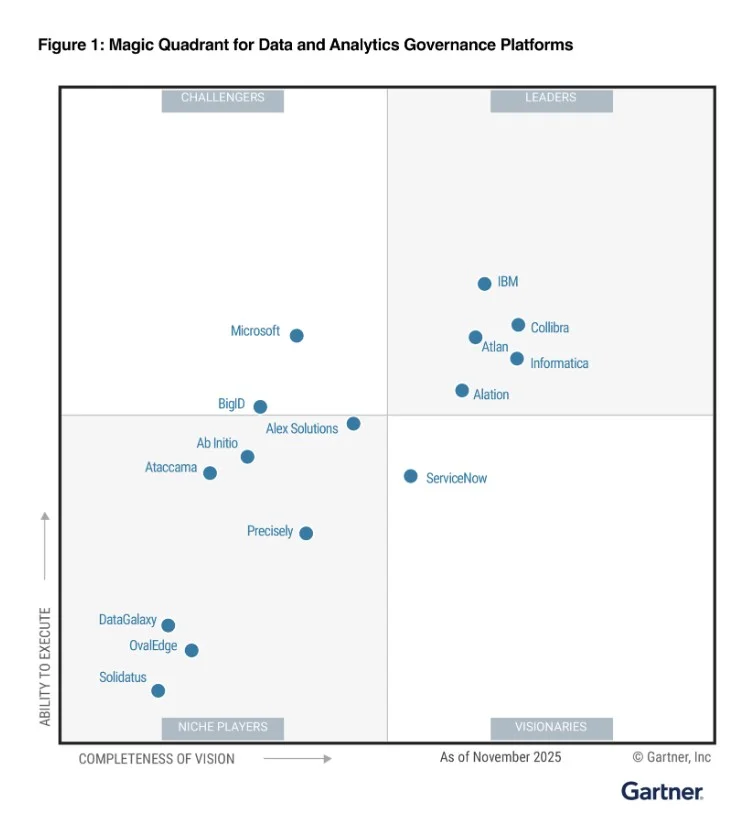
The 2026 Gartner Magic Quadrant for Data & Analytics Governance Platforms shows: AI ambitions force companies to make a platform decision. Collibra, Informatica, IBM, Alation and Atlan lead the field – but the competition is not standing still.
The market for data and analytics governance platforms is growing faster than almost any other segment in data management. Gartner estimates the market volume at around two billion US dollars for 2024 and emphasizes that growth forecasts exceed all related segments. By comparison, the overall data-related market segment – databases, integration, quality and observability combined – grew by 12.9 percent to 133 billion dollars in the same period. The governance segment is growing beyond that.
The driver behind this boom is clear: artificial intelligence. Organizations that want to use AI systems productively cannot do without structured, verifiable and compliant data. ‘Scaled AI adoption has put tremendous pressure on D&A leaders to automate and streamline governance,’ Gartner writes. Platform vendors are responding – with acquisitions, new developments and strategic partnerships.
Five Leaders, One Challenger, One Visionary
The top spots in the ‘Leaders’ quadrant this year go to Alation, Atlan, Collibra, IBM and Informatica. Each of the five brings a different focus. Collibra, the Belgian-American company with over 700 customers in more than 50 countries, impresses Gartner primarily with its broad ecosystem network – native integrations with more than 100 data environments, including SAP – as well as a dedicated AI governance module combining model documentation and automated compliance checks. However, Gartner notes that implementations frequently require significant external consulting: 40 percent of customization work falls to independent consultants.
Informatica, recently acquired by Salesforce (closing: November 18, 2025), scores with its IDMC platform and the proprietary CLAIRE AI engine, which automatically curates metadata and enables natural language queries. Analysts praise the broad hyperscaler portfolio but caution about uncertainty: the Salesforce acquisition could change product roadmap and go-to-market strategy.
IBM positions itself with its watsonx architecture as an open hybrid environment. The newly bundled ‘watsonx.data intelligence’ platform integrates IBM Knowledge Catalog, Manta Data Lineage and Data Product Hub on a shared metadata layer. Gartner critically notes functional differences between SaaS and on-premises variants, and that migrating from the predecessor platform IBM InfoSphere involves considerable effort.
Alation (California, 650+ customers) and Atlan (San Francisco, 300+ customers) represent the modern, AI-native camp. Alation focuses on an ‘Open and Portable Architecture’ that deliberately avoids vendor lock-in. Atlan builds on an Apache Iceberg-based ‘metadata lakehouse’ and has created a developer platform for custom governance agents with the Atlan App Framework. However, roughly three-quarters of Atlan’s customer base are mid-sized organizations from less regulated industries – an indicator that enterprise-scale deployments still need to be proven.
Newcomers and Rising Stars
Two vendors were newly added to the Magic Quadrant this year: BigID and Microsoft. BigID (New York, around 350 customers) positions itself as a Challenger. Its roots in data privacy and security make it a specialist for data discovery and classification of unstructured data – one of the most sought-after capabilities in the AI governance context. Microsoft’s Purview benefits massively from the Azure customer base and is tightly integrated into the Microsoft 365 and Fabric world. However, Gartner sees product maturity as a weakness: workflow automation, data profiling and knowledge graph capabilities lag behind competitors.
ServiceNow makes its first appearance as a Visionary – following the acquisition of data.world in July 2025. The workflow giant brings an interesting perspective with its knowledge-graph-native approach and strength in process orchestration. Whether the integration of data.world’s governance platform into the ServiceNow ecosystem succeeds will be shown in the next evaluation round.
The Seven Trend Movements of the Market
Gartner identifies seven structural developments shaping the market. First: unstructured data. Classical governance platforms focused on structured data – now they must capture documents, emails, images and vector data, since language models are trained precisely on these types. Second: horizontal market consolidation. Security, privacy and quality governance are growing under one roof, as demonstrated by two strategic acquisitions: Salesforce bought Informatica, ServiceNow bought data.world. Third: overlap with metadata management markets. The boundaries between governance platforms and metadata management solutions are blurring. Fourth: Consumerization 2.0. Platforms are expanding their marketplace functions and connecting with AI agents of business applications such as ERP or CRM systems. Fifth: trust models. Sixth: agent-based governance enforcement – AI agents that autonomously execute governance workflows remain nascent. Seventh: AI governance. A current Gartner survey confirms: 74 percent of organizations already use data governance tools to operationalize AI governance.
Strategic Forecasts and Market Warning
Gartner offers two strategic forecasts: by 2027, 60 percent of all data governance teams will prioritize governance of unstructured data. By 2028, 80 percent of S&P 1200 companies will relaunch their governance programs based on a modern trust model. The analysts warn against a typical implementation error, however: governance platforms are too often purchased too early, before the operative governance model is in place within the organization. ‘The biggest faltering point of such investments are often when governance platforms are frontloaded in designing a D&A governance program,’ the report states.
For organizations evaluating now, Gartner recommends using their own data architecture as the starting point for platform selection. Those predominantly relying on Microsoft infrastructure will find a cost-effective entry point in Purview. Those with complex regulatory requirements in finance, healthcare or the public sector are better served by Collibra, IBM or Informatica. Those building a modern, AI-native architecture will find what they need at Atlan or Alation. The market is in motion – and it will continue to consolidate.

Dr. Jakob Jung is Editor-in-Chief of Security Storage and Channel Germany. He has been working in IT journalism for more than 20 years. His career includes Computer Reseller News, Heise Resale, Informationweek, Techtarget (storage and data center) and ChannelBiz. He also freelances for numerous IT publications, including Computerwoche, Channelpartner, IT-Business, Storage-Insider and ZDnet. His main topics are channel, storage, security, data center, ERP and CRM.
Contact via Mail: jakob.jung@security-storage-und-channel-germany.de